
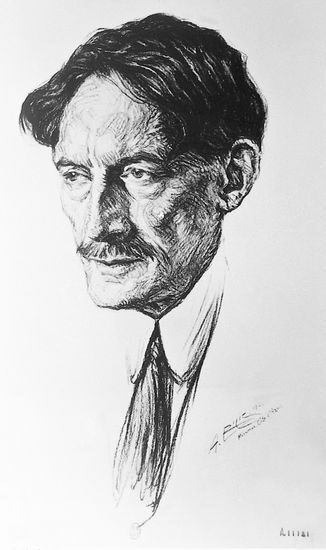
Henri Barbusse
Henri Barbusse was a French author. Born May 17, 1873, in Asnières-sur-Seine. Died August 30, 1935, in Moscow. Positions held include literary editor (1926–) and director (1928–1935). Known for Under Fire. Awards include Prix Goncourt, Concours général and Croix de guerre 1914–1918.
Facts
31 facts · 2 confirmed by two sources · 7 cited · 21 from one source · 1 where the sources disagree
What’s different
- Buried in: we show Père Lachaise Cemetery (Sources disagree). Wikidata also lists Grave of Henri Barbusse
Where this comes from
Papalocal keeps its own record. It started from these sources; what each one said is kept here as it was copied, so a change on their side never changes this page by itself. Tap one to read its version.
What Wikidata says · copied November 16, 2026 · revision 2569074206
- Described as
- French author (1873-1935)
- Born
- May 17, 1873 · 14 references
- Died
- August 30, 1935 · 15 references
- Born in
- Asnières-sur-Seine · 1 reference
- Died in
- Moscow · 3 references
- Buried in
- Père Lachaise Cemetery · 1 reference; Grave of Henri Barbusse
- Cause of death
- pneumonia
- Name at birth
- Adrien Gustave Henri Barbusse
- Citizen of
- France · 1 reference
- Occupation
- writer · 2 references; journalist · 1 reference; screenwriter; biographer; novelist; politician · 1 reference; painter; poet · 1 reference
- Positions held
- literary editor (1926–); director (1928–1935)
- Political party
- French Communist Party (1923–)
- Worked for
- L'Humanité; Monde (review) (1928–1935); Le Populaire
- Member of
- Academy of Sciences of the USSR; Russian Academy of Sciences; Republican Veterans Association (1917–); Amsterdam-Pleyel group
- Known for
- Under Fire
- Awards
- Prix Goncourt (1916); Concours général; Croix de guerre 1914–1918
- Spouse
- Hélyonne Mendès
- Wikipedias with a page
- 91
Wikidata item Q18404 (wikidata.org/wiki/Q18404), public domain (CC0). Copied November 16, 2026.
What Wikipedia says · copied November 16, 2026 · revision 1383438768
Henri Barbusse (French: [ɑ̃ʁi baʁbys]; 17 May 1873 – 30 August 1935) was a French novelist, short story writer, journalist, poet and political activist. He began his literary career in the 1890s as a Symbolist poet and continued as a neo-Naturalist novelist; in 1916, he published Under Fire, a novel about World War I based on his experience which is described as one of the earliest works of the Lost Generation movement or as the work which started it; the novel had a major impact on the later writers of the movement, namely on Ernest Hemingway and Erich Maria Remarque. Barbusse is considered one of the important French writers of 1910–1939 who mingled the war memories with moral and political meditations.
Before World War I, Barbusse was a pacifist, but in 1914, he volunteered for wartime service and was awarded the Croix de guerre; during the war, he was influenced by the Communists and came to the belief that a Revolution against the imperialist governments would be the only quick way to end the war and to deal with militarism and reaction. In years following the war, his work acquired a definite political orientation; he became a member of the French Communist Party and an anti-fascist and anti-war activist. In the 1930s, he supported the Stalinist regime despite having a friendly relationship with Leon Trotsky in the middle of the 1920s and contributed to Joseph Stalin's personality cult by writing his biography, which became a 'canonical' text for the French Stalinists but was not in line with the glorification of Stalin in the USSR. He died in 1935 and did not see the events that followed, like the Moscow trials and the Nazi-Soviet pact.
He was a lifelong friend of Albert Einstein.
- Born, in its opening lines
- May 17, 1873
- Died, in its opening lines
- August 30, 1935
From the Wikipedia article “Henri Barbusse” (en.wikipedia.org/wiki/Henri_Barbusse), by its contributors, under CC BY-SA 4.0 (creativecommons.org/licenses/by-sa/4.0/). Copied November 16, 2026; not changed.
Confirmed Two sources agree. Cited One source, and it names where it got it. One source One source, without a reference of its own. Sources disagree The sources disagree. We show the best-supported value and keep theirs below.
