
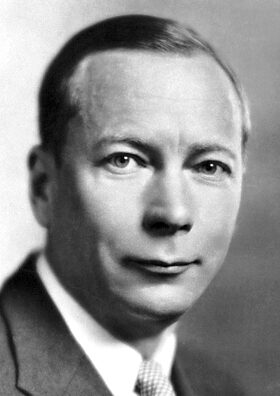
Henrik Dam
Henrik Dam was a Danish biochemist and physiologist. Born February 21, 1895, in Copenhagen. Died April 17, 1976, in Copenhagen. Educated at Technical University of Denmark and University of Graz. Awards include Nobel Prize in Physiology or Medicine.
Facts
19 facts · 2 confirmed by two sources · 6 cited · 11 from one source
Where this comes from
Papalocal keeps its own record. It started from these sources; what each one said is kept here as it was copied, so a change on their side never changes this page by itself. Tap one to read its version.
What Wikidata says · copied November 16, 2026 · revision 2566092918
- Described as
- Danish biochemist and physiologist (1895-1976)
- Other names
- Carl Peter Henrik Dam
- Born
- February 21, 1895 · 8 references
- Died
- April 17, 1976 · 6 references
- Born in
- Copenhagen · 2 references
- Died in
- Copenhagen · 2 references
- Buried in
- Bispebjerg Cemetery · 1 reference
- Citizen of
- Kingdom of Denmark
- Occupation
- biochemist · 1 reference; physician; pedagogue; university teacher; chemist; physiologist · 1 reference
- Worked for
- Technical University of Denmark; University of Copenhagen
- Education
- Technical University of Denmark; University of Graz
- Awards
- Nobel Prize in Physiology or Medicine (1943) · 2 references
- Field
- biochemistry; physiology
- Wikipedias with a page
- 61
Wikidata item Q190501 (wikidata.org/wiki/Q190501), public domain (CC0). Copied November 16, 2026.
What Wikipedia says · copied November 16, 2026 · revision 1372649670
Carl Peter Henrik Dam (21 February 1895 – 17 April 1976) was a Danish biochemist and physiologist.
He was awarded the Nobel Prize in Medicine in 1943 for joint work with Edward Doisy in discovering vitamin K and its role in human physiology. Dam's key experiment involved feeding a cholesterol-free diet to chickens. He initially replicated experiments reported by scientists at the Ontario Agricultural College (OAC). McFarlane, Graham and Richardson, working on the chick feed program at OAC, had used chloroform to remove all fat from chick chow. They noticed that chicks fed only fat-depleted chow developed hemorrhages and started bleeding from tag sites. Dam found that these defects could not be restored by adding purified cholesterol to the diet. It appeared that—together with the cholesterol—a second compound had been extracted from the food, and this compound was called the coagulation vitamin. The new vitamin received the letter K because the initial discoveries were reported in a German journal, in which it was designated as Koagulationsvitamin.
He received an undergraduate degree in chemistry from the Copenhagen Polytechnic Institute (now the Technical University of Denmark) in 1920, and was appointed as assistant instructor in chemistry at the School of Agriculture and Veterinary Medicine. By 1923 he had attained the post of instructor in biochemistry at the University of Copenhagen's Physiological Laboratory. He studied microchemistry at the University of Graz under Fritz Pregl in 1925, but returned to the University of Copenhagen, where he was appointed as an assistant professor at the Institute of Biochemistry in 1928, and assistant professor in 1929. During his time as professor at the University of Copenhagen he spent some time working abroad, and in 1934 submitted the thesis Nogle Undersøgelser over Sterinernes Biologiske Betydning (Some Investigations on the Biological Significance of the Sterines) to the University of Copenhagen, and received the degree of PhD in biochemistry.
Between 1942 and 1945 Dam was a senior research associate at the University of Rochester; it was during this period that he was awarded the 1943 Nobel Prize for Physiology or Medicine. In 1951, he was one of seven Nobel Laureates who attended the first Lindau Nobel Laureate Meeting.
- Born, in its opening lines
- February 21, 1895
- Died, in its opening lines
- April 17, 1976
From the Wikipedia article “Henrik Dam” (en.wikipedia.org/wiki/Henrik_Dam), by its contributors, under CC BY-SA 4.0 (creativecommons.org/licenses/by-sa/4.0/). Copied November 16, 2026; not changed.
Confirmed Two sources agree. Cited One source, and it names where it got it. One source One source, without a reference of its own. Sources disagree The sources disagree. We show the best-supported value and keep theirs below.
