
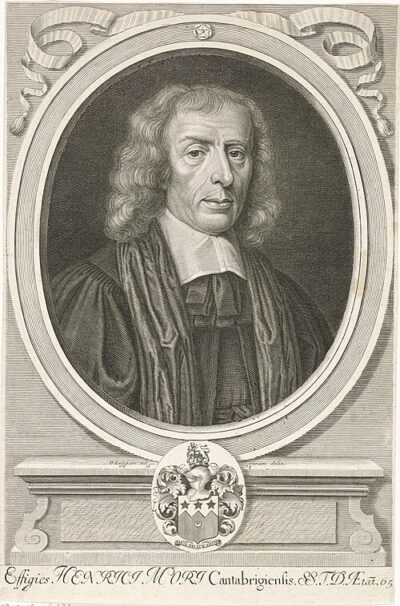
Henry More
Henry More was an English philosopher. Born October 12, 1614, in Grantham. Died September 1, 1687, in Cambridge. Educated at Christ's College and Eton College. Awards include Fellow of the Royal Society.
Facts
16 facts · 2 confirmed by two sources · 8 cited · 6 from one source
Where this comes from
Papalocal keeps its own record. It started from these sources; what each one said is kept here as it was copied, so a change on their side never changes this page by itself. Tap one to read its version.
What Wikidata says · copied November 16, 2026 · revision 2564350940
- Described as
- English philosopher (1614–1687)
- Other names
- Alazonomastix Philalethes, Philophilus Parresiastes
- Born
- October 12, 1614 · 4 references
- Died
- September 1, 1687 · 7 references
- Born in
- Grantham
- Died in
- Cambridge
- Buried in
- Christ's College Chapel · 1 reference
- Citizen of
- Kingdom of England
- Occupation
- philosopher · 1 reference
- Worked for
- University of Cambridge; Christ's College (1639–1687) · 2 references
- Education
- Christ's College (1631–1636) · 1 reference; Eton College (1628–1631) · 2 references; The King's School, Grantham · 1 reference; University of Cambridge (1636–1639) · 1 reference
- Member of
- Royal Society of London (1664–)
- Awards
- Fellow of the Royal Society · 1 reference
- Religion
- Anglicanism
- Wikipedias with a page
- 31
Wikidata item Q528802 (wikidata.org/wiki/Q528802), public domain (CC0). Copied November 16, 2026.
What Wikipedia says · copied November 16, 2026 · revision 1379825536
Henry More (; 12 October 1614 – 1 September 1687) was an English philosopher, Anglican priest, theologian, and poet, associated with the Cambridge Platonists. He sought to reconcile Platonism with Christian theology and responded critically to Cartesian philosophy. His metaphysical writings addressed the nature of spirit, matter, divine providence, and the soul, and he was a prominent voice in seventeenth-century religious and philosophical debates.
More rejected Cartesian dualism, arguing that spirit, like matter, must be extended in space. He coined the term fourth dimension and introduced the concept of essential spissitude to describe the spatial extension of immaterial substance. He also proposed the existence of a Spirit of Nature—an unconscious, incorporeal agent through which God sustained the order of the physical world. His metaphysics grounded his opposition to materialist atheism and emphasised the necessity of immaterial principles in explaining life and motion.
He opposed the Cartesian view that animals were mere machines, asserting instead that they possess immaterial but mortal souls. More regarded animals as part of divine providence and cited their usefulness to humans as evidence of design, while acknowledging the theological difficulty posed by predation and suffering.
His writings, in both Latin and English, spanned metaphysics, ethics, natural philosophy, and theology, and included poetry and prose. He influenced figures such as Lady Anne Conway, Joseph Glanvill, and John Norris, and was later cited by Ralph Waldo Emerson and Helena Blavatsky.
- Born, in its opening lines
- October 12, 1614
- Died, in its opening lines
- September 1, 1687
From the Wikipedia article “Henry More” (en.wikipedia.org/wiki/Henry_More), by its contributors, under CC BY-SA 4.0 (creativecommons.org/licenses/by-sa/4.0/). Copied November 16, 2026; not changed.
Confirmed Two sources agree. Cited One source, and it names where it got it. One source One source, without a reference of its own. Sources disagree The sources disagree. We show the best-supported value and keep theirs below.
