
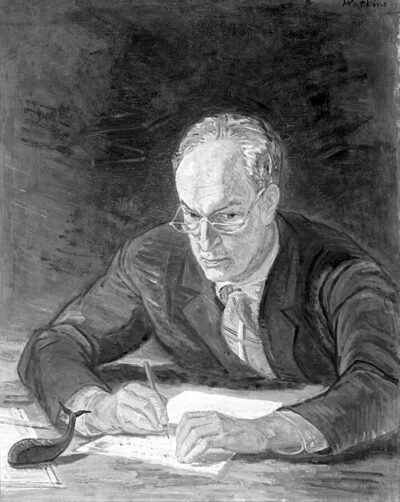
Henry Murray
Henry Murray was an American psychologist and academic. Born May 13, 1893, in New York City. Died June 23, 1988, in Cambridge. Educated at Harvard University and Columbia University Vagelos College of Physicians and Surgeons. Awards include APA Award for Distinguished Scientific Contributions to Psychology, Bruno Klopfer Award and Honorary Fellow of the British Psychological Society.
Facts
22 facts · 2 confirmed by two sources · 10 cited · 10 from one source
Where this comes from
Papalocal keeps its own record. It started from these sources; what each one said is kept here as it was copied, so a change on their side never changes this page by itself. Tap one to read its version.
What Wikidata says · copied November 15, 2026 · revision 2567361693
- Described as
- American psychologist and academic (1893–1988)
- Other names
- Henry Alexander Murray, Jr., Henry Alexander Murray
- Born
- May 13, 1893 · 7 references
- Died
- June 23, 1988 · 6 references
- Born in
- New York City · 2 references
- Died in
- Cambridge · 1 reference
- Citizen of
- United States
- Occupation
- psychologist · 1 reference; university teacher
- Worked for
- Harvard University
- Education
- Harvard University; Columbia University Vagelos College of Physicians and Surgeons; Columbia University · 1 reference; University of Cambridge · 1 reference
- Member of
- American Academy of Arts and Sciences
- Awards
- APA Award for Distinguished Scientific Contributions to Psychology (1961) · 1 reference; Bruno Klopfer Award (1967) · 1 reference; Honorary Fellow of the British Psychological Society; Kenneth D. Herman, Ph.D., J.D. Career Contribution Award (1971) · 1 reference
- Spouse
- Josephine Lee Rantoul (1916–) · 1 reference; Caroline Fish Chandler (1969–) · 1 reference
- Children
- Josephine Lee Murray · 1 reference
- Father
- Henry Alexander Murray
- Mother
- Fanny Morris Babcock · 1 reference
- Wikipedias with a page
- 28
Wikidata item Q463153 (wikidata.org/wiki/Q463153), public domain (CC0). Copied November 15, 2026.
What Wikipedia says · copied November 15, 2026 · revision 1383486251
Henry Alexander Murray (May 13, 1893 – June 23, 1988) was an American professor of psychology at Harvard University. Despite no formal training in psychology (Murray was a medical doctor trained in biochemistry), he made several notable contributions to the field. Murray developed the “personology” theory of personality. Murray was also a co-developer, with Christiana Morgan, of the Thematic Apperception Test (TAT), a projective measure of personality widely used for many years.
Murray was invited to join the psychology faculty at Harvard in 1926, serving as Director of the Harvard Psychological Clinic from 1928 until 1937, when he left to work with the U.S. Government during World War II. Murray returned to Harvard after the war ended. In his later years at the university (1959 to 1962), Murray led a series of experiments on how beliefs held up under extreme stress. The experiments have since been recognized as likely unethical due to their psychologically damaging and purposefully abusive nature, along with the use of deception and unclear scientific benefit. One participant in the study was Ted Kaczynski, who later gained infamy as the Unabomber.
- Born, in its opening lines
- May 13, 1893
- Died, in its opening lines
- June 23, 1988
From the Wikipedia article “Henry Murray” (en.wikipedia.org/wiki/Henry_Murray), by its contributors, under CC BY-SA 4.0 (creativecommons.org/licenses/by-sa/4.0/). Copied November 15, 2026; not changed.
Confirmed Two sources agree. Cited One source, and it names where it got it. One source One source, without a reference of its own. Sources disagree The sources disagree. We show the best-supported value and keep theirs below.
