
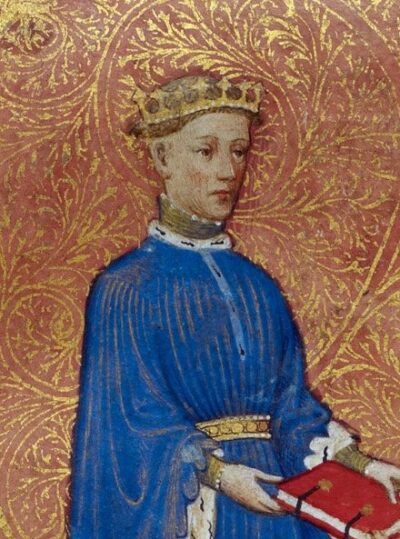
Henry V of England
Henry V of England was a King of England from 1413 to 1422. Born September 16, 1386, in Monmouth Castle. Died August 31, 1422, in Château de Vincennes. Positions held include Monarch of England (1413–1422), Lord of Ireland (1413–1422) and Lord Warden of the Cinque Ports (1409–1413). Educated at The Queen's College. Awards include Knight of the Garter.
Facts
23 facts · 2 confirmed by two sources · 9 cited · 12 from one source
Where this comes from
Papalocal keeps its own record. It started from these sources; what each one said is kept here as it was copied, so a change on their side never changes this page by itself. Tap one to read its version.
What Wikidata says · copied November 16, 2026 · revision 2569839730
- Described as
- King of England from 1413 to 1422
- Other names
- Henry V, Henry, Henry of Monmouth, King of England Henry V
- Born
- September 16, 1386
- Died
- August 31, 1422 · 2 references
- Born in
- Monmouth Castle · 1 reference
- Died in
- Château de Vincennes · 1 reference
- Buried in
- Westminster Abbey · 1 reference
- Cause of death
- dysentery
- Citizen of
- Kingdom of England
- Occupation
- politician
- Positions held
- Monarch of England (1413–1422); Lord of Ireland (1413–1422); Lord Warden of the Cinque Ports (1409–1413)
- Education
- The Queen's College
- Member of
- Order of the Garter (1399–)
- Awards
- Knight of the Garter (1399) · 1 reference
- Spouse
- Catherine of Valois (1420–) · 2 references
- Children
- Henry VI of England · 1 reference
- Father
- Henry IV of England · 1 reference
- Mother
- Mary de Bohun · 1 reference
- Siblings
- John of Lancaster, Duke of Bedford; Humphrey of Lancaster, 1st Duke of Gloucester · 1 reference; Thomas of Lancaster, 1st Duke of Clarence · 1 reference; Philippa of England; Blanche of England · 1 reference
- Wikipedias with a page
- 87
Wikidata item Q131581 (wikidata.org/wiki/Q131581), public domain (CC0). Copied November 16, 2026.
What Wikipedia says · copied November 16, 2026 · revision 1384326545
Henry V (16 September 1386 – 31 August 1422), also called Henry of Monmouth, was King of England, Lord of Ireland, and Duke of Aquitaine from 1413 until his death in 1422. His victory at Agincourt in 1415 and his conquest of Normandy gave England the upper hand in the Hundred Years' War and led, by the Treaty of Troyes in 1420, to his recognition as heir and regent of France. This was the high-water mark of the English cause in the war. Celebrated in William Shakespeare's Henriad as one of the greatest warrior-kings of medieval England, Henry was also a forceful ruler at home, restoring public order, working closely with Parliament, and enforcing a strict religious orthodoxy.
Henry of Monmouth was the eldest son of Henry IV, and became heir apparent and Prince of Wales after his father seized the throne from Richard II in 1399. During his father's reign, he gained military experience in Wales against the Glyndŵr rebellion and in fighting the powerful Percy family of Northumberland, and played an important part at the Battle of Shrewsbury when only 16. As his father's health declined, Henry took an increasingly central role in government, though disagreements between the two men led to political conflict. Henry succeeded to the throne after his father's death in March 1413 and revived the long-standing English claim to the French throne.
In 1415, Henry renewed active warfare with France, opening the Lancastrian phase of the Hundred Years' War (1415–1453). His first campaign successfully besieged Harfleur and won a celebrated victory at Agincourt, which strengthened his position in England and lent weight to his claim. A second expedition from 1417 set out to conquer Normandy, recovering for the English crown a duchy lost two centuries earlier; by 1419, his army stood before Paris. Exploiting the civil war that divided France, and allying with Burgundy after the murder of Duke John the Fearless, Henry was able to impose the Treaty of Troyes on Charles VI. The treaty made him regent and heir to the French throne, disinherited the king's own son, the Dauphin Charles, and provided for his marriage to Charles's daughter Catherine of Valois. It envisaged a union of the two crowns in Henry's person on Charles's death. But Henry died in August 1422, seven weeks before the ailing Charles VI, and was succeeded by his only son, the infant Henry VI.
At home, Henry restored order after the turbulence of his father's reign, strengthening the enforcement of justice and working closely with Parliament. He promoted the use of English in royal government and upheld a strict orthodoxy, crushing the Lollard movement and helping to end the Western Schism at the Council of Constance. His later fame has rested above all on his military prowess, on which there has been near-unanimity since his own day. Contemporary French and Burgundian verdicts ranged from admiration for his discipline and prudence to portrayals of a vainglorious tyrant. Modern scholars are divided in their assessments, some condemning Henry as a warmonger whose ambition bankrupted his realm, others reckoning him the greatest of England's kings. Much of the debate turns on his French conquests and how far he was to blame for their loss under his son. His biographer Christopher Allmand concludes that Henry's gifts as a ruler showed most clearly not on the battlefield but in the governing of England, and that the fuller the reckoning of his reign, the higher he stands.
- Born, in its opening lines
- September 16, 1386
- Died, in its opening lines
- August 31, 1422
From the Wikipedia article “Henry V of England” (en.wikipedia.org/wiki/Henry_V_of_England), by its contributors, under CC BY-SA 4.0 (creativecommons.org/licenses/by-sa/4.0/). Copied November 16, 2026; not changed.
Confirmed Two sources agree. Cited One source, and it names where it got it. One source One source, without a reference of its own. Sources disagree The sources disagree. We show the best-supported value and keep theirs below.
