
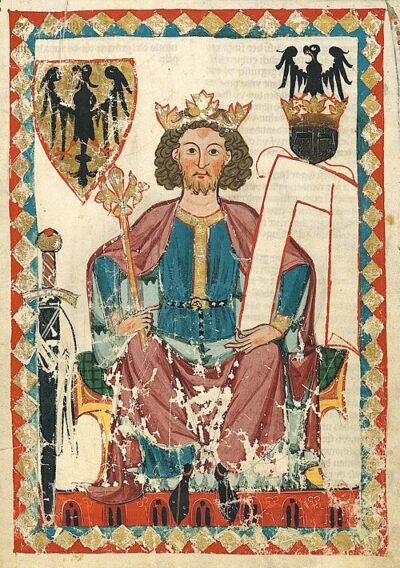
Henry VI
Henry VI was a Holy Roman Emperor from 1191 to 1197. Born November 1, 1165, in Nijmegen. Died September 28, 1197, in Messina. Positions held include Holy Roman Emperor (1191–1197), King of the Romans (1169–1197) and Monarch of Italy (1186–1197).
Facts
22 facts · 2 confirmed by two sources · 7 cited · 12 from one source · 1 where the sources disagree
What’s different
- Buried in: we show Palermo Cathedral (Sources disagree). Wikidata also lists Tomb of Henry VI, Holy Roman Emperor
Where this comes from
Papalocal keeps its own record. It started from these sources; what each one said is kept here as it was copied, so a change on their side never changes this page by itself. Tap one to read its version.
What Wikidata says · copied November 16, 2026 · revision 2563977041
- Described as
- Holy Roman Emperor from 1191 to 1197
- Other names
- King of Sicily Henry VI, Holy Roman Emperor Henry VI, King of the Germans Henry VI
- Born
- November 1, 1165
- Died
- September 28, 1197 · 1 reference
- Born in
- Nijmegen · 1 reference
- Died in
- Messina · 1 reference
- Buried in
- Palermo Cathedral · 1 reference; Tomb of Henry VI, Holy Roman Emperor · 1 reference
- Cause of death
- malaria
- Citizen of
- Germany
- Occupation
- monarch; writer
- Positions held
- Holy Roman Emperor (1191–1197); King of the Romans (1169–1197); Monarch of Italy (1186–1197); Monarch of the Kingdom of the Two Sicilies (1194–1197)
- Spouse
- Costanza I of Sicily (1186–) · 2 references
- Children
- Frederick II, Holy Roman Emperor · 1 reference
- Father
- Frederick Barbarossa · 1 reference
- Mother
- Beatrice I, Countess of Burgundy · 1 reference
- Siblings
- Philip of Swabia · 1 reference; Conrad II, Duke of Swabia; Otto I, Count of Burgundy; Frederick V, Duke of Swabia; Frederick VI, Duke of Swabia
- Wikipedias with a page
- 58
Wikidata item Q150953 (wikidata.org/wiki/Q150953), public domain (CC0). Copied November 16, 2026.
What Wikipedia says · copied November 16, 2026 · revision 1362345295
Henry VI (German: Heinrich VI.; November 1165 – 28 September 1197), a member of the Hohenstaufen dynasty, was King of Germany (King of the Romans) from 1169 and Holy Roman Emperor from 1191 until his death. From 1194, he was also King of Sicily as the husband and co-ruler of Queen Constance I.
Henry was the second son of Emperor Frederick Barbarossa and Beatrice I, Countess of Burgundy. Well educated in the Latin language, as well as Roman and canon law, he was also a patron of poets and a skilled poet himself. In 1186, he married Constance of Sicily. Henry, stuck in the Hohenstaufen conflict with the House of Welf until 1194, had to enforce the inheritance claims by his wife against her nephew Count Tancred of Lecce. His attempt to conquer the Kingdom of Sicily failed at the siege of Naples in 1191 due to an epidemic, with Empress Constance captured. Based on an enormous ransom for the release and submission of King Richard I of England, he conquered Sicily in 1194; however, the intended unification with the Holy Roman Empire ultimately failed due to the opposition of the Papacy. In Sicily, Henry had a reputation for ruthless suppression of political opponents. To this day, he is sometimes given the epithet "the Cruel" (il crudele) by Italian historiographers.
Henry threatened to invade the Byzantine Empire after 1194 and succeeded in extracting a ransom, the Alamanikon, from Emperor Alexios III Angelos in return for cancelling the invasion. He made the Kingdom of Cyprus and the Armenian Kingdom of Cilicia formal subjects of the empire and compelled Tunis and Tripolitania to pay tribute to him. Between 1195 and 1196, he attempted to turn the Holy Roman Empire from an elective to a hereditary monarchy, the so-called Erbreichsplan, but met strong resistance from the prince-electors. Henry pledged to go on crusade in 1195 and began preparations. A revolt in Sicily was crushed in 1197. The Crusaders set sail for the Holy Land that same year, but Henry died of malaria at Messina before he could join them. His death plunged the Empire into the chaos of the German throne dispute for the next 17 years.
- Born, in its opening lines
- November 1165
- Died, in its opening lines
- September 28, 1197
From the Wikipedia article “Henry VI, Holy Roman Emperor” (en.wikipedia.org/wiki/Henry_VI,_Holy_Roman_Emperor), by its contributors, under CC BY-SA 4.0 (creativecommons.org/licenses/by-sa/4.0/). Copied November 16, 2026; not changed.
Confirmed Two sources agree. Cited One source, and it names where it got it. One source One source, without a reference of its own. Sources disagree The sources disagree. We show the best-supported value and keep theirs below.
