
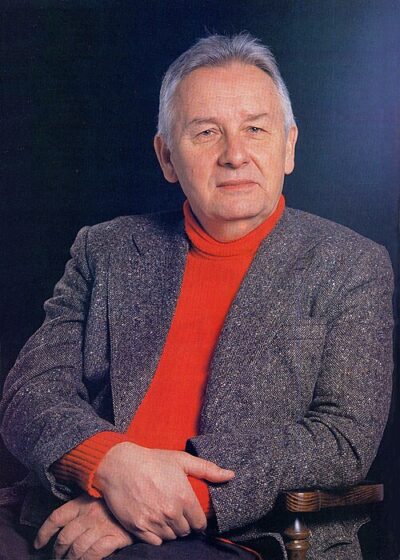
Henryk Mikolaj Górecki
Henryk Mikolaj Górecki was a Polish composer. Born December 6, 1933, in Czernica. Died November 12, 2010, in Katowice. Positions held include associate professor (1977–). Known for Symphony No. 3 and Symphony No. 4. Educated at Academy of Music in Katowice and Szafrankowie Brothers State School of Music. Awards include Order of the White Eagle, Golden Medal for Merit to Culture and Knight Grand Cross of the Order of St. Gregory the Great.
Facts
40 facts · 2 confirmed by two sources · 14 cited · 24 from one source
Where this comes from
Papalocal keeps its own record. It started from these sources; what each one said is kept here as it was copied, so a change on their side never changes this page by itself. Tap one to read its version.
What Wikidata says · copied November 16, 2026 · revision 2569181357
- Described as
- Polish composer (1933–2010)
- Other names
- Henryk-Mikolaj Górecki, Henryk Mikołaj Górecki, Henryk Gorecki
- Born
- December 6, 1933 · 15 references
- Died
- November 12, 2010 · 12 references
- Born in
- Czernica · 1 reference
- Died in
- Katowice · 1 reference
- Buried in
- Cemetery on Sienkiewicza Street in Katowice
- Cause of death
- disease
- Name at birth
- Henryk Mikołaj Górecki · 1 reference
- Citizen of
- Poland · 1 reference
- Occupation
- classical composer; pedagogue; musicologist; musician · 1 reference; composer · 2 references; university teacher · 1 reference
- Positions held
- associate professor (1977–) · 2 references
- Worked for
- Academy of Music in Katowice · 1 reference
- Education
- Academy of Music in Katowice · 1 reference; Szafrankowie Brothers State School of Music
- Member of
- Polish Academy of Learning; Union of Polish Composers · 1 reference; Klub Inteligencji Katolickiej · 1 reference
- Genre
- minimalist music
- Record label
- Nonesuch Records
- Known for
- Symphony No. 3; Symphony No. 4
- Awards
- Order of the White Eagle (2010) · 1 reference; Golden Medal for Merit to Culture (2005) · 1 reference; Knight Grand Cross of the Order of St. Gregory the Great; Commander with Star of the Order of Polonia Restituta; honorary doctor of the Jagiellonian University of Krakow; Herder Prize (1999); honorary doctorate from the Catholic University of Lublin; Order Ecce Homo · 1 reference
- Field
- performing arts; art music; music education
- Children
- Mikołaj Górecki; Anna Górecka · 1 reference
- Religion
- Catholicism · 1 reference; Catholic Church · 1 reference
- Wikipedias with a page
- 47
Wikidata item Q294568 (wikidata.org/wiki/Q294568), public domain (CC0). Copied November 16, 2026.
What Wikipedia says · copied November 16, 2026 · revision 1380469933
Henryk Mikołaj Górecki ( gə-RET-skee; Polish: [ˈxɛnrɨk miˈkɔwaj ɡuˈrɛt͡skʲi] ; 6 December 1933 – 12 November 2010) was a Polish composer of contemporary classical music. According to critic Alex Ross, no recent classical composer has had as much commercial success as Górecki. He became a leading figure of the Polish avant-garde during the post-Stalin cultural thaw. His Anton Webern-influenced serialist works of the 1950s and 1960s were characterized by adherence to dissonant modernism and influenced by Luigi Nono, Karlheinz Stockhausen, Krzysztof Penderecki and Kazimierz Serocki. He continued in this direction throughout the 1960s, but by the mid-1970s had changed to a less complex sacred minimalist sound, exemplified by the transitional Symphony No. 2 "Copernican" and the Symphony No. 3 "Symphony of Sorrowful Songs". This later style developed through several other distinct phases, from such works as his 1979 Beatus Vir, to the 1981 choral hymn Miserere, the 1993 Kleines Requiem für eine Polka and his requiem Good Night.
Górecki was largely unknown outside Poland until the late 1980s. In 1992, 15 years after it was composed, a recording of his Symphony of Sorrowful Songs with soprano Dawn Upshaw and conductor David Zinman became a worldwide commercial and critical success, selling more than a million copies and vastly exceeding the typical lifetime sales of a recording of symphonic music by a 20th-century composer. Commenting on its popularity, Górecki said, "Perhaps people find something they need in this piece of music ... somehow I hit the right note, something they were missing. Something somewhere had been lost to them. I feel that I instinctively knew what they needed." This popular acclaim did not generate wide interest in Górecki's other works, and he pointedly resisted the temptation to repeat earlier success, or compose for commercial reward.
Apart from two brief periods studying in Paris and a short time living in Berlin, Górecki spent most of his life in southern Poland.
- Born, in its opening lines
- December 6, 1933
- Died, in its opening lines
- November 12, 2010
From the Wikipedia article “Henryk Górecki” (en.wikipedia.org/wiki/Henryk_Górecki), by its contributors, under CC BY-SA 4.0 (creativecommons.org/licenses/by-sa/4.0/). Copied November 16, 2026; not changed.
Confirmed Two sources agree. Cited One source, and it names where it got it. One source One source, without a reference of its own. Sources disagree The sources disagree. We show the best-supported value and keep theirs below.
