
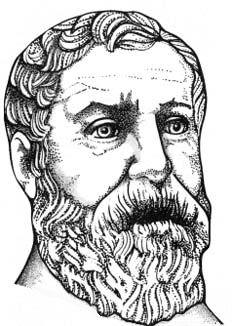
Hero of Alexandria
Hero of Alexandria was an ancient Greek mathematician and engineer. Born 10, in Alexandria. Died 75, in Alexandria. Known for aeolipile, Heron's formula and Heron's fountain.
Facts
20 facts · 0 confirmed by two sources · 7 cited · 13 from one source
Where this comes from
Papalocal keeps its own record. It started from these sources; what each one said is kept here as it was copied, so a change on their side never changes this page by itself. Tap one to read its version.
What Wikidata says · copied November 16, 2026 · revision 2565602145
- Described as
- ancient Greek mathematician and engineer
- Other names
- Hero
- Born
- 10 · 2 references
- Died
- 75 · 1 reference
- Born in
- Alexandria · 1 reference
- Died in
- Alexandria · 1 reference
- Name at birth
- Ἥρων
- Occupation
- mathematician · 2 references; physicist; mechanical automaton engineer; engineer · 1 reference; inventor; mechanic · 1 reference
- Known for
- aeolipile; Heron's formula; Heron's fountain
- Field
- geometry; mechanics · 1 reference; engineering · 1 reference; optics · 1 reference; mathematics · 1 reference; geodesy · 1 reference
- Wikipedias with a page
- 78
Wikidata item Q161853 (wikidata.org/wiki/Q161853), public domain (CC0). Copied November 16, 2026.
What Wikipedia says · copied November 16, 2026 · revision 1383907799
Hero of Alexandria (; Ancient Greek: Ἥρων ὁ Ἀλεξανδρεύς, Hērōn hò Alexandreús, also known as Heron of Alexandria ; fl. probably 1st or 2nd century AD) was a Greek mathematician and engineer who was active in Alexandria during the Roman era. He has been described as the greatest experimentalist of antiquity and a representative of the Hellenistic scientific tradition.
Hero published a well-recognized description of a steam-powered device called an aeolipile, also known as "Hero's engine". Among his most famous inventions was a windwheel, constituting the earliest instance of wind harnessing on land. In his work Mechanics, he described pantographs. Some of his ideas were derived from the works of Ctesibius.
In mathematics, he wrote a commentary on Euclid's Elements and a work on applied geometry known as the Metrica. He is mostly remembered for Heron's formula, a way to calculate the area of a triangle using only the lengths of its sides.
Much of Hero's original writings and designs have been lost, but some of his works were preserved in manuscripts from the Byzantine Empire and, to a lesser extent, in Latin or Arabic translations.
From the Wikipedia article “Hero of Alexandria” (en.wikipedia.org/wiki/Hero_of_Alexandria), by its contributors, under CC BY-SA 4.0 (creativecommons.org/licenses/by-sa/4.0/). Copied November 16, 2026; not changed.
Confirmed Two sources agree. Cited One source, and it names where it got it. One source One source, without a reference of its own. Sources disagree The sources disagree. We show the best-supported value and keep theirs below.
