
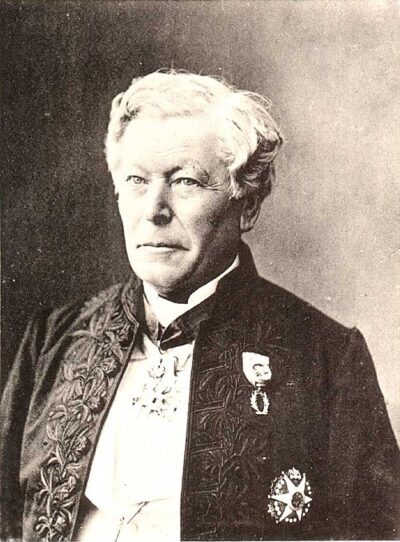
Hervé Faye
Hervé Faye was a French astronomer. Born October 1, 1814, in Saint-Benoît-du-Sault. Died July 4, 1902, in Paris. Positions held include French Education Minister and president of the French Academy of Sciences (1872). Educated at École polytechnique. Awards include Lalande Prize and Legion of Honour.
Facts
21 facts · 2 confirmed by two sources · 5 cited · 14 from one source
Where this comes from
Papalocal keeps its own record. It started from these sources; what each one said is kept here as it was copied, so a change on their side never changes this page by itself. Tap one to read its version.
What Wikidata says · copied November 17, 2026 · revision 2562693605
- Described as
- French astronomer (1814–1902)
- Other names
- Herve Faye, Hervé Auguste Étienne Albans Faye, Hervé A. E. A. Faye
- Born
- October 1, 1814 · 3 references
- Died
- July 4, 1902 · 4 references
- Born in
- Saint-Benoît-du-Sault
- Died in
- Paris
- Buried in
- Passy Cemetery
- Citizen of
- France
- Occupation
- astronomer · 1 reference; minister; politician · 1 reference
- Positions held
- French Education Minister; president of the French Academy of Sciences (1872) · 1 reference
- Education
- École polytechnique
- Member of
- French Academy of Sciences; American Academy of Arts and Sciences; Accademia Nazionale dei Lincei (1900–) · 1 reference; Astronomical Society of France; Académie de Stanislas (Nancy, France) · 1 reference
- Awards
- Lalande Prize (1843); Legion of Honour
- Field
- astronomy
- Father
- Hervé Charles Antoine Faye · 1 reference
- Wikipedias with a page
- 26
Wikidata item Q472118 (wikidata.org/wiki/Q472118), public domain (CC0). Copied November 17, 2026.
What Wikipedia says · copied November 17, 2026 · revision 1380734895
Hervé Auguste Étienne Albans Faye ((1814-10-01)1 October 1814 – (1902-07-04)4 July 1902) was a French astronomer, born at Saint-Benoît-du-Sault (Indre) and educated at the École Polytechnique, which he left in 1834, before completing his course, to accept a position in the Paris Observatory to which he had been appointed on the recommendation of M. Arago. It was during his time at the École Polytechnique that he developed his interest in astronomy.
He studied comets, and discovered the periodic comet 4P/Faye on 22 November 1843. His discovery of "Faye's Comet" attracted worldwide attention, and won him the 1844 Lalande Prize and a membership in the French Academy of Sciences. In 1848 he became an instructor in geodesy at the Polytechnique, and in 1854 rector of the academy at Nancy and professor of astronomy in the faculty of science there. Other promotions followed in succeeding decades. He became Minister of Public Instruction in the Rochebouet cabinet in 1877, a position which he held only briefly.
Faye served as the President of the Société Astronomique de France (SAF), the French astronomical society, from 1889 to 1891. He also served as president of the International Geodetic Association from 1892 to 1902.
His work covered the entire field of astronomical investigation. It comprised the determination of comet periods, the measurement of parallaxes, and the study of stellar and planetary movements. He also studied the physics of the sun. He advanced several original theories on the nature and form of comets, meteors, the aurora borealis, and the sun.
Faye crater on the Moon is named after him.
- Born, in its opening lines
- October 1, 1814
- Died, in its opening lines
- July 4, 1902
From the Wikipedia article “Hervé Faye” (en.wikipedia.org/wiki/Hervé_Faye), by its contributors, under CC BY-SA 4.0 (creativecommons.org/licenses/by-sa/4.0/). Copied November 17, 2026; not changed.
Confirmed Two sources agree. Cited One source, and it names where it got it. One source One source, without a reference of its own. Sources disagree The sources disagree. We show the best-supported value and keep theirs below.
