
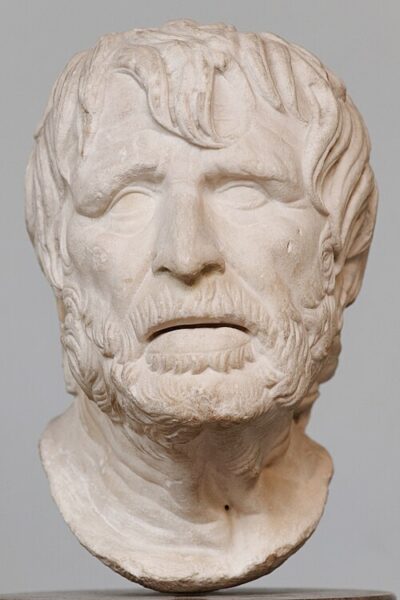
Hesiod
Hesiod was an ancient Greek poet of the archaic period. Born 776 BC, in Cyme. Died 7th century BC, in Ascra. Known for Theogony, Works and Days and Catalogue of Women.
Facts
15 facts · 0 confirmed by two sources · 1 cited · 13 from one source · 1 where the sources disagree
What’s different
- Buried in: we show Orchomenus (Sources disagree). Wikidata also lists Tomb of Hesiod in Orchomenos
Where this comes from
Papalocal keeps its own record. It started from these sources; what each one said is kept here as it was copied, so a change on their side never changes this page by itself. Tap one to read its version.
What Wikidata says · copied November 16, 2026 · revision 2565594890
- Described as
- ancient Greek poet of the archaic period
- Other names
- Hesiod of Ascra, Hesiodus
- Born
- 776 BC · 1 reference
- Died
- 7th century BC · 1 reference
- Born in
- Cyme · 1 reference
- Died in
- Ascra · 1 reference
- Buried in
- Tomb of Hesiod in Orchomenos; Orchomenus · 1 reference
- Citizen of
- Cyme
- Occupation
- poet; writer · 3 references; rhapsode; mythographer
- Genre
- poetry
- Known for
- Theogony; Works and Days; Catalogue of Women
- Siblings
- Perses · 2 references
- Wikipedias with a page
- 127
Wikidata item Q44233 (wikidata.org/wiki/Q44233), public domain (CC0). Copied November 16, 2026.
What Wikipedia says · copied November 16, 2026 · revision 1384898761
Hesiod ( HEE-see-əd or HEH-see-əd; Ancient Greek: Ἡσίοδος Hēsíodos; fl. c. 700 BC) was an Ancient Greek poet generally thought to have been active between 750 and 650 BC, around the same time as Homer.
Several of Hesiod's works have survived in their entirety. Among these are Theogony, which tells the origins of the gods, their lineages, and the events that led to Zeus's rise to power, and Works and Days, a poem that describes the five Ages of Man, offers advice and wisdom, and includes myths such as Pandora's box.
Hesiod is generally regarded by Western authors as 'the first written poet in the Western tradition to regard himself as an individual persona with an active role to play in his subject.' Ancient authors credited Hesiod and Homer with establishing Greek religious customs. Modern scholars refer to him as a major source on Greek mythology, farming techniques, early economic thought, Archaic Greek astronomy, cosmology, and ancient time-keeping.
From the Wikipedia article “Hesiod” (en.wikipedia.org/wiki/Hesiod), by its contributors, under CC BY-SA 4.0 (creativecommons.org/licenses/by-sa/4.0/). Copied November 16, 2026; not changed.
Confirmed Two sources agree. Cited One source, and it names where it got it. One source One source, without a reference of its own. Sources disagree The sources disagree. We show the best-supported value and keep theirs below.
