
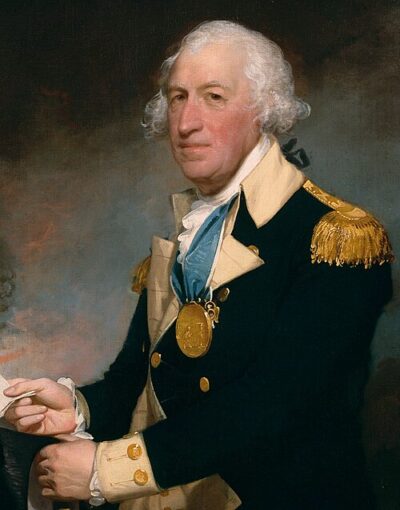
Horatio Gates
Horatio Gates was an American general in the American Revolutionary War. Born July 26, 1727, in Maldon. Died April 10, 1806, in Manhattan. Positions held include member of the New York State Assembly. Awards include Congressional Gold Medal.
Facts
16 facts · 2 confirmed by two sources · 1 cited · 13 from one source
Where this comes from
Papalocal keeps its own record. It started from these sources; what each one said is kept here as it was copied, so a change on their side never changes this page by itself. Tap one to read its version.
What Wikidata says · copied November 15, 2026 · revision 2532547448
- Described as
- American general in the American Revolutionary War (1727–1806)
- Other names
- Horatio Lloyd Gates
- Born
- July 26, 1727 · 1 reference
- Died
- April 10, 1806 · 3 references
- Born in
- Maldon
- Died in
- Manhattan
- Buried in
- Trinity Church · 1 reference
- Citizen of
- United States; Kingdom of Great Britain
- Occupation
- military officer · 1 reference; politician
- Positions held
- member of the New York State Assembly
- Awards
- Congressional Gold Medal
- Military branch
- Continental Army; British Army; army · 1 reference
- Military rank
- major general; Major · 1 reference
- Wikipedias with a page
- 28
Wikidata item Q365124 (wikidata.org/wiki/Q365124), public domain (CC0). Copied November 15, 2026.
What Wikipedia says · copied November 15, 2026 · revision 1380210393
Horatio Lloyd Gates (July 26, 1727 – April 10, 1806) was a British-born American army officer and politician who served in the British and Continental armies. During the American Revolutionary War, he led the Continental Army to victory at the 1777 Battles of Saratoga. However, his career was subsequently tarnished when he was defeated by the British at the 1780 Battle of Camden. Gates has been described as "one of the Revolution's most controversial military figures" due to his role in the Conway Cabal, which attempted to discredit and replace George Washington as the Continental Army's commander-in-chief, along with his controversial actions at Saratoga and Camden.
Gates was born in Maldon, Essex, and served as a British Army officer during the War of the Austrian Succession and French and Indian War. He became frustrated by his inability to advance in rank, so he sold his commission and bought a slave plantation in the colony of Virginia. On Washington's recommendation, the Continental Congress made Gates the Adjutant General of the Continental Army in 1775. He was made the commander of Fort Ticonderoga in 1776 and of the Northern Department in 1777, and American forces defeated a British army at Saratoga soon after. Some members of Congress considered replacing Washington with Gates after the victory at Saratoga, but that did not materialize.
Gates took command of the Southern Department in 1780, but he was removed from command later that year after the disastrous American defeat at Camden. Gates's military reputation was destroyed, and he was not given another command for the remainder of the war. He retired to his Virginia plantation after the war, but eventually decided to manumit his slaves and move to New York. He was elected to a single term in the New York State Legislature and died in 1806.
- Born, in its opening lines
- July 26, 1727
- Died, in its opening lines
- April 10, 1806
From the Wikipedia article “Horatio Gates” (en.wikipedia.org/wiki/Horatio_Gates), by its contributors, under CC BY-SA 4.0 (creativecommons.org/licenses/by-sa/4.0/). Copied November 15, 2026; not changed.
Confirmed Two sources agree. Cited One source, and it names where it got it. One source One source, without a reference of its own. Sources disagree The sources disagree. We show the best-supported value and keep theirs below.
