
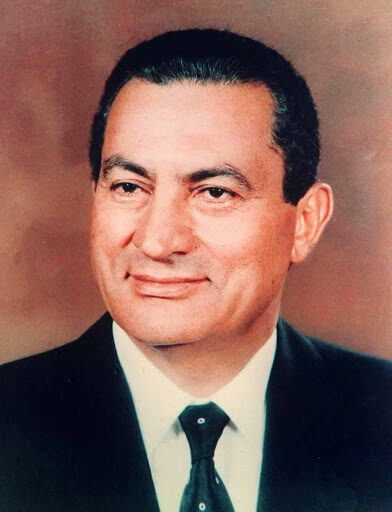
Hosni Mubarak
Hosni Mubarak was a President of Egypt from 1981 to 2011. Born May 4, 1928, in Kafr el-Muṣīlḥa. Died February 25, 2020, in Cairo. Positions held include President of Egypt (1981–2011), Prime Minister of Egypt (1981–1982) and chairperson of the Organisation of African Unity (2 times) (1989–1994). Educated at Egyptian Military College and Military Academy of the General Staff of the Armed Forces of Russia. Awards include Jawaharlal Nehru Award for International Understanding, Knight Grand Cross of the Order of St Michael and St George and Order of the Nile.
Facts
51 facts · 2 confirmed by two sources · 9 cited · 40 from one source
Where this comes from
Papalocal keeps its own record. It started from these sources; what each one said is kept here as it was copied, so a change on their side never changes this page by itself. Tap one to read its version.
What Wikidata says · copied November 16, 2026 · revision 2563040260
- Described as
- President of Egypt from 1981 to 2011
- Other names
- Mubarak, Muhammad Husni Mubarak, Mobarak, Muhammad Hosni El Sayed Mubarak, Muhammad Husni Saʿid Mubarak, Mohammed Hosni Mobarak
- Born
- May 4, 1928 · 7 references
- Died
- February 25, 2020 · 6 references
- Born in
- Kafr el-Muṣīlḥa · 1 reference
- Died in
- Cairo · 2 references
- Buried in
- Heliopolis
- Cause of death
- surgical complications
- Citizen of
- Kingdom of Egypt (1928–1952); Republic of Egypt (1953–1958); United Arab Republic (1958–1971); Egypt (1971–2020)
- Occupation
- politician · 2 references; aircraft pilot · 1 reference; military personnel; vice president; president; military officer · 1 reference
- Positions held
- President of Egypt (1981–2011); Prime Minister of Egypt (1981–1982); chairperson of the Organisation of African Unity (2 times) (1989–1994); Vice President of Egypt (1975–1981); Secretary General of the Non-Aligned Movement (2009–2011); prime minister
- Political party
- National Democratic Party; Arab Socialist Union
- Education
- Egyptian Military College (–1949); Military Academy of the General Staff of the Armed Forces of Russia; Supreme Military Institute of the Armed Forces of the Kyrgyz Republic; M.V. Frunze Military Academy
- Awards
- Jawaharlal Nehru Award for International Understanding (1995) · 1 reference; Knight Grand Cross of the Order of St Michael and St George; Order of the Nile; Order of the Republic; Order of Merit; Grand Collar of the Order of Prince Henry (1983) · 1 reference; Order of the Golden Eagle; Knight of the Seraphim; Order of the Elephant (1986) · 1 reference; Order of the National Flag; Grand Collar of the Order of Good Hope; Grand Cross of the Order of Merit of the Republic of Poland; Knight Grand Cross with Collar of the Order of Merit of the Italian Republic; Order of State of Republic of Turkey; honorary doctor of the Peking University (1999) · 1 reference
- Field
- politics · 1 reference
- Spouse
- Suzanne Mubarak (1959–2020)
- Children
- Alaa Mubarak; Gamal Mubarak
- Religion
- Sunni Islam
- Military branch
- Egyptian Air Force · 1 reference
- Military rank
- air marshal
- Lived in
- Cairo
- Wikipedias with a page
- 137
Wikidata item Q34105 (wikidata.org/wiki/Q34105), public domain (CC0). Copied November 16, 2026.
What Wikipedia says · copied November 16, 2026 · revision 1381132303
Muhammad Hosni El Sayed Mubarak (4 May 1928 – 25 February 2020) was an Egyptian politician and military officer who served as the fourth president of Egypt from 1981 until his resignation in 2011, following the Egyptian revolution. He was previously the seventh vice president under President Anwar Sadat from 1975 until his accession to the presidency, and the 41st prime minister from 1981 to 1982. Before he entered politics, Mubarak was a career officer in the Egyptian Air Force. He served as its commander from 1972 to 1975 and rose to the rank of air chief marshal in 1973.
After Sadat was assassinated in 1981, Mubarak assumed the presidency in a single-candidate referendum, and renewed his term through single-candidate referendums in 1987, 1993, and 1999. Under United States pressure, Mubarak held the country's first multi-party election in 2005, which he won. In 1989, he succeeded in reinstating Egypt's membership in the Arab League, which had been frozen since the Camp David Accords with Israel, and in returning the Arab League's headquarters back to Cairo. He was known for his supportive stance on the Israeli–Palestinian peace process, in addition to his role in the Gulf War. Despite providing stability and reasons for economic growth, his rule was repressive. The state of emergency, which had not been lifted since the 1967 war, stifled political opposition, the security services became known for their brutality, and corruption became widespread.
Mubarak stepped down during the 2011 Egyptian revolution after 18 days of demonstrations, transferring power to the Supreme Council of the Armed Forces. He was later ordered to stand trial on charges of killing peaceful protesters during the revolution. These trials began on 3 August 2011, making him the first Arab leader to be tried in his own country in an ordinary court of law. On 2 June 2012, an Egyptian court sentenced Mubarak to life imprisonment. After sentencing, he was reported to have suffered a series of health crises. On 13 January 2013, Egypt's Court of Cassation (the nation's high court of appeal) overturned Mubarak's sentence and ordered a retrial. On retrial, Mubarak and his sons were convicted on 9 May 2015 of corruption and given prison sentences. Mubarak was detained in a military hospital while his sons were freed on 12 October 2015 by a Cairo court. Mubarak was acquitted on 2 March 2017 by the Court of Cassation and was released on 24 March 2017.
Mubarak died in 2020, aged 91. He was honoured with a military funeral and buried at a family plot outside Cairo. Mubarak's presidency lasted almost thirty years, making him Egypt's longest-serving ruler since Muhammad Ali Pasha, who ruled the country for 43 years from 1805 to 1848.
- Born, in its opening lines
- May 4, 1928
- Died, in its opening lines
- February 25, 2020
From the Wikipedia article “Hosni Mubarak” (en.wikipedia.org/wiki/Hosni_Mubarak), by its contributors, under CC BY-SA 4.0 (creativecommons.org/licenses/by-sa/4.0/). Copied November 16, 2026; not changed.
Confirmed Two sources agree. Cited One source, and it names where it got it. One source One source, without a reference of its own. Sources disagree The sources disagree. We show the best-supported value and keep theirs below.
