
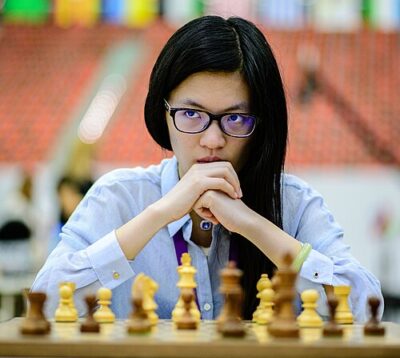
Hou Yifan
Hou Yifan is a Chinese chess player. Born February 27, 1994, in Xinghua. Educated at Peking University and High School Affiliated to Renmin University of China. Awards include BBC 100 Women, Women's World Chess Championship and Rhodes Scholarship.
Facts
11 facts · 1 confirmed by two sources · 5 cited · 5 from one source
Where this comes from
Papalocal keeps its own record. It started from these sources; what each one said is kept here as it was copied, so a change on their side never changes this page by itself. Tap one to read its version.
What Wikidata says · copied November 16, 2026 · revision 2561575624
- Described as
- Chinese chess player
- Other names
- Yifan Hou, Hou, Yifan
- Born
- February 27, 1994 · 4 references
- Born in
- Xinghua · 3 references
- Citizen of
- People's Republic of China · 1 reference
- Occupation
- chess player
- Education
- Peking University; High School Affiliated to Renmin University of China; St Hilda's College · 1 reference
- Sport
- chess
- Awards
- BBC 100 Women (2017) · 1 reference; Women's World Chess Championship; Rhodes Scholarship (2018) · 1 reference
- Wikipedias with a page
- 55
Wikidata item Q234011 (wikidata.org/wiki/Q234011), public domain (CC0). Copied November 16, 2026.
What Wikipedia says · copied November 16, 2026 · revision 1377299982
Hou Yifan (Chinese: 侯逸凡; pinyin: Hóu Yìfán ; born 27 February 1994) is a Chinese chess grandmaster, four-time Women's World Chess Champion and professor at Peking University. She is the second-highest-rated female player of all time. A chess prodigy, she was the youngest female player ever to qualify for the title of grandmaster (at the age of 14 years, 6 months, 2 days) and the youngest ever to win the Women's World Chess Championship (at age 16).
At the age of 12, Hou became the youngest player ever to participate in the Women's World Championship (Yekaterinburg 2006) and the Chess Olympiad (Torino 2006). In June 2007, she became the youngest Chinese Women's Champion ever. She achieved the titles of Woman FIDE Master in January 2004, Woman Grandmaster in January 2007, and Grandmaster in August 2008. In 2010, she won the 2010 Women's World Championship in Hatay, Turkey at age 16. She won the next three championships in which the title was decided by a match (in 2011, 2013 and 2016, with a total of ten wins to zero losses and fourteen draws against three different opponents), but was either eliminated early or she declined to participate in the championships in which the title was decided by a knockout tournament (in 2012, 2015 and 2017).
Hou was the third woman ever to be rated among the world's top 100 players (2014–16 and 2017–22), after Maia Chiburdanidze and Judit Polgár. After Polgár's retirement, she was widely regarded as the strongest active female player, maintaining a substantial rating lead over her peers. She has been the No. 1 ranked woman in the world since September 2015, but has been largely inactive since 2018. She was named in the BBC's 100 Women programme in 2017. In 2020, she became the youngest professor at Shenzhen University at the age of 26, and has since moved to Peking University.
- Born, in its opening lines
- February 27, 1994
From the Wikipedia article “Hou Yifan” (en.wikipedia.org/wiki/Hou_Yifan), by its contributors, under CC BY-SA 4.0 (creativecommons.org/licenses/by-sa/4.0/). Copied November 16, 2026; not changed.
Confirmed Two sources agree. Cited One source, and it names where it got it. One source One source, without a reference of its own. Sources disagree The sources disagree. We show the best-supported value and keep theirs below.
