
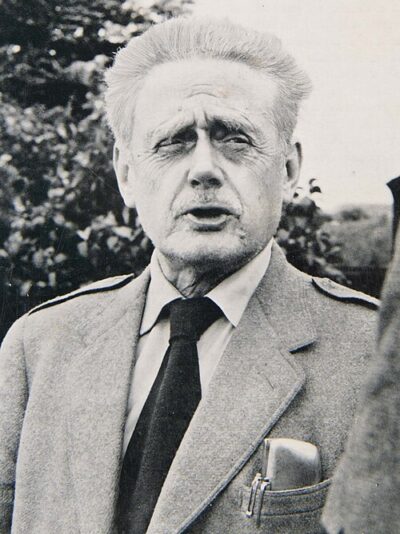
Hugh MacDiarmid
Hugh MacDiarmid was a Scottish poet, pen name of Christopher Murray Grieve. Born August 11, 1892, in Langholm. Died September 9, 1978, in Edinburgh. Known for A Drunk Man Looks at the Thistle. Educated at Edinburgh College of Art and Langholm Academy.
Facts
23 facts · 2 confirmed by two sources · 6 cited · 15 from one source
Where this comes from
Papalocal keeps its own record. It started from these sources; what each one said is kept here as it was copied, so a change on their side never changes this page by itself. Tap one to read its version.
What Wikidata says · copied November 17, 2026 · revision 2565963563
- Described as
- Scottish poet, pen name of Christopher Murray Grieve (1892–1978)
- Other names
- Grieve, Christopher Murray,, Christopher Murray Grieve
- Born
- August 11, 1892 · 9 references
- Died
- September 9, 1978 · 9 references
- Born in
- Langholm · 1 reference
- Died in
- Edinburgh · 1 reference
- Name at birth
- Christopher Murray Grieve
- Citizen of
- United Kingdom
- Occupation
- linguist; poet · 1 reference; politician; translator; journalist; writer · 1 reference; literary critic; biographer
- Political party
- Scottish National Party; National Party of Scotland; Communist Party of Great Britain
- Education
- Edinburgh College of Art; Langholm Academy
- Known for
- A Drunk Man Looks at the Thistle · 1 reference
- Spouse
- Valda Trevlyn Grieve · 1 reference
- Children
- Michael Grieve · 1 reference
- Military branch
- British Army
- Wikipedias with a page
- 26
Wikidata item Q981981 (wikidata.org/wiki/Q981981), public domain (CC0). Copied November 17, 2026.
What Wikipedia says · copied November 17, 2026 · revision 1378783291
Christopher Murray Grieve (11 August 1892 – 9 September 1978), best known by his pen name Hugh MacDiarmid ( mək-DUR-mid; Scots: [ˈhju məkˈdjɑrmɪd]), was a Scottish poet, journalist, essayist and political figure. He is considered one of the principal forces behind the Scottish Renaissance and has had a lasting impact on Scottish culture and politics. He was a founding member of the National Party of Scotland in 1928 but left in 1933 due to his Marxist–Leninist views. He joined the Communist Party of Great Britain the following year only to be expelled in 1938 for his nationalist sympathies. He subsequently stood as a parliamentary candidate for both the Scottish National Party (1945) and Communist Party of Great Britain (1964).
Grieve's earliest poetry was written in English, but he is best known for his use of "synthetic Scots", a literary version of the Scots language that he himself developed. From the early 1930s onwards MacDiarmid made greater use of English, sometimes a "synthetic English" that was supplemented by scientific and technical vocabularies.
The son of a postman, MacDiarmid was born in the Scottish border town of Langholm, Dumfriesshire. He was educated at Langholm Academy before becoming a teacher for a brief time at Broughton Higher Grade School in Edinburgh. He began his writing career as a journalist in Wales, contributing to the socialist newspaper The Merthyr Pioneer run by Labour party founder Keir Hardie before joining the Royal Army Medical Corps at the outbreak of the First World War. He served in Salonica, Greece and France before developing cerebral malaria and subsequently returning to Scotland in 1918. MacDiarmid's time in the army was influential in his political and artistic development.
After the war he continued to work as a journalist, living in Montrose where he became editor and reporter of the Montrose Review as well as a justice of the peace and a member of the county council. In 1923 his first book, Annals of the Five Senses, was published at his own expense, followed by Sangschaw in 1925, and Penny Wheep. A Drunk Man Looks at the Thistle, published in 1926, is generally regarded as MacDiarmid's most famous and influential work.
Moving to the Shetland island of Whalsay in 1933 with his son Michael and second wife, Valda Trevlyn, MacDiarmid continued to write essays and poetry and maintain an active correspondence with other intellectuals. He made visits to other parts of Scotland and in May 1934 George Elder Davie introduced him to the Gaelic poet Sorley MacLean in Rutherford's Bar in Drummond Street, Edinburgh. MacLean assisted MacDiarmid by translating seven Gaelic poems into English for his Golden Treasury of Scottish Poetry (1940).
In 1978, MacDiarmid give a reading at a celebration in East Kilbride to mark the 650th anniversary of the Declaration of Arbroath and attended the launch of the literary magazine The Chapman.
MacDiarmid died at his cottage Brownsbank, near Biggar, in 1978 at the age of 86.
As well as being a Scottish nationalist, MacDiarmid was, at different times in his life, a supporter of fascism, and Stalinism, views that often put him at acrimonious odds with his contemporaries. He rejected fascism in the 1930s as a result of developing international events. He was a founding member of the National Party of Scotland, forerunner to the modern Scottish National Party. He stood as a candidate for the Scottish National Party in 1945 and 1950, and for the Communist Party of Great Britain in 1964. In 1949, MacDiarmid's opinions led George Orwell to include his name in a list of "those who should not be trusted" to MI5. Today, MacDiarmid's work is credited with inspiring a new generation of writers. Fellow poet Edwin Morgan said of him: "Eccentric and often maddening genius he may be, but MacDiarmid has produced many works which, in the only test possible, go on haunting the mind and memory and casting Coleridgean seeds of insight and surprise."
- Born, in its opening lines
- August 11, 1892
- Died, in its opening lines
- September 9, 1978
From the Wikipedia article “Hugh MacDiarmid” (en.wikipedia.org/wiki/Hugh_MacDiarmid), by its contributors, under CC BY-SA 4.0 (creativecommons.org/licenses/by-sa/4.0/). Copied November 17, 2026; not changed.
Confirmed Two sources agree. Cited One source, and it names where it got it. One source One source, without a reference of its own. Sources disagree The sources disagree. We show the best-supported value and keep theirs below.
