
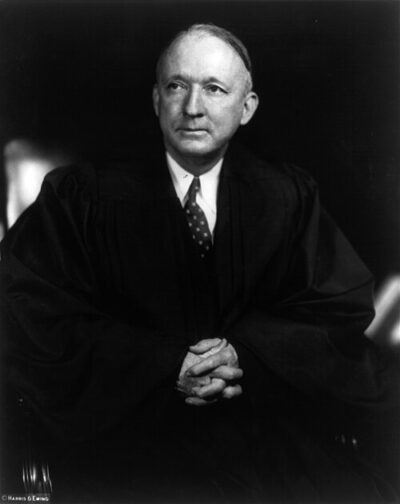
Hugo Black
Hugo Black was an U.S. Supreme Court justice. Born February 27, 1886, in Ashland. Died September 25, 1971, in Bethesda. Positions held include Associate Justice of the Supreme Court of the United States (1937–1971) and United States senator (1927–1937). Educated at University of Alabama School of Law.
Facts
24 facts · 2 confirmed by two sources · 4 cited · 18 from one source
Where this comes from
Papalocal keeps its own record. It started from these sources; what each one said is kept here as it was copied, so a change on their side never changes this page by itself. Tap one to read its version.
What Wikidata says · copied November 15, 2026 · revision 2565601938
- Described as
- U.S. Supreme Court justice (1886-1971)
- Other names
- Hugo L. Black, Hugo Lafayette Black
- Born
- February 27, 1886 · 4 references
- Died
- September 25, 1971 · 4 references
- Born in
- Ashland
- Died in
- Bethesda
- Buried in
- Arlington National Cemetery (1971) · 1 reference
- Cause of death
- stroke
- Name at birth
- Hugo Lafayette Black
- Citizen of
- United States
- Occupation
- politician; judge; lawyer; military personnel; jurist · 1 reference
- Positions held
- Associate Justice of the Supreme Court of the United States (1937–1971); United States senator (1927–1937) · 1 reference
- Political party
- Democratic Party
- Education
- University of Alabama School of Law
- Member of
- Ku Klux Klan
- Spouse
- Josephine Foster Black
- Children
- Hugo Black, Jr.; Sterling Foster Black
- Father
- William Lafayette Black · 1 reference
- Military branch
- United States Army
- Military rank
- captain
- Wikipedias with a page
- 26
Wikidata item Q459752 (wikidata.org/wiki/Q459752), public domain (CC0). Copied November 15, 2026.
What Wikipedia says · copied November 15, 2026 · revision 1373671073
Hugo Lafayette Black (February 27, 1886 – September 25, 1971) was an American lawyer, politician, and jurist who served as a U.S. Senator from Alabama from 1927 to 1937 and as an associate justice of the U.S. Supreme Court from 1937 to 1971. A member of the Democratic Party and a devoted New Dealer, Black endorsed Franklin D. Roosevelt in both the 1932 and 1936 presidential elections.
Early in his life, Black was a member of the revived Ku Klux Klan in the 1920s, espousing the group's largely anti-Catholic views. An article from the Pittsburgh Post-Gazette reported that he temporarily resigned from the Klan in 1925 to bolster his senatorial campaign, before quietly rejoining in 1926. In 1937, upon being appointed to the Supreme Court, Black said: "Before becoming a Senator I dropped the Klan. I have had nothing to do with it since that time. I abandoned it. I completely discontinued any association with the organization."
Black served as the secretary of the Senate Democratic Conference and the chair of the Senate Education Committee during his decade in the Senate. Having gained a reputation in the Senate as a reformer, Black was nominated to the Supreme Court by President Roosevelt and confirmed by the Senate by a vote of 63 to 16 (six Democratic Senators and ten Republican Senators voted against him). He was the first of nine Roosevelt appointees to the court, and he outlasted all except for William O. Douglas.
The sixth longest-serving justice in Supreme Court history, Black was one of the most influential Supreme Court justices in the 20th century. He is noted for using historical evidence to support textualist arguments, his position that the liberties guaranteed in the Bill of Rights were imposed on the states ("incorporated") by the Fourteenth Amendment, and his absolutist stance on the First Amendment, often declaring "No law [abridging the freedom of speech] means no law." Black expanded individual rights in his opinions in cases such as Gideon v. Wainwright, Engel v. Vitale, and Wesberry v. Sanders.
Black's views were not uniformly liberal. During World War II, he wrote the majority opinion in Korematsu v. United States (1944), which upheld the internment of Japanese Americans ordered by the president Franklin Roosevelt. During the mid-1960s, Black became slightly more conservative. Black opposed the doctrine of substantive due process (the pre-1937 Supreme Court's interpretation of this concept made it impossible for the government to enact legislation that conservatives claimed interfered with the freedom of business owners), and believed that there was no basis in the words of the Constitution for a right to privacy, voting against finding one in Griswold v. Connecticut (1965). He also took conservative positions in cases such as Shapiro v. Thompson, Goldberg v. Kelly, Tinker v. Des Moines, and Cohen v. California where he distinguished between "pure speech" and "expressive conduct".
- Born, in its opening lines
- February 27, 1886
- Died, in its opening lines
- September 25, 1971
From the Wikipedia article “Hugo Black” (en.wikipedia.org/wiki/Hugo_Black), by its contributors, under CC BY-SA 4.0 (creativecommons.org/licenses/by-sa/4.0/). Copied November 15, 2026; not changed.
Confirmed Two sources agree. Cited One source, and it names where it got it. One source One source, without a reference of its own. Sources disagree The sources disagree. We show the best-supported value and keep theirs below.
