
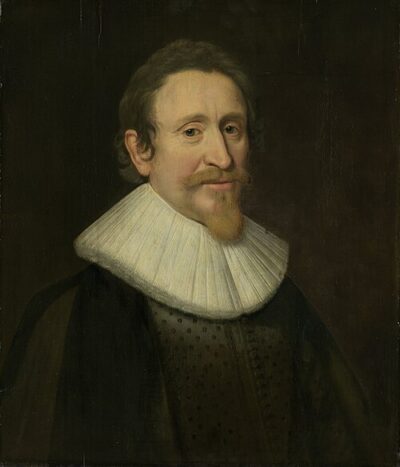
Hugo Grotius
Hugo Grotius was a Dutch jurist and scholar. Born April 10, 1583, in Delft. Died August 28, 1645, in Rostock. Positions held include ambassador and Pensionary (1613–1618). Educated at Leiden University.
Facts
28 facts · 2 confirmed by two sources · 12 cited · 14 from one source
Where this comes from
Papalocal keeps its own record. It started from these sources; what each one said is kept here as it was copied, so a change on their side never changes this page by itself. Tap one to read its version.
What Wikidata says · copied November 16, 2026 · revision 2569694529
- Described as
- Dutch jurist and scholar (1583-1645)
- Other names
- Huig van Groot, H. de Groot, Huigh de Groot, Grotius, Huig de Groot, Hugo de Groot
- Born
- April 10, 1583 · 14 references
- Died
- August 28, 1645 · 14 references
- Born in
- Delft · 3 references
- Died in
- Rostock · 3 references
- Buried in
- Nieuwe Kerk Delft
- Name at birth
- Hugo Grocio, Hugo Grotius eller Hugo de Groot
- Citizen of
- Dutch Republic
- Occupation
- poet; playwright; international law scholar; politician · 1 reference; diplomat; historian · 1 reference; philosopher · 1 reference; theologian · 1 reference
- Positions held
- ambassador; Pensionary (1613–1618) · 1 reference
- Education
- Leiden University
- Field
- international law; political philosophy; Christian theology
- Spouse
- Maria van Reigersberch (1608–1645) · 1 reference
- Children
- Cornelis de Groot; Pieter de Groot · 2 references
- Father
- Jan Cornets de Groot · 2 references
- Mother
- Aeltje van Overschie · 2 references
- Religion
- Arminianism; Remonstrants · 1 reference
- Wikipedias with a page
- 94
Wikidata item Q154959 (wikidata.org/wiki/Q154959), public domain (CC0). Copied November 16, 2026.
What Wikipedia says · copied November 16, 2026 · revision 1385566173
Hugo Grotius ( GROH-shee-əss; 10 April 1583 – 28 August 1645), also known as Hugo de Groot (Dutch: [ˈɦyɣoː də ˈɣroːt]) or Huig de Groot (Dutch: [ˈɦœyx də ˈɣroːt]), was a Dutch humanist, diplomat, lawyer, theologian, jurist, statesman, poet and playwright. A teenage prodigy, he was born in Delft and studied at Leiden University. He was imprisoned in Loevestein Castle for his involvement in the controversies over religious policy of the Dutch Republic, but escaped hidden in a chest of books that was regularly brought to him and was transported to Gorinchem. Grotius wrote most of his major works in exile in France.
Grotius was a major figure in the fields of philosophy, political theory and law during the 16th and 17th centuries. Along with the earlier works of Francisco de Vitoria and Alberico Gentili, his writings laid the foundations for international law. Two of his books have had a lasting impact in the field: De jure belli ac pacis (On the Law of War and Peace) dedicated to Louis XIII of France and the Mare Liberum (The Free Seas) for which Grotius has been called the "father of international law". Grotius has also contributed significantly to the evolution of the notion of rights. Before him, rights were, above all, perceived as attached to objects; after him, they are seen as belonging to persons, as the expression of an ability to act, or as a means of realizing something.
Peter Borschberg suggests that Grotius was significantly influenced by Francisco de Vitoria and the School of Salamanca in Spain, who supported the idea that the sovereignty of a nation does not lie simply in a ruler through God's will, but originates in its people, who agree to confer such authority upon a ruler. It is also thought that Grotius was not the first to formulate the international society doctrine, but he was one of the first to define expressly the idea of one society of states, governed not by force or warfare but by actual laws and mutual agreement to enforce those laws. As Hedley Bull declared in 1990: "The idea of international society which Grotius propounded was given concrete expression in the Peace of Westphalia, and Grotius may be considered the intellectual father of this first general peace settlement of modern times." Additionally, his contributions to Arminian theology helped provide the seeds for later Arminian-based movements, such as Methodism and Pentecostalism; Grotius is acknowledged as a significant figure in the Arminian–Calvinist debate. Because of his theological underpinning of free trade, he is also considered an "economic theologist".
After fading over time, the influence of Grotius's ideas revived in the 20th century following the First World War.
- Born, in its opening lines
- April 10, 1583
- Died, in its opening lines
- August 28, 1645
From the Wikipedia article “Hugo Grotius” (en.wikipedia.org/wiki/Hugo_Grotius), by its contributors, under CC BY-SA 4.0 (creativecommons.org/licenses/by-sa/4.0/). Copied November 16, 2026; not changed.
Confirmed Two sources agree. Cited One source, and it names where it got it. One source One source, without a reference of its own. Sources disagree The sources disagree. We show the best-supported value and keep theirs below.
