
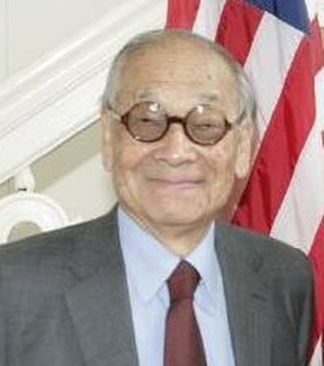
I. M. Pei
I. M. Pei was a Chinese-American architect. Born April 26, 1917, in Guangzhou. Died May 16, 2019, in New York City. Positions held include assistant professor. Known for Louvre Pyramid, Rock and Roll Hall of Fame and Bank of China Tower. Educated at Harvard Graduate School of Design and MIT School of Architecture and Planning. Awards include Pritzker Architecture Prize, National Medal of Arts and Royal Gold Medal.
Facts
47 facts · 2 confirmed by two sources · 16 cited · 29 from one source
Where this comes from
Papalocal keeps its own record. It started from these sources; what each one said is kept here as it was copied, so a change on their side never changes this page by itself. Tap one to read its version.
What Wikidata says · copied November 13, 2026 · revision 2568774742
- Described as
- Chinese-American architect (1917–2019)
- Other names
- I.M. Pei, Bèi Yù Míng, Yü-Ming Pei, Yuming Bei, Ieoh Ming Pei, Bei Yu Ming, IM Pei
- Born
- April 26, 1917 · 9 references
- Died
- May 16, 2019 · 8 references
- Born in
- Guangzhou · 1 reference
- Died in
- New York City · 1 reference
- Buried in
- Kensico Cemetery · 1 reference
- Name at birth
- 貝聿銘
- Citizen of
- United States; Taiwan
- Occupation
- architect · 1 reference
- Positions held
- assistant professor · 1 reference
- Worked for
- Webb and Knapp (1948–1955)
- Education
- Harvard Graduate School of Design; MIT School of Architecture and Planning; University of Pennsylvania
- Member of
- American Academy of Arts and Letters; Chinese Academy of Engineering; Royal Academy of Arts; American Academy of Arts and Sciences; Académie d'architecture · 1 reference; Committee of 100; Académie des beaux-arts
- Known for
- Louvre Pyramid; Rock and Roll Hall of Fame; Bank of China Tower; Mastercard International Global Headquarters; Luce Memorial Chapel · 1 reference; Bali Refuse Incineration Plant · 1 reference; The Garden Hotel, Guangzhou
- Awards
- Pritzker Architecture Prize (1983) · 1 reference; National Medal of Arts (1988); Royal Gold Medal (2010) · 1 reference; Presidential Medal of Freedom (1992) · 1 reference; Praemium Imperiale (1989) · 1 reference; Architecture Firm Award (1968); Library of Congress Living Legend (2000–) · 2 references; Officer of the Legion of Honour; Medal of Liberty (1986); honorary doctor of the University of Hong Kong; honorary doctor of the Tongji University (1994) · 1 reference; honorary doctor of the Chinese University of Hong Kong; Eugene McDermott Award in the Arts at MIT (1984) · 1 reference; Berliner Bär (1999); Great Immigrants Award (2006) · 1 reference
- Field
- architecture · 1 reference
- Spouse
- Eileen Loo
- Children
- Sandi Pei · 1 reference
- Father
- Tsuyee Pei
- Wikipedias with a page
- 94
Wikidata item Q46868 (wikidata.org/wiki/Q46868), public domain (CC0). Copied November 13, 2026.
What Wikipedia says · copied November 13, 2026 · revision 1372557855
Ieoh Ming Pei ( YOH ming PAY; Chinese: 貝聿銘; pinyin: Bèi Yùmíng; April 26, 1917 – May 16, 2019) was a Chinese-American architect.
Born in Guangzhou into a Chinese family, Pei drew inspiration at an early age from the garden villas at Suzhou, the traditional retreat of the scholar-gentry to which his family belonged. In 1935, he moved to the United States and enrolled in the University of Pennsylvania's architecture school, but quickly transferred to the Massachusetts Institute of Technology. Unhappy with the focus on Beaux-Arts architecture at both schools, he spent his free time researching emerging architects, especially Le Corbusier.
After graduating from MIT, Pei enrolled in the Harvard Graduate School of Design (GSD) where he befriended faculty members Walter Gropius and Marcel Breuer, both of whom had formerly taught at the Bauhaus. Beginning in 1948, Pei worked as an in-house architect for New York City real estate developer William Zeckendorf. In 1955, he established an independent design firm, I. M. Pei & Associates. In 1966, the firm was reorganized as I. M. Pei & Partners, and in 1989 reorganized
as Pei Cobb Freed & Partners. Pei retired from full-time practice in 1990. In his retirement, he worked as an architectural consultant primarily with his sons' architectural firm Pei Partnership Architects.
Pei's first major recognition came with the Mesa Laboratory at the National Center for Atmospheric Research in Colorado (designed in 1961, and completed in 1967). His new stature led to his selection as chief architect for the John F. Kennedy Library in Massachusetts. He went on to design Dallas City Hall and the East Building of the National Gallery of Art. He returned to China for the first time in 1975 to design a hotel at Fragrant Hills and, fifteen years later, designed Bank of China Tower, Hong Kong. In the early 1980s, Pei was the focus of controversy when he designed a glass-and-steel pyramid for the Louvre in Paris. He designed the Morton H. Meyerson Symphony Center in Dallas, the Miho Museum in Japan, Shigaraki, near Kyoto, and the chapel of the junior and high school: MIHO Institute of Aesthetics, the Suzhou Museum in Suzhou, Museum of Islamic Art in Qatar, and the Grand Duke Jean Museum of Modern Art in Luxembourg.
Pei won prizes and awards in the field of architecture, including the AIA Gold Medal in 1979, the first Praemium Imperiale for Architecture in 1989, and the Lifetime Achievement Award from the Cooper-Hewitt, National Design Museum, in 2003. In 1983, he won the Pritzker Prize, which is sometimes referred to as the Nobel Prize of architecture.
- Born, in its opening lines
- April 26, 1917
- Died, in its opening lines
- May 16, 2019
From the Wikipedia article “I. M. Pei” (en.wikipedia.org/wiki/I._M._Pei), by its contributors, under CC BY-SA 4.0 (creativecommons.org/licenses/by-sa/4.0/). Copied November 13, 2026; not changed.
Confirmed Two sources agree. Cited One source, and it names where it got it. One source One source, without a reference of its own. Sources disagree The sources disagree. We show the best-supported value and keep theirs below.
