
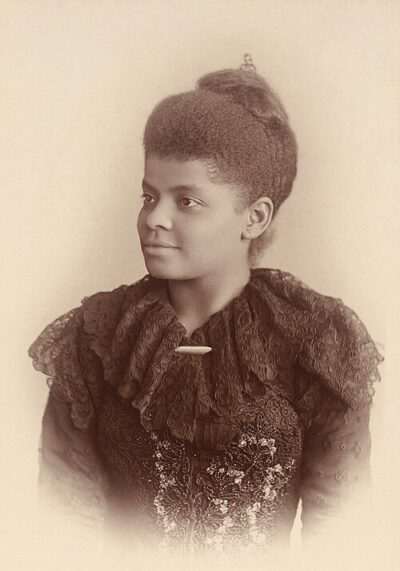
Ida B. Wells
Ida B. Wells was an American journalist and civil rights activist. Born July 16, 1862, in Holly Springs. Died March 25, 1931, in Chicago. Educated at Fisk University and Rust College. Awards include National Women's Hall of Fame, Chicago Women's Hall of Fame and National Association of Black Journalists Hall of Fame.
Facts
33 facts · 2 confirmed by two sources · 20 cited · 11 from one source
Where this comes from
Papalocal keeps its own record. It started from these sources; what each one said is kept here as it was copied, so a change on their side never changes this page by itself. Tap one to read its version.
What Wikidata says · copied November 13, 2026 · revision 2567381324
- Described as
- American journalist and civil rights activist (1862–1931)
- Other names
- Ida B. Wells-Barnett, Ida Wells-Barnett, Ida Bell Wells, Ida Bell Wells-Barnett, Ida Wells
- Born
- July 16, 1862 · 6 references
- Died
- March 25, 1931 · 6 references
- Born in
- Holly Springs · 1 reference
- Died in
- Chicago · 1 reference
- Buried in
- Oak Woods Cemetery · 1 reference
- Cause of death
- uremia · 1 reference
- Name at birth
- Ida Bell Wells
- Citizen of
- United States
- Occupation
- journalist · 2 references; sociologist; suffragist · 1 reference; writer · 2 references; human rights defender · 1 reference; newspaperperson · 1 reference; civil rights advocate · 2 references; lecturer · 1 reference
- Political party
- Republican Party
- Education
- Fisk University (1883–) · 1 reference; Rust College (1883–); LeMoyne–Owen College; Shaw University · 1 reference
- Member of
- NAACP · 1 reference; National Association of Colored Women's Clubs; National Afro-American Council; Negro Fellowship League · 1 reference; Alpha Suffrage Club · 1 reference
- Awards
- National Women's Hall of Fame (1988) · 1 reference; Chicago Women's Hall of Fame (1988) · 2 references; National Association of Black Journalists Hall of Fame (2004) · 1 reference; Pulitzer Prize Special Citations and Awards (2020) · 1 reference
- Field
- sociology
- Spouse
- Ferdinand Lee Barnett (1895–1931) · 2 references
- Children
- Alfreda Duster
- Wikipedias with a page
- 50
Wikidata item Q289428 (wikidata.org/wiki/Q289428), public domain (CC0). Copied November 13, 2026.
What Wikipedia says · copied November 13, 2026 · revision 1383944398
Ida Bell Wells-Barnett (July 16, 1862 – March 25, 1931) was an American investigative journalist, sociologist, educator, and early leader in the civil rights movement. She was one of the founders of the National Association for the Advancement of Colored People (NAACP). Wells dedicated her career to combating prejudice and violence, and advocating for African-American equality—especially for women.
Throughout the 1890s, Wells documented lynching of African-Americans in the United States in articles and through pamphlets such as Southern Horrors: Lynch Law in all its Phases and The Red Record, which debunked the fallacy frequently voiced by whites at the time – that all Black lynching victims were guilty of crimes. Wells exposed the brutality of lynching, and analyzed its sociology, arguing that whites used lynching to terrorize African Americans in the South because they represented economic and political competition—and thus a threat of loss of power—for whites. She aimed to demonstrate the truth about this violence and advocate for measures to stop it.
Wells was born into slavery in Holly Springs, Mississippi. She was freed as an infant under the Emancipation Proclamation, when Union Army troops captured Holly Springs. At the age of 16, she lost both her parents and her infant brother in the 1878 yellow fever epidemic. She got a job teaching and kept the rest of the family together with the help of her grandmother, later moving with some of her siblings to Memphis, Tennessee. Soon, Wells co-owned and wrote for the Memphis Free Speech and Headlight newspaper, where her reporting covered incidents of racial segregation and inequality. Eventually, her investigative journalism was carried nationally in Black-owned newspapers. Subjected to continued threats and criminal violence, including when a white mob destroyed her newspaper office and presses, Wells left Memphis for Chicago, Illinois. She married Ferdinand L. Barnett in 1895 and had a family while continuing her work writing, speaking, and organizing for civil rights and the women's movement for the rest of her life.
Wells was outspoken regarding her beliefs as a Black female activist and faced regular public disapproval, sometimes including from other leaders within the civil rights movement and the women's suffrage movement. She was active in women's rights and the women's suffrage movement, establishing several notable women's organizations. A skilled and persuasive speaker, Wells traveled nationally and internationally on lecture tours. Wells died on March 25, 1931, in Chicago, and in 2020 was posthumously honored with a Pulitzer Prize special citation "for her outstanding and courageous reporting on the horrific and vicious violence against African Americans during the era of lynching."
- Born, in its opening lines
- July 16, 1862
- Died, in its opening lines
- March 25, 1931
From the Wikipedia article “Ida B. Wells” (en.wikipedia.org/wiki/Ida_B._Wells), by its contributors, under CC BY-SA 4.0 (creativecommons.org/licenses/by-sa/4.0/). Copied November 13, 2026; not changed.
Confirmed Two sources agree. Cited One source, and it names where it got it. One source One source, without a reference of its own. Sources disagree The sources disagree. We show the best-supported value and keep theirs below.
