
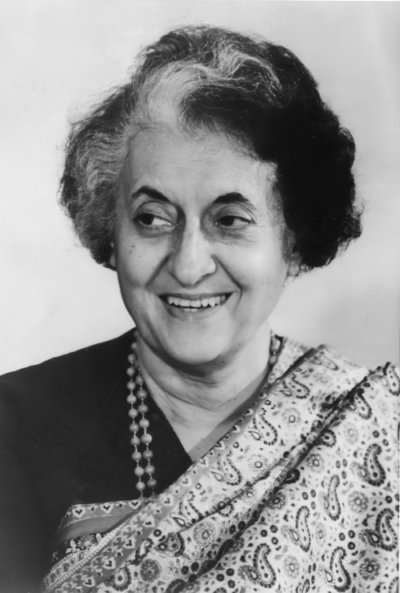
Indira Gandhi
Indira Gandhi was a Prime Minister of India (1966-1977; 1980-1984). Born November 19, 1917, in Prayagraj. Died October 31, 1984, in New Delhi. Positions held include Minister of External Affairs (2 times) (1967–1984), Prime Minister of India (2 times) (1966–1984) and Member of the Lok Sabha. Educated at Somerville College and Visva-Bharati University. Awards include honorary doctorate of Taras Shevchenko National University of Kyiv, honorary doctor of Waseda University and honorary citizen of Kyiv.
Facts
45 facts · 2 confirmed by two sources · 10 cited · 33 from one source
Where this comes from
Papalocal keeps its own record. It started from these sources; what each one said is kept here as it was copied, so a change on their side never changes this page by itself. Tap one to read its version.
What Wikidata says · copied November 16, 2026 · revision 2568852887
- Described as
- Prime Minister of India (1966-1977; 1980-1984)
- Other names
- Indira Feroze Gandhi, Indira Priyadarshini Nehru, Indira Ghandi, Gandhi Indira, Indira Nehru, Nehru Indira, indira Gandi, Indira Priyadarshini Gandhi
- Born
- November 19, 1917 · 12 references
- Died
- October 31, 1984 · 12 references
- Born in
- Prayagraj · 2 references
- Died in
- New Delhi · 1 reference
- Buried in
- Raj Ghat and associated memorials
- Cause of death
- gunshot wound
- Citizen of
- India (1950–); British Raj (–1947); Dominion of India (1947–1950)
- Occupation
- politician · 4 references; writer
- Positions held
- Minister of External Affairs (2 times) (1967–1984); Prime Minister of India (2 times) (1966–1984); Member of the Lok Sabha; member of Rajya Sabha (1964–1984); Minister of Defence (2 times) (1975–1982); Minister of Home Affairs (1970–1973); Minister of Finance (1969–1970); Minister of Information and Broadcasting (1964–1966); Member of the 7th Lok Sabha
- Political party
- Indian National Congress
- Education
- Somerville College (1937–); Visva-Bharati University; Badminton School; Patha Bhavana
- Member of
- National Flag Presentation Committee (1947) · 1 reference
- Awards
- honorary doctorate of Taras Shevchenko National University of Kyiv; honorary doctor of Waseda University; honorary citizen of Kyiv · 1 reference; Order of the Rose · 1 reference; Bharat Ratna (1971); honorary doctor of the Sorbonne Nouvelle University (1981) · 3 references; Gold Olympic Order (1983) · 1 reference; Lenin Peace Prize (1984); Jawaharlal Nehru Award for International Understanding (1984) · 1 reference; Order of José Martí (1985) · 1 reference
- Field
- politics · 1 reference
- Spouse
- Feroze Gandhi (1942–1960)
- Children
- Rajiv Gandhi · 1 reference; Sanjay Gandhi · 1 reference
- Father
- Jawaharlal Nehru · 2 references
- Mother
- Kamala Nehru
- Religion
- Hinduism
- Lived in
- New Delhi; Raebareli
- Wikipedias with a page
- 174
Wikidata item Q1149 (wikidata.org/wiki/Q1149), public domain (CC0). Copied November 16, 2026.
What Wikipedia says · copied November 16, 2026 · revision 1385938538
Indira Priyadarshini Gandhi (née Nehru; 19 November 1917 – 31 October 1984) was an Indian stateswoman who twice served as the Prime Minister of India from 1966 to 1977 and again from 1980 until her assassination in 1984. She was India's first and only female prime minister, and a central figure in Indian politics as the leader of the Indian National Congress (INC). Gandhi also served as chairperson of the Non-Aligned Movement (NAM) from 1983 to 1984, becoming the first Indian to hold the position. She was the daughter of Jawaharlal Nehru, the first prime minister of India, and the mother of Rajiv Gandhi, who succeeded her as prime minister.
Gandhi was married to Feroze Gandhi, a Member of Parliament, with whom she had two sons, Rajiv Gandhi and Sanjay Gandhi. During her father Jawaharlal Nehru's premiership from 1947 to 1964, Gandhi was his hostess and accompanied him on his numerous foreign trips. In 1959, she played a part in the dissolution of the communist-led Kerala state government as then-president of the Indian National Congress, otherwise a ceremonial position to which she was elected earlier that year. Lal Bahadur Shastri, who had succeeded Nehru as prime minister upon his death in 1964, appointed her minister of information and broadcasting in his government; the same year she was elected to the Rajya Sabha, the upper house of the Indian Parliament. After Shastri's death in January 1966, Gandhi defeated her rival, Morarji Desai, in the INC's parliamentary leadership election to become leader and also succeeded Shastri as prime minister. With her premiership of India she became the world's second female prime minister after her Sri Lankan counterpart Sirimavo Bandaranaike. She led the Congress to a majority in the 1967 Indian general election, in which she was first elected to the lower house of the Indian parliament, the Lok Sabha, from Rae Bareli, in Uttar Pradesh. In 1969, the INC expelled Gandhi from the party in a dispute over government policy and party discipline. Gandhi and her supporters formed a new party, the INC (R), which formed India's first coalition government. In the 1971 Indian general election, the INC (R) won a landslide victory, focusing on issues such as poverty.
As prime minister, Gandhi was known for her uncompromising political stances and centralisation of power within the executive branch. In 1967, she headed a military conflict with China in which India repelled Chinese incursions into Sikkim, an Indian protectorate in the Himalayas. In the same year, the Naxalbari uprising in West Bengal was suppressed. In 1971, she went to war with Pakistan in support of the independence movement and war of independence in East Pakistan, which resulted in an Indian victory, the end of the Bangladeshi genocide, and the independence of Bangladesh, as well as an increase in India's influence to the point where it became the sole regional power in South Asia. The end of East Pakistan weakened the Insurgency in North-East India. In 1975, Sikkim joined the Indian Union. The same year, Kashmiri separatists had to agree to an accord establishing special autonomous status for Kashmir in return for dropping long-standing demands for a plebiscite. Jammu and Kashmir became a constituent unit of India. Another military operation against Pakistan, codenamed Operation Meghdoot, occurred during her tenure in 1984, which led to India expanding the territory it effectively controlled in the disputed Kashmir region.
Gandhi's rule saw India grow closer to the Soviet Union by signing a friendship treaty in 1971 to ward off the perceived geopolitical threat of the alliance between the United States and Pakistan. India received military, financial, and diplomatic support from the Soviet Union during its conflict with Pakistan in the same year. Though India was at the forefront of the Non-Aligned Movement, Gandhi made it one of the Soviet Union's closest allies in Asia, each often supporting the other at the United Nations and in proxy wars in Vietnam, Cambodia, and Afghanistan. Gandhi played a crucial role in initialising India's first successful nuclear weapon test in 1974, codenamed 'Smiling Buddha', a year after the United States and the People's Republic of China had established friendly relations, in 1973.
Responding to the verdict on State of Uttar Pradesh v. Raj Narain, and citing powers to tackle "internal disturbance" under Article 352 of the Constitution, Gandhi instituted a state of emergency from 1975 to 1977, during which she ruled by decree and basic civil liberties were suspended. More than 100,000 political opponents, journalists and dissenters were imprisoned. Following the Emergency, the INC lost the 1977 Indian general election in the midst of anti-incumbency sentiment in North India — the first such loss for the INC in the history of the Republic of India. She lost her own parliamentary constituency, Rae Bareli, albeit the INC swept the seats in South India and North-East India. She withdrew her membership of INC (R) and was publicly persecuted by the ruling Janata Party government for implementing and directing the Emergency. However, she gained parliamentary immunity by winning the Chikmagalur by-election in Karnataka in 1978. The same year, Gandhi and her supporters formed a new political party, the INC (I). Due to her public perception as a strong leader, public sympathy over her prosecution by the Janata Party government, and the weak governance of the Janata Party ministers, the Congress (I) won the 1980 Indian general election by a landslide and Gandhi returned to the premiership. She represented Medak, then in Andhra Pradesh, from 1980 to 1984.
As Prime Minister starting in 1980, Gandhi implemented economic reforms which led to India's fastest GDP growth in its history up till that date, averaging 5.7% for the decade. This was a departure from the so-called Hindu rate of growth in which India grew 3.5% annually from the 1950s to the 1970s. Her second son, Sanjay Gandhi, who was Congress (I) General Secretary, died in an aviation accident in June 1980. Gandhi faced also the Sikh separatist movement throughout her fourth premiership; in response, she ordered Operation Blue Star, which involved military action in the Golden Temple and killed hundreds of Sikhs. On 31 October 1984, she was assassinated by two of her bodyguards, both of whom were Sikh nationalists seeking retribution for the events at the temple. Her death was the trigger for the 1984 Anti-Sikh Riots in the nation's capital, Delhi. Her cumulative tenure of 15 years and 350 days, spanning four terms, makes her the second-longest-serving Indian prime minister after her father and the longest-serving female head of government at the time of her death.
Gandhi was cremated at the site now known as Shakti Sthal (transl. 'Place of strength'). The site is marked by a large monolithic rock of iron ore commemorating her as the "Iron Lady of India". Gandhi is remembered as one of the most powerful women in the world. Her supporters cite her leadership during victories over geopolitical rivals China and Pakistan, the Green Revolution, a growing economy in the early 1980s, and her anti-poverty campaign that led her to be known as Mother Indira among the country's poor and rural population. Critics note her cult of personality and authoritarian rule of India during the Emergency. In 1999, she was named "Woman of the Millennium" in an online poll organised by the BBC. In 2020, she was named by Time magazine among the 100 women who defined the past century as counterparts to the magazine's previous choices for Man of the Year.
- Born, in its opening lines
- November 19, 1917
- Died, in its opening lines
- October 31, 1984
From the Wikipedia article “Indira Gandhi” (en.wikipedia.org/wiki/Indira_Gandhi), by its contributors, under CC BY-SA 4.0 (creativecommons.org/licenses/by-sa/4.0/). Copied November 16, 2026; not changed.
Confirmed Two sources agree. Cited One source, and it names where it got it. One source One source, without a reference of its own. Sources disagree The sources disagree. We show the best-supported value and keep theirs below.
