
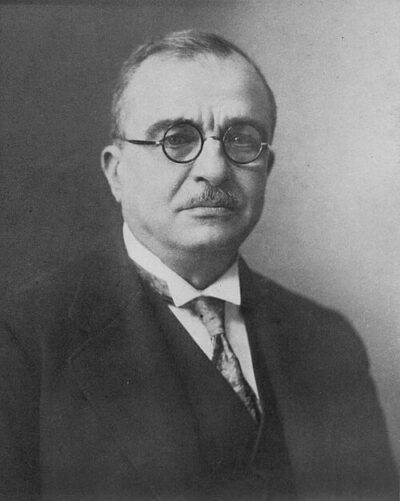
Ioannis Metaxas
Ioannis Metaxas was a Greek military officer and politician. Born April 12, 1871, in Vathy. Died January 29, 1941, in Kifisia. Positions held include Prime Minister of Greece (1936–1941), Greek Minister of the Interior and Minister of Military Affairs of Greece (1936–1941). Awards include Order of the Redeemer.
Facts
27 facts · 2 confirmed by two sources · 4 cited · 21 from one source
Where this comes from
Papalocal keeps its own record. It started from these sources; what each one said is kept here as it was copied, so a change on their side never changes this page by itself. Tap one to read its version.
What Wikidata says · copied November 16, 2026 · revision 2562811338
- Described as
- Greek military officer and politician (1871–1941)
- Other names
- İoannis Metaksas, Ioannis Metaksas
- Born
- April 12, 1871 · 2 references
- Died
- January 29, 1941 · 5 references
- Born in
- Vathy · 1 reference
- Died in
- Kifisia · 3 references
- Cause of death
- infectious disease
- Citizen of
- Greece
- Occupation
- politician · 1 reference; military officer; military personnel; diplomat
- Positions held
- Prime Minister of Greece (1936–1941); Greek Minister of the Interior; Minister of Military Affairs of Greece (1936–1941); Transport Minister of Greece; Deputy Prime Minister of Greece; member of the Hellenic Parliament; Chief of the Hellenic Army General Staff (1915); ambassador
- Political party
- Freethinkers' Party
- Awards
- Order of the Redeemer (1913)
- Spouse
- Lela Jatzioannou (1909–1941)
- Children
- Nana Metaxas; Loukia Metaxas
- Religion
- Eastern Orthodox Church
- Military branch
- Hellenic Army · 1 reference
- Military rank
- general · 1 reference
- Website
- http://www.ioannismetaxas.gr/
- Wikipedias with a page
- 51
Wikidata item Q189139 (wikidata.org/wiki/Q189139), public domain (CC0). Copied November 16, 2026.
What Wikipedia says · copied November 16, 2026 · revision 1384691816
Ioannis Metaxas (Greek: Ιωάννης Μεταξάς; 12 April 1871 – 29 January 1941) was a Greek general and statesman who was the prime minister of Greece from 1936 until his death in 1941. He governed constitutionally for the first four months of his tenure, and thereafter as the strongman leader of the 4th of August Regime, following his appointment by King George II.
Born to an aristocratic family in Ithaca, Metaxas took part in the Greco-Turkish War of 1897 and the Balkan Wars (1912–13), and quickly rose through the ranks of the Hellenic Army. As a monarchist during the National Schism, Metaxas unsuccessfully opposed Prime Minister Eleftherios Venizelos and Greece's entry in World War I, most famously leading monarchist forces during the Noemvriana. He was exiled to Corsica in response in 1917. On his return, Metaxas moved into politics and founded the Freethinkers' Party, but had only limited success under the Second Hellenic Republic.
Metaxas was appointed prime minister in April 1936, a year after the Greek monarchy was restored. With the support of King George II, Metaxas initiated a self-coup and established an authoritarian, nationalist, and anti-communist regime, which Metaxas himself and some historians called totalitarian. The ideology and system associated with his rule, Metaxism, has been described as a form of fascism, a conventional authoritarian-conservative dictatorship, or a regime with a strong fascist component.
On 28 October 1940, Metaxas rejected an ultimatum imposed by the Italians to surrender, committing Greece to the Allies and bringing the country into World War II. He died in January 1941 during the Greco–Italian War from a bloodstream infection, before the German invasion and subsequent fall of Greece.
- Born, in its opening lines
- April 12, 1871
- Died, in its opening lines
- January 29, 1941
From the Wikipedia article “Ioannis Metaxas” (en.wikipedia.org/wiki/Ioannis_Metaxas), by its contributors, under CC BY-SA 4.0 (creativecommons.org/licenses/by-sa/4.0/). Copied November 16, 2026; not changed.
Confirmed Two sources agree. Cited One source, and it names where it got it. One source One source, without a reference of its own. Sources disagree The sources disagree. We show the best-supported value and keep theirs below.
