
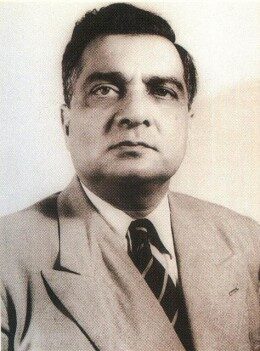
Iskandar Ali Mirza
Iskandar Ali Mirza was a Pakistani politician, statesman and military general. Born November 13, 1899, in Murshidabad. Died November 13, 1969, in London. Positions held include Governor-General of Pakistan (1955–1956), Defence Secretary of Pakistan (1947–1954) and President of Pakistan (1956–1958). Educated at Elphinstone College and University of Mumbai. Awards include Officer of the Order of the British Empire, Companion of the Order of the Indian Empire and King George VI Coronation Medal.
Facts
26 facts · 2 confirmed by two sources · 2 cited · 22 from one source
Where this comes from
Papalocal keeps its own record. It started from these sources; what each one said is kept here as it was copied, so a change on their side never changes this page by itself. Tap one to read its version.
What Wikidata says · copied November 16, 2026 · revision 2563056428
- Described as
- Pakistani politician, statesman and military general (1899–1969)
- Born
- November 13, 1899 · 1 reference
- Died
- November 13, 1969 · 1 reference
- Born in
- Murshidabad
- Died in
- London
- Buried in
- Tehran · 1 reference
- Cause of death
- cardiac arrest
- Citizen of
- British Raj; Pakistan
- Occupation
- politician
- Positions held
- Governor-General of Pakistan (1955–1956); Defence Secretary of Pakistan (1947–1954); President of Pakistan (1956–1958); defence minister; Federal Minister for Interior (1954–1955) · 1 reference
- Political party
- Republican Party
- Education
- Elphinstone College; University of Mumbai; Royal Military College, Sandhurst
- Awards
- Officer of the Order of the British Empire (1939) · 1 reference; Companion of the Order of the Indian Empire; King George VI Coronation Medal; Queen Elizabeth II Coronation Medal; Collar of the Spanish Order of the Civil Merit (1957) · 1 reference
- Spouse
- Nahid Mirza · 1 reference
- Religion
- Sunni Islam
- Military rank
- general
- Wikipedias with a page
- 55
Wikidata item Q155111 (wikidata.org/wiki/Q155111), public domain (CC0). Copied November 16, 2026.
What Wikipedia says · copied November 16, 2026 · revision 1379311091
Iskander Ali Mirza (13 November 1899 – 13 November 1969) was a Pakistani politician and military general who served as the fourth and last governor-general of Pakistan from 1955 to 1956, and as the first president of Pakistan from promulgation of the constitution in 1956 till his overthrow in a coup d'état in 1958. Declaring martial law and unilaterally abrogating the constitution on 7 October 1958, he appointed Ayub Khan as Chief Martial Law Administrator who later overthrew Mirza on 27 October 1958 and assumed the presidency.
Mirza was educated at the University of Bombay before attending the Royal Military College, Sandhurst. After military service in the British Indian Army, he joined the Indian Political Service and spent the most of his career as a political agent in the Western region of British India until elevated as Joint Secretary to the Government of India at the Ministry of Defence in New Delhi in 1946. Following the independence of Pakistan in 1947 as a result of the Partition of British India, Mirza was appointed the first Defence Secretary by prime minister Liaquat Ali Khan, only to oversee the military efforts in the first war with India in 1947, followed by the failed secession in Balochistan in 1948. In 1954, he was appointed the Governor of his home province of East Bengal by Prime Minister Mohammad Ali Bogra to control the law and order situation sparked by the popular language movement in 1952, but was later elevated as Interior Minister in the Bogra administration in 1955.
Playing a crucial role in the ousting of Governor-General Malik Ghulam Muhammad, Mirza assumed his position in 1955 and was elected as the first President of Pakistan when the first Constitution was promulgated in 1956. His presidency, however, was marked with political instability which saw his unconstitutional interferences in the civilian administration that led to the dismissal of four prime ministers in a mere two years. Facing challenges in getting the political endorsements and reelection for the presidency, Mirza surprisingly suspended the writ of the Constitution by imposing martial law against his own party's administration governed by Prime Minister Feroz Khan Noon on 8 October 1958, enforcing it through his army commander General Ayub Khan. Three weeks later, General Ayub ousted President Mirza when the situation between them escalated and sent him into exile. Mirza lived in the United Kingdom for the remainder of his life and was buried in Iran in 1969.
His legacy and image are viewed negatively by some Pakistani historians who believe that Mirza was responsible for weakening democracy and causing political instability in the country.
- Born, in its opening lines
- November 13, 1899
- Died, in its opening lines
- November 13, 1969
From the Wikipedia article “Iskander Mirza” (en.wikipedia.org/wiki/Iskander_Mirza), by its contributors, under CC BY-SA 4.0 (creativecommons.org/licenses/by-sa/4.0/). Copied November 16, 2026; not changed.
Confirmed Two sources agree. Cited One source, and it names where it got it. One source One source, without a reference of its own. Sources disagree The sources disagree. We show the best-supported value and keep theirs below.
