
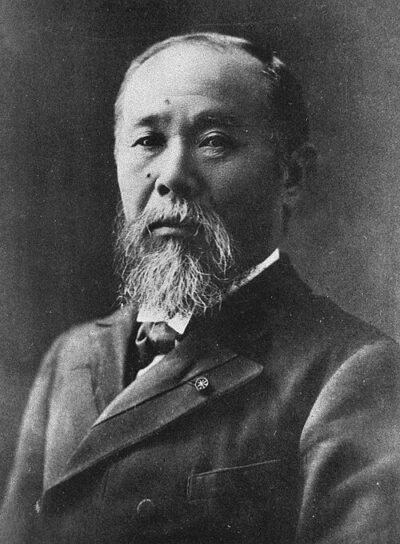
Itō Hirobumi
Itō Hirobumi was the 1st, 5th, 7th and 10th Prime Minister of Japan. Born October 16, 1841, in Tsukari. Died October 26, 1909, in Harbin railway station. Positions held include Prime Minister of Japan (4 times) (1885–1901), Lord of Home Affairs (2 times) (1874–1880) and member of the House of Peers. Known for Kokuze Kōmoku. Educated at University College London and Shōkasonjuku Academy. Awards include Grand Cross of the Legion of Honour, Knight of the Order of St. Alexander Nevsky and Knight Grand Cross of the Order of the Bath.
Facts
43 facts · 2 confirmed by two sources · 5 cited · 36 from one source
Where this comes from
Papalocal keeps its own record. It started from these sources; what each one said is kept here as it was copied, so a change on their side never changes this page by itself. Tap one to read its version.
What Wikidata says · copied November 16, 2026 · revision 2564346317
- Described as
- 1st, 5th, 7th and 10th Prime Minister of Japan (1841–1909)
- Other names
- Hayashi Risuke, Shunpo, Shunsuke, Sōrōkakushujin
- Born
- October 16, 1841 · 3 references
- Died
- October 26, 1909 · 5 references
- Born in
- Tsukari · 1 reference
- Died in
- Harbin railway station
- Buried in
- Nishiōi
- Cause of death
- gunshot wound
- Name at birth
- 林利助
- Citizen of
- Japan
- Occupation
- politician · 1 reference; diplomat
- Positions held
- Prime Minister of Japan (4 times) (1885–1901) · 1 reference; Lord of Home Affairs (2 times) (1874–1880) · 1 reference; member of the House of Peers; governor of Hyōgo Prefecture (1868–1869); Chairman of the Privy Council of Japan
- Political party
- Rikken Seiyūkai
- Education
- University College London; Shōkasonjuku Academy
- Known for
- Kokuze Kōmoku
- Awards
- Grand Cross of the Legion of Honour (1898); Knight of the Order of St. Alexander Nevsky; Knight Grand Cross of the Order of the Bath (1902) · 1 reference; Order of the Rising Sun, 1st class; Order of the Rising Sun with Paulownia Flowers, 1st class; Grand Cordon of the Supreme Order of the Chrysanthemum (1906) · 1 reference; Knight of the Order of the Most Holy Annunciation; Collar of the Supreme Order of the Chrysanthemum (1895) · 1 reference; Grand Cross of the Order of Charles III (1896) · 1 reference; Order of the Red Eagle · 1 reference; Order of the Iron Crown (Kingdom of Italy) · 1 reference; Grand Cordon of the Order of Leopold (1897); Royal Order of Vasa · 1 reference; Knight Grand Cross of the Order of Saints Maurice and Lazarus · 1 reference; Knight grand cross of the order of the crown of Italy · 1 reference
- Spouse
- Itō Umeko; Sumiko Ito
- Children
- Itō Bunkichi; Ikuko Suematsu; Asako Nishi
- Father
- Itō Jūzō · 1 reference
- Religion
- Shinto; Rinzai school
- Lived in
- Sōrōkaku
- Wikipedias with a page
- 73
Wikidata item Q174971 (wikidata.org/wiki/Q174971), public domain (CC0). Copied November 16, 2026.
What Wikipedia says · copied November 16, 2026 · revision 1369376190
Prince Itō Hirobumi (Japanese: 伊藤 博文 [i.toː (|) çi.ɾoꜜ.bɯ.mʲi]; born Hayashi Risuke (林 利助); 16 October 1841 – 26 October 1909) was a Japanese statesman who served as the first prime minister of Japan from 1885 to 1888. Itō held office again as prime minister three times between 1892 and 1901. He was also a member of the genrō, a group of senior statesmen who effectively dictated policy for the Empire of Japan during the Meiji era. A key figure in the making of modern Japan, Itō played a central role in the drafting of the 1889 Meiji Constitution as well as the establishment of the National Diet and Japanese cabinet system.
Born into a poor farming family in the Chōshū Domain, Itō Hirobumi and his father were adopted into a low-ranking samurai family. After the opening of Japan in 1854, he joined the nationalist sonnō jōi movement before being sent to England in 1863 to study at University College London. Following the Meiji Restoration of 1868, Itō was appointed a junior councilor for foreign affairs in the newly formed Empire of Japan. Later in 1870, he traveled to the United States to study Western currency, and subsequently helped establish Japan's modern banking and taxation systems. Itō then set off on another overseas trip with the Iwakura Mission to the U.S. and Europe. Upon his return to Japan in 1873, he became a full councilor and public works minister.
By the early 1880s, Itō emerged as the de facto leader of the Meiji oligarchy. In 1881, he was officially entrusted with overseeing the drafting of the Meiji Constitution. After traveling to Europe to study its nations' political systems, Itō settled on adopting a constitution emulating that of Prussia by reserving considerable power with the emperor while limiting political parties' involvement in government. In 1885, he replaced the Daijō-kan with a cabinet composed of ministry heads, and became Japan's first prime minister. After the Meiji Constitution was drafted in 1888, he established a supra-cabinet Privy Council led by himself to review it before its official promulgation in 1889. Even out of office as prime minister, Itō continued to exert significant influence on government policy as an imperial adviser, or genkun, and as President of the Privy Council. In 1900, he founded the Rikken Seiyūkai political party as party politics grew more prominent in the Diet.
On the world stage, Itō pursued an active foreign policy. He strengthened diplomatic ties with Western powers including Germany, the United States, and especially the United Kingdom. In Asia, he oversaw the First Sino-Japanese War and negotiated the surrender of China's ruling Qing dynasty on terms favorable to Japan, including the annexation of Taiwan and the release of Korea from the Chinese tributary system. After the Russo-Japanese War, the ensuing Japan–Korea Treaty of 1905 made Itō the first Resident-General of Korea. Despite initially supporting a protectorate rather than outright annexation of Korea, pressure from the Imperial Japanese Army leadership and the failure of his gradualist approach contributed to his support for annexation. Itō resigned as Resident-General in June 1909 only to be assassinated four months later by Korean-independence activist and nationalist An Jung-geun in Harbin, Manchuria.
- Born, in its opening lines
- October 16, 1841
- Died, in its opening lines
- October 26, 1909
From the Wikipedia article “Itō Hirobumi” (en.wikipedia.org/wiki/Itō_Hirobumi), by its contributors, under CC BY-SA 4.0 (creativecommons.org/licenses/by-sa/4.0/). Copied November 16, 2026; not changed.
Confirmed Two sources agree. Cited One source, and it names where it got it. One source One source, without a reference of its own. Sources disagree The sources disagree. We show the best-supported value and keep theirs below.
