
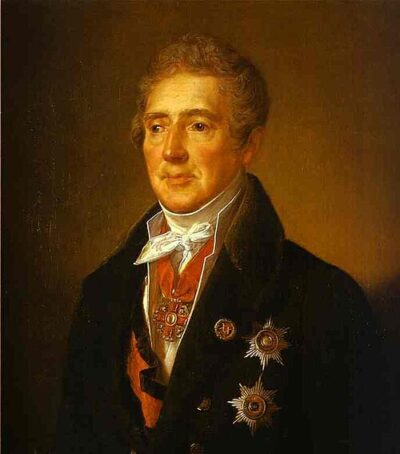
Ivan Dmitriev
Ivan Dmitriev was a Russian writer and politician. Born September 10, 1760, in Troitskoe. Died October 3, 1837, in Moscow. Positions held include member of the State Council of the Russian Empire. Awards include Order of Saint Anna, 1st class, Order of St. Vladimir, 1st class and Order of Saint Alexander Nevsky.
Facts
20 facts · 0 confirmed by two sources · 5 cited · 13 from one source · 2 where the sources disagree
What’s different
- Born: we show September 10, 1760 (Sources disagree). Wikipedia says September 21, 1760
- Died: we show October 3, 1837 (Sources disagree). Wikipedia says October 15, 1837
Where this comes from
Papalocal keeps its own record. It started from these sources; what each one said is kept here as it was copied, so a change on their side never changes this page by itself. Tap one to read its version.
What Wikidata says · copied November 18, 2026 · revision 2571589140
- Described as
- Russian writer and politician
- Other names
- Ivan Ivanovich Dmitriev
- Born
- September 10, 1760 · 4 references
- Died
- October 3, 1837 · 4 references
- Born in
- Troitskoe
- Died in
- Moscow · 3 references
- Buried in
- New Donskoe cemetery
- Citizen of
- Russian Empire
- Occupation
- statesperson · 1 reference; poet · 2 references; translator · 1 reference; writer · 2 references; fabulist · 1 reference
- Positions held
- member of the State Council of the Russian Empire
- Genre
- Sentimentalism · 1 reference
- Awards
- Order of Saint Anna, 1st class (1806) · 1 reference; Order of St. Vladimir, 1st class (1819) · 2 references; Order of Saint Alexander Nevsky (1809) · 1 reference; Order of Saint Anna, 2nd class · 1 reference
- Father
- Ivan Gavrilovič Dmitriev
- Mother
- Ekaterina Afanas'evna Beketova
- Siblings
- Aleksandr Dmitriyev · 2 references
- Wikipedias with a page
- 20
Wikidata item Q2564168 (wikidata.org/wiki/Q2564168), public domain (CC0). Copied November 18, 2026.
What Wikipedia says · copied November 18, 2026 · revision 1375167175
Ivan Ivanovich Dmitriev (Russian: Ива́н Ива́нович Дми́триев, IPA: [ɪˈvan ɨˈvanəvʲɪdʑ ˈdmʲitrʲɪjɪf] ; 21 September [O.S. 10 September] 1760 – 15 October [O.S. 3 October] 1837) was a Russian statesman. He was also a poet associated with the sentimentalist movement in Russian literature.
Dmitriev was born at his father's estate in the government of Simbirsk. In consequence of the revolt of Yemelyan Pugachev, the family had to flee to Saint Petersburg, and there Ivan was entered at the school of the Semenov Guards, and afterwards obtained a post in the military service. On the accession of Paul I to the imperial throne, he quit the army with the rank of colonel; and his appointment as procurator for the senate was soon after renounced for the position of privy councillor.
During the four years from 1810 to 1814 he served as minister of justice under the Emperor Alexander I; but at the close of this period he retired into private life, and though he lived more than twenty years, he never again took office, but occupied himself with his literary labors and the collection of books and works of art.
In the matter of language he sided with Karamsin, and did good service by his own pen against the Old Slavonic party. His poems include songs, odes, satires, tales, epistles, and others, as well as the fables—partly original and partly translated from La Fontaine, Florian and Arnault—on which his fame chiefly rests. Several of his lyrics have become thoroughly popular from the readiness with which they can be sung; and a short dramatico-epic poem on Yermak, the Cossack conqueror of Siberia, is well known.
His writings occupy three volumes in the first five editions; in the 6th (Saint Petersburg, 1823) there are only two. His memoirs, to which he devoted the last years of his life, were published at Moscow in 1866.
- Born, in its opening lines
- September 21, 1760
- Died, in its opening lines
- October 15, 1837
From the Wikipedia article “Ivan Dmitriev” (en.wikipedia.org/wiki/Ivan_Dmitriev), by its contributors, under CC BY-SA 4.0 (creativecommons.org/licenses/by-sa/4.0/). Copied November 18, 2026; not changed.
Confirmed Two sources agree. Cited One source, and it names where it got it. One source One source, without a reference of its own. Sources disagree The sources disagree. We show the best-supported value and keep theirs below.
