
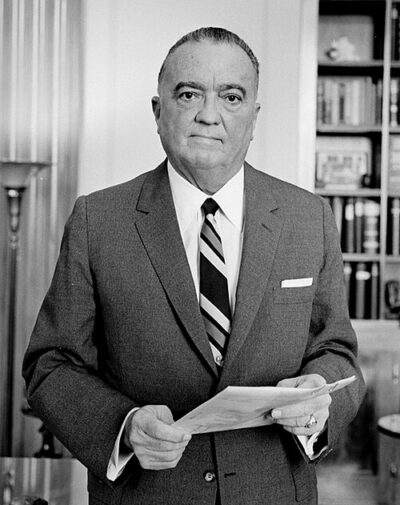
J. Edgar Hoover
J. Edgar Hoover was an American law enforcement administrator. Born January 1, 1895, in Washington, D.C.. Died May 2, 1972, in Washington, D.C.. Positions held include Director of the Federal Bureau of Investigation (1935–1972) and Chief of the Bureau of Investigation (1924–1935). Educated at Georgetown University and George Washington University. Awards include Knight Commander of the Order of the British Empire, NAS Public Welfare Medal and James Cardinal Gibbons Medal.
Facts
28 facts · 2 confirmed by two sources · 6 cited · 20 from one source
Where this comes from
Papalocal keeps its own record. It started from these sources; what each one said is kept here as it was copied, so a change on their side never changes this page by itself. Tap one to read its version.
What Wikidata says · copied November 13, 2026 · revision 2567359380
- Described as
- American law enforcement administrator (1895–1972)
- Other names
- John Edgar Hoover
- Born
- January 1, 1895 · 8 references
- Died
- May 2, 1972 · 8 references
- Born in
- Washington, D.C. · 3 references
- Died in
- Washington, D.C. · 2 references
- Buried in
- Congressional Cemetery
- Cause of death
- respiratory failure
- Name at birth
- John Edgar Hoover
- Citizen of
- United States
- Occupation
- military officer; politician; lawyer · 1 reference; librarian · 1 reference; screenwriter · 1 reference; jurist · 1 reference; police officer · 1 reference
- Positions held
- Director of the Federal Bureau of Investigation (1935–1972); Chief of the Bureau of Investigation (1924–1935)
- Political party
- independent politician · 1 reference
- Worked for
- Library of Congress; United States Department of Justice (1917–)
- Education
- Georgetown University; George Washington University; George Washington University Law School; Cardozo Education Campus
- Awards
- Knight Commander of the Order of the British Empire; NAS Public Welfare Medal (1939) · 1 reference; James Cardinal Gibbons Medal
- Religion
- Presbyterianism
- Wikipedias with a page
- 64
Wikidata item Q210435 (wikidata.org/wiki/Q210435), public domain (CC0). Copied November 13, 2026.
What Wikipedia says · copied November 13, 2026 · revision 1385404935
John Edgar Hoover (January 1, 1895 – May 2, 1972) was an American law enforcement administrator who served as the fifth and final director of the Bureau of Investigation (BOI) and the first director of the Federal Bureau of Investigation (FBI). President Calvin Coolidge first appointed Hoover as director of the BOI, the predecessor to the FBI, in 1924. After 11 years in the post, Hoover became instrumental in founding the FBI in June 1935, where he remained as director for an additional 37 years until his death in May 1972 – serving a total of 48 years leading both the BOI and the FBI under eight presidents.
Hoover expanded the FBI into a larger crime-fighting agency and instituted a number of modernizations to policing technology, such as a centralized fingerprint file and forensic laboratories. Hoover also established and expanded a national blacklist, referred to as the FBI Index or Index List.
Later in life and after his death, Hoover became a controversial figure as evidence of his secretive abuses of power began to surface. He was found to have routinely violated both the FBI's own policies and the very laws which the FBI was charged with enforcing, to have used the FBI to harass and disrupt political dissidents, as well as civil rights leaders and organizations, and to have extensively collected information on officials and private citizens using illegal surveillance, wiretapping, and burglaries. Hoover consequently amassed a great deal of power and was able to intimidate and threaten high-ranking political figures.
- Born, in its opening lines
- January 1, 1895
- Died, in its opening lines
- May 2, 1972
From the Wikipedia article “J. Edgar Hoover” (en.wikipedia.org/wiki/J._Edgar_Hoover), by its contributors, under CC BY-SA 4.0 (creativecommons.org/licenses/by-sa/4.0/). Copied November 13, 2026; not changed.
Confirmed Two sources agree. Cited One source, and it names where it got it. One source One source, without a reference of its own. Sources disagree The sources disagree. We show the best-supported value and keep theirs below.
