
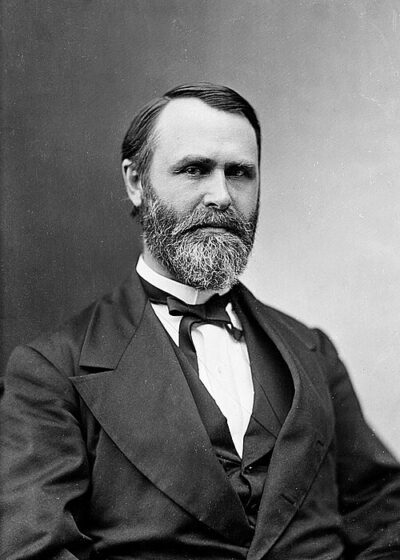
Jacob Dolson Cox
Jacob Dolson Cox was an American statesman, lawyer, Union Army general, educator, author, and microbiologist. Born October 27, 1828, in Montreal. Died August 4, 1900, in Magnolia. Positions held include United States representative (1877–1879), Governor of Ohio (1866–1868) and United States Secretary of the Interior (1869–1870). Educated at Oberlin College and Oberlin Academy.
Facts
31 facts · 2 confirmed by two sources · 9 cited · 20 from one source
Where this comes from
Papalocal keeps its own record. It started from these sources; what each one said is kept here as it was copied, so a change on their side never changes this page by itself. Tap one to read its version.
What Wikidata says · copied November 18, 2026 · revision 2562777745
- Described as
- American statesman, lawyer, Union Army general, educator, author, and microbiologist (1828-1900)
- Other names
- Jacob Cox, Jacob Dolson Cox, Jr.
- Born
- October 27, 1828 · 3 references
- Died
- August 4, 1900 · 3 references
- Born in
- Montreal · 1 reference
- Died in
- Magnolia · 1 reference
- Buried in
- Spring Grove Cemetery
- Cause of death
- myocardial infarction
- Citizen of
- United States; Canada · 1 reference
- Occupation
- politician · 2 references; military officer; lawyer; microbiologist; educator; microscopist · 1 reference; governor · 1 reference
- Positions held
- United States representative (1877–1879); Governor of Ohio (1866–1868); United States Secretary of the Interior (1869–1870); member of the State Senate of Ohio; interior minister · 1 reference
- Political party
- Republican Party
- Worked for
- University of Cincinnati College of Law
- Education
- Oberlin College; Oberlin Academy · 1 reference
- Member of
- American Philosophical Society (1870–)
- Spouse
- Helen Clarissa Finney
- Children
- Kenyon Cox
- Mother
- Thedia Cox · 1 reference
- Military branch
- Union Army; United States Army
- Military rank
- general · 1 reference
- Wikipedias with a page
- 15
Wikidata item Q177350 (wikidata.org/wiki/Q177350), public domain (CC0). Copied November 18, 2026.
What Wikipedia says · copied November 18, 2026 · revision 1380190436
Jacob Dolson Cox Jr. (October 27, 1828 – August 4, 1900), was a statesman, lawyer, Union Army general during the American Civil War, Republican politician from Ohio, Liberal Republican Party founder, educator, author, and recognized microbiologist. He served as president of the University of Cincinnati, the 28th governor of Ohio and as United States Secretary of the Interior. As Governor of Ohio, Cox sided for a time with President Andrew Johnson's Reconstruction plan and was against African American suffrage in the South, though he supported it in Ohio. However, Cox increasingly expressed racist and segregationist viewpoints, advocating a separate colony for blacks to "work out their own salvation." Seeing himself caught between Johnson and the Radical Republicans, Cox decided not to run for reelection. He stayed out of politics for a year, though both Sherman and Grant advocated that Cox replace Stanton as Secretary of War as a means of stemming the demands for Johnson's impeachment. But Johnson declined. When Ulysses S. Grant became president, he nominated Cox Secretary of Interior, and Cox immediately accepted.
Secretary of Interior Cox implemented the first civil service reform in a federal government department, including examinations for most clerks. Grant initially supported Cox and civil service reform, creating America's first Civil Service Commission. However, Cox was opposed by Republican Party managers, who ultimately convinced Grant to cease civil service reforms in the Interior, a large department coveted for its vast Congressional patronage. President Grant and Secretary Cox were at odds over the fraudulent McGarahan Claims and the Dominican Republic annexation treaty. Secretary Cox advocated a lasting, honest, and comprehensive Indian policy legislated by Congress after the Piegan Indian massacre. Cox resigned as Secretary of Interior having been unable to gain Grant's support over civil service reform. Although Cox was a reformer, Grant had believed Cox had overstepped his authority as Secretary of Interior and had undermined his authority as president. In 1871 Cox helped found the Liberal Republicans in opposition to Grant's renomination. In 1876, Cox returned to politics and served one term as a United States Congressman from Ohio. Congressman Cox supported President Hayes's reform efforts, but his term as Congressman was unsuccessful at establishing permanent Civil Service reform.
Cox was elected as a member to the American Philosophical Society in 1870.
Cox was elected U.S. Representative (Ohio) and served in Congress from 1877 to 1879. Afterward, Cox never returned to active politics. Cox served as president and receiver of a railroad, Dean of Cincinnati Law School, and as president of the University of Cincinnati. Cox also studied microscopy and made hundreds of photo-micrographs, and in 1881 he was elected fellow of the Royal Microscopical Society. In 1882, Cox started a series of books he authored on Civil War campaigns, which remain today respected histories and memoirs. After Cox retired in 1897, he died in Massachusetts in 1900. Throughout the 20th century, Cox's life was mostly forgotten by historians, however, there has been renewed interest during the 21st century in Cox's military career as Union general during the Civil War, and his implementation of civil service while Secretary of Interior under President Grant, the first cabinet officer to do so in U.S. history.
- Born, in its opening lines
- October 27, 1828
- Died, in its opening lines
- August 4, 1900
From the Wikipedia article “Jacob D. Cox” (en.wikipedia.org/wiki/Jacob_D._Cox), by its contributors, under CC BY-SA 4.0 (creativecommons.org/licenses/by-sa/4.0/). Copied November 18, 2026; not changed.
Confirmed Two sources agree. Cited One source, and it names where it got it. One source One source, without a reference of its own. Sources disagree The sources disagree. We show the best-supported value and keep theirs below.
