
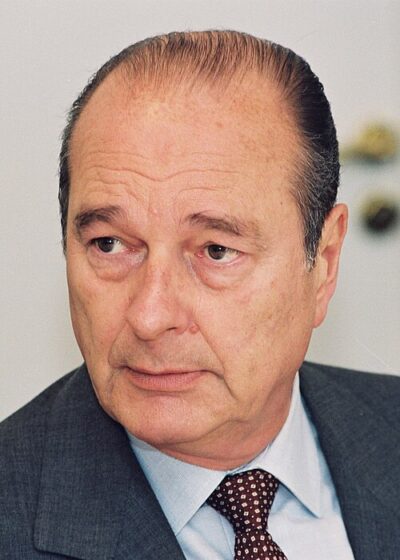
Jacques Chirac
Jacques Chirac was a President of France from 1995 to 2007. Born November 29, 1932. Died September 26, 2019, in 6th arrondissement of Paris. Positions held include President of the French Republic (1995–2007), Prime Minister of France (2 times) (1974–1988) and president of the general council (1970–1979). Known for The development of the port of New-Orleans. Educated at Paris Institute of Political Studies and Cours Hattemer. Awards include Grand Cross of the Legion of Honour, Grand Cross of the National Order of Merit and Ig Nobel Prize.
Facts
56 facts · 2 confirmed by two sources · 11 cited · 43 from one source
Where this comes from
Papalocal keeps its own record. It started from these sources; what each one said is kept here as it was copied, so a change on their side never changes this page by itself. Tap one to read its version.
What Wikidata says · copied November 16, 2026 · revision 2563121305
- Described as
- President of France from 1995 to 2007
- Other names
- Jacques René Chirac, Chirac, Jacques René, Chirac, Jacques, Chirac
- Born
- November 29, 1932 · 14 references
- Died
- September 26, 2019 · 13 references
- Died in
- 6th arrondissement of Paris · 2 references
- Buried in
- Montparnasse Cemetery · 2 references
- Cause of death
- kidney failure
- Name at birth
- Jacques René Chirac · 1 reference
- Citizen of
- France · 1 reference
- Occupation
- official; politician · 2 references
- Positions held
- President of the French Republic (1995–2007) · 1 reference; Prime Minister of France (2 times) (1974–1988) · 1 reference; president of the general council (1970–1979); French co-prince of Andorra (1995–2007); mayor of Paris (1977–1995) · 2 references; Minister of the Interior of France (1974); Minister of Agriculture and Rural Development (1972–1974); party leader (1976–1994); Minister Delegate for Relations with Parliament (1971–1972); Member of the European Parliament (1979–1980) · 1 reference; general councillor of Corrèze (1968–1988)
- Political party
- Union for a Popular Movement (2002–2007); Rally for the Republic (1976–2002); Union of Democrats for the Republic (1971–1976); Union for the New Republic (1962–1968)
- Education
- Paris Institute of Political Studies (1951–1953); Cours Hattemer; Lycée Louis-le-Grand (–1950); École nationale d'administration (1957–1959); Lycée Carnot; Harvard Summer School (1952)
- Known for
- The development of the port of New-Orleans
- Awards
- Grand Cross of the Legion of Honour; Grand Cross of the National Order of Merit; Ig Nobel Prize (1996) · 1 reference; Knight Grand Cross of the Order of the Bath; Collar of the Order of Isabella the Catholic (1999) · 1 reference; Order of the White Eagle; Collar of the Order of the White Lion (1997); Medal "In Commemoration of the 300th Anniversary of Saint Petersburg"; Order "For Merit to the Fatherland", 1st class; Knight Grand Cross of the Order of St. Olav (2000) · 1 reference; Order of the Three Stars, 1st Class (2006); Collar of the Order of Charles III (2006) · 1 reference; Grand Cross of the Order of Merit of the Republic of Poland; Knight Grand Cross of the Order of Merit of the Italian Republic; Chevalier des Arts et des Lettres
- Field
- politics · 2 references
- Spouse
- Bernadette Chirac (1956–2019)
- Children
- Claude Chirac; Laurence Chirac
- Father
- François Chirac
- Mother
- Marie-Louise Valette
- Religion
- Catholicism
- Lived in
- Hôtel Matignon; Élysée Palace; Hôtel de Montmorency-Fosseux (–2019)
- Wikipedias with a page
- 160
Wikidata item Q2105 (wikidata.org/wiki/Q2105), public domain (CC0). Copied November 16, 2026.
What Wikipedia says · copied November 16, 2026 · revision 1385809841
Jacques René Chirac (UK: , US: ; French: [ʒak ʁəne ʃiʁak] ; 29 November 1932 – 26 September 2019) was President of France from 1995 to 2007. He was previously Prime Minister of France from 1974 to 1976 and 1986 to 1988, as well as Mayor of Paris from 1977 to 1995.
After attending the École nationale d'administration, Chirac began his career as a high-level civil servant, entering politics shortly thereafter. Chirac occupied various senior positions, including minister of agriculture and minister of the interior. In 1981 and 1988, he unsuccessfully ran for president as the standard-bearer for the conservative Gaullist party Rally for the Republic (RPR). Chirac's internal policies initially included lower tax rates, the removal of price controls, strong punishment for crime and terrorism, and business privatisation.
After pursuing these policies in his second term as prime minister, Chirac changed his views. He argued for different economic policies and was elected president in 1995, with 52.6% of the vote in the second round, beating Socialist Lionel Jospin, after campaigning on a platform of healing the "social rift" (fracture sociale).
Chirac's economic policies, based on dirigisme, allowing for state-directed investment, stood in opposition to the laissez-faire policies of the United Kingdom under the ministries of Margaret Thatcher and John Major, which Chirac described as "Anglo-Saxon ultraliberalism".Chirac was known for his stand against the American-led invasion of Iraq, his recognition of the collaborationist French government's role in deporting Jews, his ending conscription in 1997, and his reduction of the presidential term from seven years to five through a referendum in 2000. At the 2002 presidential election, he won 82.2% of the vote in the second round against the far-right candidate, Jean-Marie Le Pen, and was the last president to be re-elected until 2022. In 2011, a Paris court declared Chirac guilty of diverting public funds and abusing public confidence, giving him a two-year suspended prison sentence.
- Born, in its opening lines
- November 29, 1932
- Died, in its opening lines
- September 26, 2019
From the Wikipedia article “Jacques Chirac” (en.wikipedia.org/wiki/Jacques_Chirac), by its contributors, under CC BY-SA 4.0 (creativecommons.org/licenses/by-sa/4.0/). Copied November 16, 2026; not changed.
Confirmed Two sources agree. Cited One source, and it names where it got it. One source One source, without a reference of its own. Sources disagree The sources disagree. We show the best-supported value and keep theirs below.
