
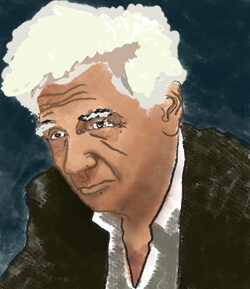
Jacques Derrida
Jacques Derrida was a French philosopher. Born July 15, 1930, in El Biar. Died October 9, 2004, in 5th arrondissement of Paris. Educated at École Normale Supérieure and Harvard University. Awards include Theodor W. Adorno Award and Harry Oppenheimer Fellowship Award.
Facts
30 facts · 2 confirmed by two sources · 11 cited · 17 from one source
Where this comes from
Papalocal keeps its own record. It started from these sources; what each one said is kept here as it was copied, so a change on their side never changes this page by itself. Tap one to read its version.
What Wikidata says · copied November 16, 2026 · revision 2568288925
- Described as
- French philosopher (1930–2004)
- Other names
- J. Derrida, Jackie Derrida, Jackie Elie Derrida, Jackie Élie Derrida
- Born
- July 15, 1930 · 18 references
- Died
- October 9, 2004 · 2 references
- Born in
- El Biar · 3 references
- Died in
- 5th arrondissement of Paris · 1 reference
- Buried in
- Cemetery of Ris-Orangis
- Cause of death
- pancreatic cancer
- Name at birth
- Jackie Derrida · 1 reference
- Citizen of
- France · 2 references
- Occupation
- philosopher · 2 references; literary critic · 1 reference; university teacher · 1 reference; writer · 1 reference; professor · 1 reference
- Worked for
- School for Advanced Studies in the Social Sciences · 1 reference; European Graduate School; University of California, Irvine
- Education
- École Normale Supérieure; Harvard University; University of Paris 1 Pantheon-Sorbonne (–1980) · 1 reference; Faculty of Arts of Paris; Lycée Louis-le-Grand
- Member of
- American Academy of Arts and Sciences
- Awards
- Theodor W. Adorno Award (2001); Harry Oppenheimer Fellowship Award (2008)
- Field
- philosophy of language; philosophy · 1 reference; logic · 1 reference
- Spouse
- Marguerite Aucouturier (1957–2004)
- Children
- Daniel Agacinski · 1 reference; Pierre Alferi · 1 reference
- Wikipedias with a page
- 101
Wikidata item Q130631 (wikidata.org/wiki/Q130631), public domain (CC0). Copied November 16, 2026.
What Wikipedia says · copied November 16, 2026 · revision 1385668581
Jacques Derrida (; French: [ʒak dɛʁida]; born Jackie Élie Derrida; 15 July 1930 – 9 October 2004) was a French philosopher. He developed the philosophy of deconstruction, which he applied in some of his texts, and which he developed through close readings of the linguistics of Ferdinand de Saussure and Husserlian and Heideggerian phenomenology. He is one of the major figures associated with post-structuralism and postmodern philosophy although he distanced himself from post-structuralism and disavowed the word "postmodernity".
During his career, Derrida published over 40 books, together with hundreds of essays and public presentations. He has had a significant influence on the humanities and social sciences, including philosophy, literature, law, anthropology, historiography, applied linguistics, sociolinguistics, psychoanalysis, music, architecture, and political theory.
Into the 2000s, his work retained major academic influence throughout the United States, continental Europe, South America and all other countries where continental philosophy has been predominant, particularly in debates around ontology, epistemology (especially concerning social sciences), ethics, aesthetics, hermeneutics, and the philosophy of language. For the last two decades of his life, Derrida was Professor in Humanities at the University of California, Irvine. In most of the Anglosphere, where analytic philosophy is dominant, Derrida's influence is most presently felt in literary studies due to his longstanding interest in language and his association with prominent literary critics. He also influenced architecture (in the form of deconstructivism), music (especially in the musical atmosphere of hauntology), art, and art criticism.
Particularly in his later writings, Derrida addressed ethical and political themes in his work. Some critics consider Speech and Phenomena (1967) to be his most important work, while others cite Of Grammatology (1967), Writing and Difference (1967), and Margins of Philosophy (1972). These writings influenced various activists and political movements. He became a well-known and influential public figure, while his approach to philosophy and notoriously abstruse work made him controversial.
- Born, in its opening lines
- July 15, 1930
- Died, in its opening lines
- October 9, 2004
From the Wikipedia article “Jacques Derrida” (en.wikipedia.org/wiki/Jacques_Derrida), by its contributors, under CC BY-SA 4.0 (creativecommons.org/licenses/by-sa/4.0/). Copied November 16, 2026; not changed.
Confirmed Two sources agree. Cited One source, and it names where it got it. One source One source, without a reference of its own. Sources disagree The sources disagree. We show the best-supported value and keep theirs below.
