
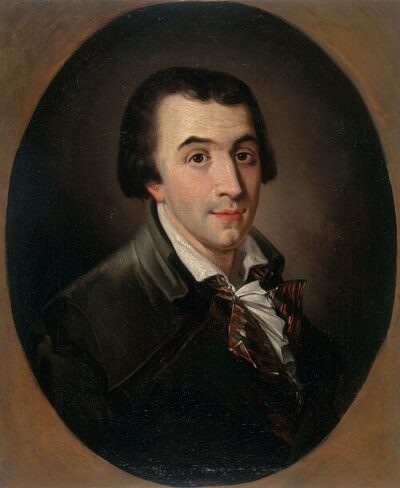
Jacques Pierre Brissot
Jacques Pierre Brissot was a French revolutionary. Born January 15, 1754, in Chartres. Died October 31, 1793, in Paris. Positions held include deputy to the National Legislative Assembly (France) (1791–1792) and deputy to the National Convention (1792–1793). Educated at University of Orléans. Awards include Fellow of the American Academy of Arts and Sciences.
Facts
21 facts · 2 confirmed by two sources · 5 cited · 14 from one source
Where this comes from
Papalocal keeps its own record. It started from these sources; what each one said is kept here as it was copied, so a change on their side never changes this page by itself. Tap one to read its version.
What Wikidata says · copied November 16, 2026 · revision 2567663543
- Described as
- French revolutionary (1754–1793)
- Other names
- Jacques Pierre Brissot de Warville, Jean Pierre Brissot de Warville
- Born
- January 15, 1754 · 6 references
- Died
- October 31, 1793 · 6 references
- Born in
- Chartres · 1 reference
- Died in
- Paris · 1 reference
- Buried in
- Catacombs of Paris
- Cause of death
- decapitation
- Citizen of
- France
- Occupation
- politician · 1 reference; journalist · 1 reference; diplomat; translator; judge; lawyer
- Positions held
- deputy to the National Legislative Assembly (France) (1791–1792) · 1 reference; deputy to the National Convention (1792–1793) · 1 reference
- Political party
- Girondists
- Education
- University of Orléans · 1 reference
- Member of
- American Academy of Arts and Sciences
- Awards
- Fellow of the American Academy of Arts and Sciences (1789–)
- Spouse
- Félicité Brissot de Warville
- Children
- Anacharsis Brissot de Warville · 1 reference
- Wikipedias with a page
- 47
Wikidata item Q314984 (wikidata.org/wiki/Q314984), public domain (CC0). Copied November 16, 2026.
What Wikipedia says · copied November 16, 2026 · revision 1384934847
Jacques Pierre Brissot (French pronunciation: [ʒak pjɛʁ bʁiso]; 15 January 1754 – 31 October 1793), also known as Brissot de Warville, was a French journalist, abolitionist, and revolutionary leading the faction of the Girondins (initially called Brissotins) at the National Convention in Paris.
Born in Chartres, Brissot trained as a law clerk, but acquired notoriety as a radical writer and journalist, winning the approval of Voltaire for his writings on the philosophy of law. He collaborated on the Mercure de France and the Courier de l'Europe, which sympathized with the insurgents in the American colonies.
In February 1788, Brissot founded the anti-slavery Society of the Friends of the Blacks. With the outbreak of the revolution in July 1789, he became one of its most vocal supporters. As a member of the Legislative Assembly, Brissot advocated for war against Austria and other European powers in order to secure France's revolutionary gains, which led to the War of the First Coalition in 1792. He voted against the immediate execution of Louis XVI which made him unpopular with the Montagnards. He was an intimate friend of Jean-Paul Marat in the 1780s, but from 1792 they became bitter political enemies.
On 3 April 1793, Maximilien Robespierre declared in the Convention that the whole war was a prepared game between Dumouriez and Brissot to overthrow the French First Republic. Conflicts with Robespierre, who accused him of royalism, eventually brought about his downfall. On 8 October, the Convention decided to arrest Brissot. Like Madame Roland and Pétion, Brissot was accused of organising (or taking part in) conspicuous dinners. At the end of October 1793, he was guillotined along with 28 other Girondins by Charles-Henri Sanson.
- Born, in its opening lines
- January 15, 1754
- Died, in its opening lines
- October 31, 1793
From the Wikipedia article “Jacques Pierre Brissot” (en.wikipedia.org/wiki/Jacques_Pierre_Brissot), by its contributors, under CC BY-SA 4.0 (creativecommons.org/licenses/by-sa/4.0/). Copied November 16, 2026; not changed.
Confirmed Two sources agree. Cited One source, and it names where it got it. One source One source, without a reference of its own. Sources disagree The sources disagree. We show the best-supported value and keep theirs below.
