
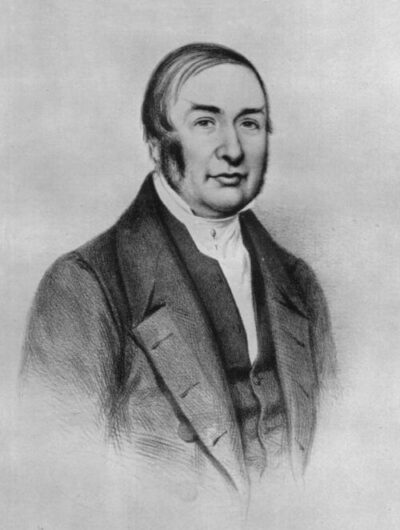
James Braid
James Braid was a Scottish surgeon, hypnotist, and hypnotherapist. Born June 19, 1795, in Fife. Died March 25, 1860, in Manchester. Educated at University of Edinburgh.
Facts
12 facts · 2 confirmed by two sources · 1 cited · 9 from one source
Where this comes from
Papalocal keeps its own record. It started from these sources; what each one said is kept here as it was copied, so a change on their side never changes this page by itself. Tap one to read its version.
What Wikidata says · copied November 16, 2026 · revision 2496075915
- Described as
- Scottish surgeon, hypnotist, and hypnotherapist (1795–1860)
- Born
- June 19, 1795
- Died
- March 25, 1860 · 6 references
- Born in
- Fife
- Died in
- Manchester
- Cause of death
- disease
- Citizen of
- United Kingdom of Great Britain and Ireland; Kingdom of Great Britain (–1801)
- Occupation
- hypnotist; physician · 1 reference; hypnotherapist; surgeon
- Education
- University of Edinburgh
- Wikipedias with a page
- 29
Wikidata item Q675789 (wikidata.org/wiki/Q675789), public domain (CC0). Copied November 16, 2026.
What Wikipedia says · copied November 16, 2026 · revision 1372234562
James Braid (19 June 1795 – 25 March 1860) was a Scottish surgeon, natural philosopher, and "gentleman scientist".
He was a significant innovator in the treatment of clubfoot, spinal curvature, knock-knees, bandy legs, and squint; a significant pioneer of hypnotism and hypnotherapy, and an important and influential pioneer in the adoption of both hypnotic anaesthesia and chemical anaesthesia.
He is regarded by some, such as William S. Kroger (2008, p. 3), as the "Father of Modern Hypnotism". However, in relation to the issue of there being significant connections between Braid's "hypnotism" and "modern hypnotism" (as it is practised), let alone "identity" between the two, André Muller Weitzenhoffer (2000) urges the utmost caution in making any such assumption:"It has been a basic assumption of modern (i.e., twentieth century) hypnotism that it is founded on the same phenomenology it historically evolved from. Such differences as exist between older versions of hypnotism and newer ones being reduced largely to a matter of interpretation of the facts. That there are common elements is not in question, but that there is full identity in questionable and basically untestable." – André Muller Weitzenhoffer (p. 3; emphasis added).
Also, in relation to the clinical application of "hypnotism",Although Braid believed that hypnotic suggestion was a valuable remedy in functional nervous disorders, he did not regard it as a rival to other forms of treatment, nor wish in any way to separate its practice from that of medicine in general. He held that whoever talked of a "universal remedy" was either a fool or a knave: similar diseases often arose from opposite pathological conditions, and the treatment ought to be varied accordingly. – John Milne Bramwell (1910)
- Born, in its opening lines
- June 19, 1795
- Died, in its opening lines
- March 25, 1860
From the Wikipedia article “James Braid (surgeon)” (en.wikipedia.org/wiki/James_Braid_(surgeon)), by its contributors, under CC BY-SA 4.0 (creativecommons.org/licenses/by-sa/4.0/). Copied November 16, 2026; not changed.
Confirmed Two sources agree. Cited One source, and it names where it got it. One source One source, without a reference of its own. Sources disagree The sources disagree. We show the best-supported value and keep theirs below.
