
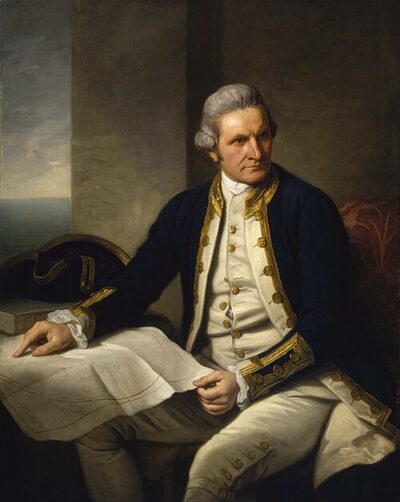
James Cook
James Cook was a British explorer, cartographer and naval officer. Born October 27, 1728, in Marton. Died February 14, 1779, in Kealakekua Bay. Awards include Fellow of the Royal Society, Copley Medal and Person of National Historic Significance.
Facts
29 facts · 1 confirmed by two sources · 15 cited · 12 from one source · 1 where the sources disagree
What’s different
- Born: we show October 27, 1728 (Sources disagree). Wikipedia says November 7, 1728
Where this comes from
Papalocal keeps its own record. It started from these sources; what each one said is kept here as it was copied, so a change on their side never changes this page by itself. Tap one to read its version.
What Wikidata says · copied November 16, 2026 · revision 2569247476
- Described as
- British explorer, cartographer and naval officer (1728–1779)
- Other names
- Cook, James, Captain James Cook, James Cooke, Captain Cook, James Marton Cook, J. Cook, Cook
- Born
- October 27, 1728 · 4 references
- Died
- February 14, 1779 · 11 references
- Born in
- Marton · 2 references
- Died in
- Kealakekua Bay · 1 reference
- Cause of death
- stab wound
- Citizen of
- Kingdom of Great Britain · 1 reference
- Occupation
- explorer · 1 reference; cartographer · 3 references; naval officer; seafarer · 2 references; botanist; discoverer · 1 reference
- Member of
- Royal Society of London
- Awards
- Fellow of the Royal Society; Copley Medal (1776) · 1 reference; Person of National Historic Significance · 1 reference
- Field
- exploration; cartography
- Spouse
- Elizabeth Cook (1762–) · 1 reference
- Children
- Nathaniel Cook · 1 reference; James Cook · 1 reference; Elizabeth Cook · 1 reference; Joseph Cook · 1 reference; George Cook · 1 reference; Hugh Cook · 1 reference
- Father
- James Cook
- Mother
- Grace Pace
- Military branch
- Royal Navy
- Military rank
- captain
- Wikipedias with a page
- 186
Wikidata item Q7324 (wikidata.org/wiki/Q7324), public domain (CC0). Copied November 16, 2026.
What Wikipedia says · copied November 16, 2026 · revision 1385832142
Captain James Cook (7 November 1728 – 14 February 1779) was a British Royal Navy officer, explorer, and cartographer who led three voyages of exploration to the Pacific and Southern Oceans between 1768 and 1779. He completed the first recorded circumnavigation of the main islands of New Zealand, and led the first recorded visit by Europeans to the east coast of Australia and the Hawaiian Islands.
Cook joined the British merchant navy as a teenager before enlisting in the Royal Navy in 1755. He first saw combat during the Seven Years' War, when he fought in the Siege of Louisbourg. Later in the war he surveyed and mapped much of the entrance to the St. Lawrence River during the Siege of Quebec. In the 1760s he mapped the coastline of Newfoundland and made important astronomical observations which brought him to the attention of the Admiralty and the Royal Society. This acclaim came at a pivotal moment in British overseas exploration, and it led to his commission in 1768 as commander of HMS Endeavour for the first of his three voyages.
During these voyages, Cook sailed tens of thousands of miles across largely uncharted areas, mapping coastlines, islands, and features across the globe in greater detail than previously charted – including Easter Island, Alaska and South Georgia Island. He made contact with numerous indigenous peoples and claimed several territories for the Kingdom of Great Britain. Renowned for exceptional seamanship and courage in times of danger, he was patient, persistent, sober, and competent, but sometimes hot-tempered. His contributions to the prevention of scurvy, a disease common among sailors, led the Royal Society to award him the Copley Gold Medal.
In 1779, during his second visit to Hawaii, Cook was killed when a dispute with Native Hawaiians turned violent. His voyages left a legacy of scientific and geographical knowledge that influenced his successors well into the 20th century. Numerous memorials have been dedicated to him worldwide. There is debate over the extent of Cook's responsibility for sometimes violent encounters with Indigenous peoples, the transmission of infectious diseases and claiming Indigenous lands for Britain without consent.
- Born, in its opening lines
- November 7, 1728
- Died, in its opening lines
- February 14, 1779
From the Wikipedia article “James Cook” (en.wikipedia.org/wiki/James_Cook), by its contributors, under CC BY-SA 4.0 (creativecommons.org/licenses/by-sa/4.0/). Copied November 16, 2026; not changed.
Confirmed Two sources agree. Cited One source, and it names where it got it. One source One source, without a reference of its own. Sources disagree The sources disagree. We show the best-supported value and keep theirs below.
