
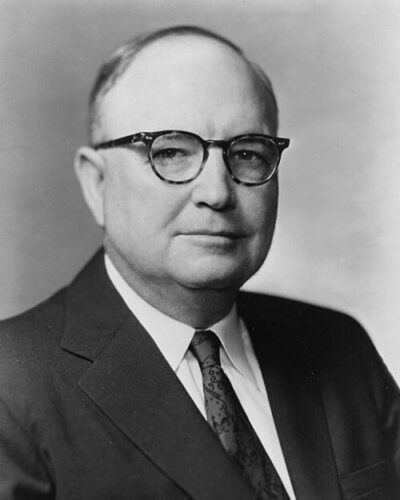
James Eastland
James Eastland was an American politician. Born November 28, 1904, in Doddsville. Died February 19, 1986, in Doddsville. Positions held include President pro tempore of the United States Senate (1972–1978), member of the Mississippi House of Representatives (1928–1932) and United States senator (2 times) (1941–1978). Educated at University of Mississippi and Vanderbilt University.
Facts
20 facts · 2 confirmed by two sources · 5 cited · 13 from one source
Where this comes from
Papalocal keeps its own record. It started from these sources; what each one said is kept here as it was copied, so a change on their side never changes this page by itself. Tap one to read its version.
What Wikidata says · copied November 18, 2026 · revision 2545348436
- Described as
- American politician (1904–1986)
- Other names
- James O. Eastland, James Oliver Eastland
- Born
- November 28, 1904 · 3 references
- Died
- February 19, 1986 · 3 references
- Born in
- Doddsville
- Died in
- Doddsville
- Buried in
- Eastern Cemetery · 1 reference
- Citizen of
- United States
- Occupation
- politician · 1 reference; lawyer; farmer; plantation owner
- Positions held
- President pro tempore of the United States Senate (1972–1978); member of the Mississippi House of Representatives (1928–1932) · 1 reference; United States senator (2 times) (1941–1978) · 1 reference; senator · 1 reference
- Political party
- Democratic Party
- Education
- University of Mississippi; Vanderbilt University; University of Alabama; primary school; University of Mississippi School of Law
- Wikipedias with a page
- 18
Wikidata item Q723926 (wikidata.org/wiki/Q723926), public domain (CC0). Copied November 18, 2026.
What Wikipedia says · copied November 18, 2026 · revision 1385181397
James Oliver Eastland (November 28, 1904 – February 19, 1986) was an American attorney, plantation owner, and politician from Mississippi. A Democrat, he served in the United States Senate in 1941 and again from 1943 until his resignation in late 1978. Eastland was a segregationist who led the Southern resistance against racial integration during the civil rights movement, often speaking of African Americans as "an inferior race". Eastland has been called the "Voice of the White South" and the "Godfather of Mississippi Politics".
The son of prominent attorney, politician, and cotton planter Woods Eastland, he attended the local schools of Scott County, Mississippi, and took courses at the University of Mississippi, Vanderbilt University, and the University of Alabama. He completed his legal education by studying in his father's office, attaining admission to the bar in 1927. Eastland practiced law in Sunflower County, Mississippi, and took over management of his family's cotton plantation. Becoming active in politics as a Democrat, he served in the Mississippi House of Representatives from 1928 to 1932.
When Senator Pat Harrison died in office in 1941, the governor appointed Eastland to fill the vacancy on the condition that Eastland not run in that year's special election to complete the term. Eastland served from June to September 1941. The special election was won by Wall Doxey. Eastland went on to defeat Doxey in the 1942 primary for the Democratic nomination for a full term. The Democratic Party was then essentially the only party in Mississippi, assuring Eastland's return to the Senate in January 1943. Eastland was reelected five times, serving until resigning in December 1978, days before the end of his final term. Eastland advanced through seniority to the chairmanship of the Senate Judiciary Committee, serving over 20 years, and President pro tempore of the Senate.
- Born, in its opening lines
- November 28, 1904
- Died, in its opening lines
- February 19, 1986
From the Wikipedia article “James Eastland” (en.wikipedia.org/wiki/James_Eastland), by its contributors, under CC BY-SA 4.0 (creativecommons.org/licenses/by-sa/4.0/). Copied November 18, 2026; not changed.
Confirmed Two sources agree. Cited One source, and it names where it got it. One source One source, without a reference of its own. Sources disagree The sources disagree. We show the best-supported value and keep theirs below.
