
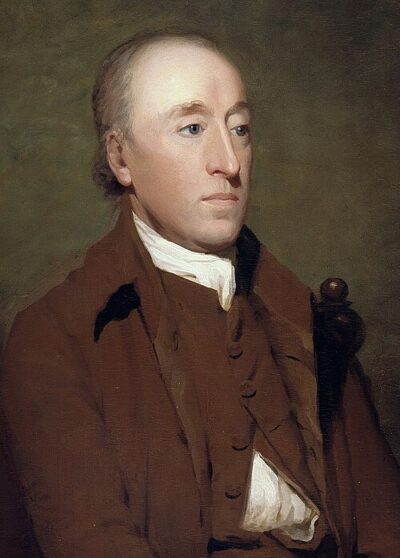
James Hutton
James Hutton was a Scottish geologist, physician, chemical manufacturer, naturalist, and experimental agriculturalist;. Born June 3, 1726, in Edinburgh. Died March 26, 1797, in Edinburgh. Educated at University of Edinburgh and University of Paris.
Facts
25 facts · 0 confirmed by two sources · 19 cited · 6 from one source
Where this comes from
Papalocal keeps its own record. It started from these sources; what each one said is kept here as it was copied, so a change on their side never changes this page by itself. Tap one to read its version.
What Wikidata says · copied November 16, 2026 · revision 2564311926
- Described as
- Scottish geologist, physician, chemical manufacturer, naturalist, and experimental agriculturalist; (1726-1797)
- Other names
- The Father of Modern Geology
- Born
- June 3, 1726 · 5 references
- Died
- March 26, 1797 · 7 references
- Born in
- Edinburgh · 1 reference
- Died in
- Edinburgh · 1 reference
- Buried in
- Greyfriars Covenanters Prison · 1 reference
- Cause of death
- bladder cancer · 1 reference
- Citizen of
- Kingdom of Great Britain
- Occupation
- geologist · 1 reference; meteorologist; farmer · 1 reference; industrialist; physician · 2 references; naturalist · 1 reference
- Education
- University of Edinburgh (1740–1746) · 2 references; University of Paris (1746–1747) · 1 reference; Leiden University (1747–1749) · 2 references; Royal High School (1736–1740) · 1 reference
- Member of
- Royal Society of Edinburgh (1783–) · 1 reference
- Field
- geology; agriculture; meteorology
- Lived in
- London (1749–1752) · 1 reference; Norfolk (1752–1754) · 1 reference; Slighhouses Farmhouse (1754–1767) · 1 reference; Edinburgh (1767–1797) · 1 reference
- Wikipedias with a page
- 63
Wikidata item Q192927 (wikidata.org/wiki/Q192927), public domain (CC0). Copied November 16, 2026.
What Wikipedia says · copied November 16, 2026 · revision 1375951175
James Hutton ( ; 3 June O.S. 1726 – 26 March 1797) was a Scottish geologist, agriculturalist, chemical manufacturer, naturalist and physician. Often referred to as the "Father of Modern Geology," he played a key role in establishing geology as a modern science.
Hutton advanced the idea that the physical world's remote history can be inferred from evidence in present-day rocks. Through his study of features in the landscape and coastlines of his native Scottish Lowlands, such as Salisbury Crags and Siccar Point, he developed the theory that geological features could not be static but underwent continuing transformation over indefinitely long periods of time. From this he argued, in agreement with many other early geologists, that the Earth could not be young. He was one of the earliest proponents of what in the 1830s became known as uniformitarianism, the science which explains features of the Earth's crust as the outcome of continuing natural processes over the long geologic time scale. Hutton also put forward a thesis for a 'system of the habitable Earth' proposed as a deistic mechanism designed to keep the world eternally suitable for humans, an early attempt to formulate what today might be called one kind of anthropic principle.
Some reflections similar to those of Hutton can be found in publications of his contemporaries, such as the French naturalist Georges-Louis Leclerc de Buffon, but it is chiefly Hutton's pioneering work that established the field.
From the Wikipedia article “James Hutton” (en.wikipedia.org/wiki/James_Hutton), by its contributors, under CC BY-SA 4.0 (creativecommons.org/licenses/by-sa/4.0/). Copied November 16, 2026; not changed.
Confirmed Two sources agree. Cited One source, and it names where it got it. One source One source, without a reference of its own. Sources disagree The sources disagree. We show the best-supported value and keep theirs below.
