
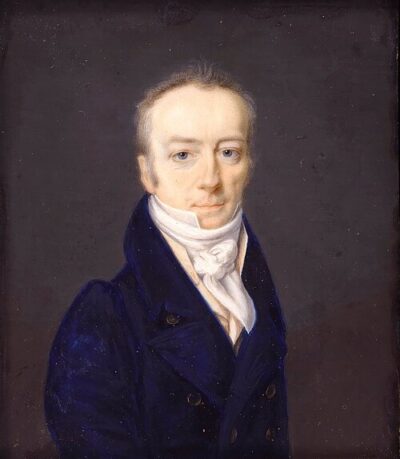
James Smithson was a British chemist. Born 1765, in Paris. Died June 27, 1829, in Genoa. Known for Smithsonian Institution. Educated at Pembroke College. Awards include Fellow of the Royal Society.
Facts
20 facts · 2 confirmed by two sources · 10 cited · 8 from one source
Where this comes from
Papalocal keeps its own record. It started from these sources; what each one said is kept here as it was copied, so a change on their side never changes this page by itself. Tap one to read its version.
What Wikidata says · copied November 16, 2026 · revision 2564377004
- Described as
- British chemist
- Other names
- James Louis Macie, Smithson J, James Lewis Smithson, James Lewis Smithson [formerly Macie], FRS, Jacques-Louis Macie
- Born
- 1765 · 12 references
- Died
- June 27, 1829 · 6 references
- Born in
- Paris · 1 reference
- Died in
- Genoa · 1 reference
- Name at birth
- Jacques-Louis Macie
- Citizen of
- United Kingdom of Great Britain and Ireland · 1 reference
- Occupation
- chemist · 1 reference; mineralogist · 1 reference; philanthropist
- Education
- Pembroke College
- Member of
- Royal Society of London (1787–)
- Known for
- Smithsonian Institution
- Awards
- Fellow of the Royal Society
- Field
- mineralogy · 1 reference; chemistry · 1 reference
- Father
- Hugh Percy, 1st Duke of Northumberland · 1 reference
- Mother
- Elizabeth Hungerford Keate · 2 references
- Siblings
- Hugh Percy, 2nd Duke of Northumberland · 1 reference; Algernon Percy, 1st Earl of Beverley; Henry Louis Dickinson · 1 reference
- Wikipedias with a page
- 28
Wikidata item Q900947 (wikidata.org/wiki/Q900947), public domain (CC0). Copied November 16, 2026.
What Wikipedia says · copied November 16, 2026 · revision 1379665300
James Smithson (c. 1765 – 27 June 1829) was a British chemist and mineralogist. He published numerous scientific papers for the Royal Society during the early 1800s as well as defining calamine, which would eventually be renamed after him as "smithsonite". He was the founding donor of the Smithsonian Institution, which also bears his name.
Born in Paris, France, as the illegitimate child of Elizabeth Hungerford Keate Macie and Hugh Percy (born Hugh Smithson), the 1st Duke of Northumberland, he was given the French name Jacques-Louis Macie. His birth date was not recorded and the exact location of his birth is unknown; it is possibly in the Pentemont Abbey. Shortly after his birth, he naturalised in Britain, where his name was anglicised to James Louis Macie. He adopted his father's original surname of Smithson in 1800, following his mother's death. He attended university at Pembroke College, Oxford, in 1782, eventually graduating with a Master of Arts in 1786. As a student he participated in a geological expedition to Scotland and studied chemistry and mineralogy. Highly regarded for his blowpipe analysis and his ability to work in miniature, Smithson spent much of his life traveling extensively throughout Europe; he published some 27 papers in his life.
Smithson never married and had no children; therefore, when he wrote his will, he left his estate to his nephew, or his nephew's family if his nephew died before Smithson. If his nephew were to die without heirs, however, Smithson's will stipulated that his estate be used "to found in Washington, under the name of the Smithsonian Institution, an establishment for the increase and diffusion of knowledge among men". He died in Genoa, Italy, on 27 June 1829, aged 64. Six years later, in 1835, his nephew died without heir, setting in motion the bequest to the United States. In this way Smithson became the patron of the Smithsonian Institution in Washington, D.C., despite having never visited the United States.
- Born, in its opening lines
- c. 1765
- Died, in its opening lines
- June 27, 1829
From the Wikipedia article “James Smithson” (en.wikipedia.org/wiki/James_Smithson), by its contributors, under CC BY-SA 4.0 (creativecommons.org/licenses/by-sa/4.0/). Copied November 16, 2026; not changed.
Confirmed Two sources agree. Cited One source, and it names where it got it. One source One source, without a reference of its own. Sources disagree The sources disagree. We show the best-supported value and keep theirs below.
