
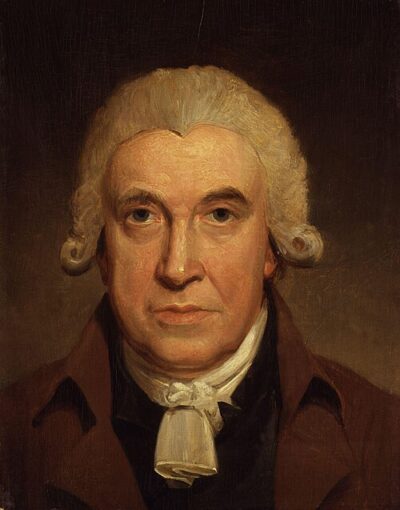
James Watt
James Watt was a British engineer. Born January 19, 1736, in Greenock. Died August 25, 1819, in Heathfield Hall. Educated at University of Glasgow. Awards include honorary doctorate of the University of Glasgow, Scottish Engineering Hall of Fame and Fellow of the Royal Society of Edinburgh.
Facts
35 facts · 0 confirmed by two sources · 22 cited · 11 from one source · 2 where the sources disagree
What’s different
- Born: we show January 19, 1736 (Sources disagree). Wikipedia says January 30, 1736
- Died: we show August 25, 1819 (Sources disagree). Wikipedia says January 19, 1736
Where this comes from
Papalocal keeps its own record. It started from these sources; what each one said is kept here as it was copied, so a change on their side never changes this page by itself. Tap one to read its version.
What Wikidata says · copied November 16, 2026 · revision 2567480962
- Described as
- British engineer (1736–1819)
- Other names
- James, Sr. Watt, James von Breda Watt
- Born
- January 19, 1736 · 4 references
- Died
- August 25, 1819 · 6 references
- Born in
- Greenock · 4 references
- Died in
- Heathfield Hall
- Buried in
- St Mary's Church · 1 reference
- Citizen of
- Scotland
- Occupation
- engineer · 1 reference; chemist · 2 references; physicist · 1 reference; inventor · 1 reference; entrepreneur; mathematician; technician · 1 reference
- Worked for
- University of Glasgow (1756) · 1 reference
- Education
- University of Glasgow
- Member of
- Royal Society of London (1785–) · 2 references; French Academy of Sciences (1814–) · 1 reference; Royal Society of Edinburgh (1784–) · 2 references; Lunar Society of Birmingham · 1 reference
- Awards
- honorary doctorate of the University of Glasgow (1806); Scottish Engineering Hall of Fame (2021) · 1 reference; Fellow of the Royal Society of Edinburgh (1784) · 1 reference
- Field
- mechanical engineering; steam engine; invention · 1 reference; instrument maker (1759) · 1 reference
- Spouse
- Ann McGriigor (1775–) · 2 references; Peggy Miller (1763–) · 2 references
- Children
- James Watt · 2 references; Margaret Watt · 2 references; Gregory Watt · 2 references; Janet Watt · 1 reference
- Father
- James Watt · 1 reference
- Mother
- Agnes Muirhead · 2 references
- Lived in
- Glasgow · 1 reference
- Wikipedias with a page
- 160
Wikidata item Q9041 (wikidata.org/wiki/Q9041), public domain (CC0). Copied November 16, 2026.
What Wikipedia says · copied November 16, 2026 · revision 1383747845
James Watt (; 30 January 1736 (19 January 1736 OS) – 25 August 1819) was a Scottish inventor, engineer and chemist who improved on Thomas Newcomen's 1712 Newcomen steam engine with his Watt steam engine in 1776, which was fundamental to the changes brought by the Industrial Revolution in both his native Great Britain and the rest of the world.
While working as an instrument maker at the University of Glasgow, Watt became interested in the technology of steam engines. At the time engineers such as John Smeaton were aware of the inefficiencies of Newcomen's engine and aimed to improve it. Watt's insight was to realise that contemporary engine designs wasted a great deal of energy by repeatedly cooling and reheating the cylinder. Watt introduced a design enhancement, the separate condenser, which avoided this waste of energy and radically improved the power, efficiency, and cost-effectiveness of steam engines. Eventually, he adapted his engine to produce rotary motion, greatly broadening its use beyond pumping water.
Watt attempted to commercialise his invention, but experienced great financial difficulties until he entered a partnership with Matthew Boulton in 1775. The new firm of Boulton and Watt was eventually highly successful and Watt became a wealthy man. In his retirement, Watt continued to develop new inventions though none was as significant as his steam engine work.
As Watt developed the concept of horsepower, the SI unit of power, the watt, was named after him.
- Born, in its opening lines
- January 30, 1736
- Died, in its opening lines
- January 19, 1736
From the Wikipedia article “James Watt” (en.wikipedia.org/wiki/James_Watt), by its contributors, under CC BY-SA 4.0 (creativecommons.org/licenses/by-sa/4.0/). Copied November 16, 2026; not changed.
Confirmed Two sources agree. Cited One source, and it names where it got it. One source One source, without a reference of its own. Sources disagree The sources disagree. We show the best-supported value and keep theirs below.
