
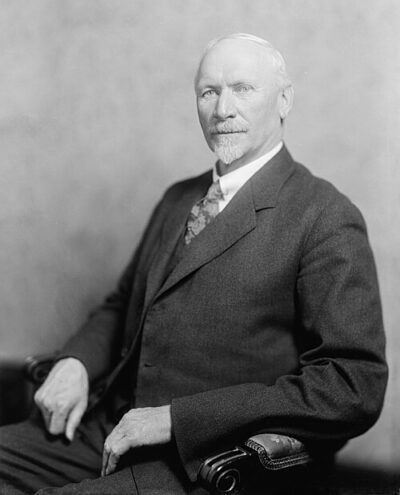
Jan Christiaan Smuts
Jan Christiaan Smuts was a South African statesman and military leader. Born May 24, 1870, in Riebeek West. Died September 11, 1950, in Irene. Positions held include Prime Minister of South Africa (2 times) (1919–1948), Member of the Privy Council of the United Kingdom and Minister of Defence of South Africa. Educated at Jesus College and Christ's College. Awards include Commander of the Legion of Honour, Croix de guerre 1914–1918 (Belgium) and James Cook Medal.
Facts
46 facts · 2 confirmed by two sources · 24 cited · 20 from one source
Where this comes from
Papalocal keeps its own record. It started from these sources; what each one said is kept here as it was copied, so a change on their side never changes this page by itself. Tap one to read its version.
What Wikidata says · copied November 16, 2026 · revision 2562805459
- Described as
- South African statesman and military leader (1870–1950)
- Other names
- Smuts, J. C. Smuts, Jan Smuts, Jan Christian Smuts
- Born
- May 24, 1870 · 11 references
- Died
- September 11, 1950 · 11 references
- Born in
- Riebeek West · 1 reference
- Died in
- Irene · 1 reference
- Name at birth
- Jan Christian Smuts
- Citizen of
- Union of South Africa
- Occupation
- botanist; military officer · 1 reference; lawyer · 1 reference; politician · 1 reference; philosopher · 2 references; writer · 1 reference; head of government · 1 reference
- Positions held
- Prime Minister of South Africa (2 times) (1919–1948); Member of the Privy Council of the United Kingdom; Minister of Defence of South Africa; Minister of Finance (South Africa); defence minister · 1 reference; Chancellor of the University of Cambridge (1948–1950)
- Political party
- South African Party (–1934); United Party (1934–)
- Education
- Jesus College; Christ's College; Stellenbosch University · 1 reference; Paul Roos Gymnasium
- Member of
- Royal Society of London (1930–); World Brotherhood Federation · 1 reference
- Awards
- Commander of the Legion of Honour (1917) · 1 reference; Croix de guerre 1914–1918 (Belgium) (1917) · 1 reference; James Cook Medal (1947) · 1 reference; Albert Medal (1942); Order of Merit (1947) · 1 reference; Companion of Honour (1917) · 1 reference; King George V Silver Jubilee Medal · 1 reference; King George VI Coronation Medal · 1 reference; Africa Star · 1 reference; France and Germany Star · 1 reference; European-African-Middle Eastern Campaign Medal · 1 reference; Grand Cross of the Military Order of the Tower and Sword · 1 reference; 1914–15 Star · 1 reference; Grand Cross of the Order of the African Star (1948) · 1 reference; British War Medal · 1 reference
- Spouse
- Isie Smuts
- Military branch
- British Army
- Military rank
- field marshal; general · 1 reference
- Wikipedias with a page
- 50
Wikidata item Q214321 (wikidata.org/wiki/Q214321), public domain (CC0). Copied November 16, 2026.
What Wikipedia says · copied November 16, 2026 · revision 1374514076
Field Marshal Jan Christian Smuts (Afrikaans: [jan smœts]; baptismal name Jan Christiaan Smuts; 24 May 1870 – 11 September 1950) was a South African statesman, military officer and philosopher. In addition to holding various military and cabinet posts, he served as Prime Minister of the Union of South Africa from 1919 to 1924 and 1939 to 1948.
Smuts was born to Afrikaner parents in the British Cape Colony. He was educated at Victoria College, Stellenbosch, before studying law at Christ's College, Cambridge, on a scholarship. He was called to the bar at the Middle Temple in 1894 but returned home the following year. In the leadup to the Second Boer War, Smuts practised law in Pretoria, the capital of the South African Republic. He led the republic's delegation to the Bloemfontein Conference and served as an officer in a commando unit following the outbreak of war in 1899. In 1902, he played a key role in negotiating the Treaty of Vereeniging, which ended the war and resulted in the annexation of the South African Republic and Orange Free State into the British Empire. He subsequently helped negotiate self-government for the Transvaal Colony, becoming a cabinet minister under Louis Botha.
Smuts played a leading role in the creation of the Union of South Africa in 1910, helping shape its constitution. He and Botha established the South African Party, with Botha becoming the union's first prime minister and Smuts holding multiple cabinet portfolios. As defence minister he was responsible for the Union Defence Force during the First World War. Smuts personally led troops in the East African campaign in 1916 and the following year joined the Imperial War Cabinet in London. He played a leading role at the Paris Peace Conference of 1919, advocating for the creation of the League of Nations and securing South African control over the former German South-West Africa.
In 1919, Smuts replaced Botha as prime minister, holding the office until the South African Party's defeat at the 1924 general election by J. B. M. Hertzog's National Party. He spent several years in academia, during which he coined the term "holism", before eventually re-entering politics as deputy prime minister in a coalition with Hertzog; in 1934 their parties subsequently merged to form the United Party. Smuts returned as prime minister in 1939, leading South Africa into the Second World War at the head of a pro-interventionist faction. He was appointed field marshal in 1941 and in 1945 signed the UN Charter, the only signer of the Treaty of Versailles to do so. His second term in office ended with the victory of his political opponents, the reconstituted National Party at the 1948 general election, with the new government implementing early apartheid policies.
Smuts was an internationalist who played a key role in establishing and defining the League of Nations, United Nations and Commonwealth of Nations. He supported racial segregation and opposed democratic non-racial rule. At the end of his career, Smuts supported the Fagan Commission's recommendations to relax restrictions on black South Africans living and working in urban areas.
- Born, in its opening lines
- May 24, 1870
- Died, in its opening lines
- September 11, 1950
From the Wikipedia article “Jan Smuts” (en.wikipedia.org/wiki/Jan_Smuts), by its contributors, under CC BY-SA 4.0 (creativecommons.org/licenses/by-sa/4.0/). Copied November 16, 2026; not changed.
Confirmed Two sources agree. Cited One source, and it names where it got it. One source One source, without a reference of its own. Sources disagree The sources disagree. We show the best-supported value and keep theirs below.
