
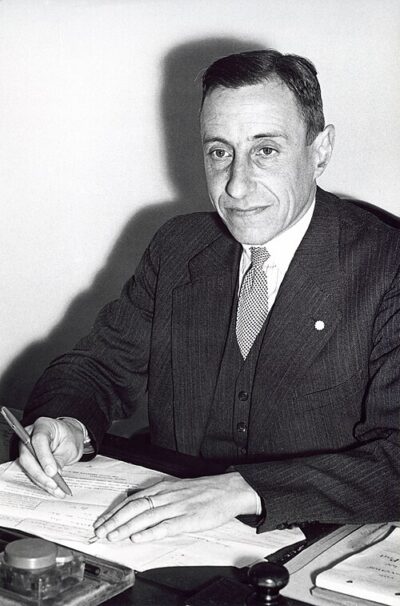
Jan Eduard de Quay
Jan Eduard de Quay was a prime minister, politician. Born August 26, 1901, in 's-Hertogenbosch. Died July 4, 1985, in Beers. Positions held include Prime Minister of the Netherlands (1959–1963), Minister of Transport, Public Works and Water Management (1966–1967) and member of the Senate of the Netherlands (1963–1966). Educated at Utrecht University and Catholic Comprehensive School, Breul. Awards include Commander of the Order of the Netherlands Lion.
Facts
29 facts · 2 confirmed by two sources · 4 cited · 23 from one source
Where this comes from
Papalocal keeps its own record. It started from these sources; what each one said is kept here as it was copied, so a change on their side never changes this page by itself. Tap one to read its version.
What Wikidata says · copied November 17, 2026 · revision 2563292057
- Described as
- prime minister, politician (1901–1985)
- Other names
- J. E. de Quay, Jan de Quay
- Born
- August 26, 1901 · 6 references
- Died
- July 4, 1985 · 6 references
- Born in
- 's-Hertogenbosch · 1 reference
- Died in
- Beers
- Citizen of
- Kingdom of the Netherlands
- Occupation
- politician; psychologist; university teacher · 1 reference; writer · 1 reference
- Positions held
- Prime Minister of the Netherlands (1959–1963); Minister of Transport, Public Works and Water Management (1966–1967); member of the Senate of the Netherlands (1963–1966); Minister of Defence; Deputy Prime Minister of the Netherlands (1966–1967); rector magnificus of Tilburg University; full professor · 1 reference; prime minister
- Political party
- Roman Catholic State Party; Catholic People's Party
- Worked for
- Utrecht University; Tilburg University (1927–1946) · 1 reference; Nederlandsche Unie · 1 reference
- Education
- Utrecht University; Catholic Comprehensive School, Breul
- Awards
- Commander of the Order of the Netherlands Lion
- Spouse
- Maria de Quay-van der Lande
- Father
- Rudolph Balthazar Antoine Nicolas de Quay
- Religion
- Catholic Church
- Military rank
- Major · 1 reference
- Wikipedias with a page
- 25
Wikidata item Q781813 (wikidata.org/wiki/Q781813), public domain (CC0). Copied November 17, 2026.
What Wikipedia says · copied November 17, 2026 · revision 1386295957
Jan Eduard de Quay (Dutch: [ˈjɑn ˈeːdyʋɑrt də ˈkʋaːi]; 26 August 1901 – 4 July 1985) was a Dutch politician of the defunct Catholic People's Party (KVP) now the Christian Democratic Appeal (CDA) party and psychologist who served as Prime Minister of the Netherlands from 19 May 1959 until 24 July 1963.
De Quay studied Applied psychology and Literature at the Utrecht University obtaining Master of Psychology and Letters degree's followed by a postgraduate education in Clinical Psychology at the Stanford University obtaining a Master of Social Science degree and worked as a researcher and associate professor of Applied psychology at the University of Tilburg from September 1927 until August 1939 before finishing his thesis at his alma and graduated as a Doctor of Psychology in Applied psychology and worked as a professor of Applied psychology, business administration and business theory at the University of Tilburg from March 1933 until August 1939. De Quay also served as Rector Magnificus of the university from January 1938 until January 1939. During World War II De Quay was co-founder of the controversial Dutch Union in July 1940 but the organisation was disbanded by the German occupation authority in December 1941. Shortly before the end of the War De Quay was appointed as Minister of War in the Cabinet Gerbrandy III, the last government-in-exile taking office on 4 April 1945. After a cabinet formation De Quay was not included in the new cabinet. De Quay continued to be active in politics and in September 1946 was nominated as the next Queen's Commissioner of North Brabant taking office on 1 November 1946. After the election of 1959 De Quay was persuaded to lead a new cabinet. Following a successful cabinet formation De Quay formed the Cabinet De Quay and became Prime Minister of the Netherlands taking office on 19 May 1959.
Before the election of 1963 De Quay indicated that he would not serve another term as Prime Minister or not stand for the election. De Quay left office following the installation of the Cabinet Marijnen on 24 July 1963. De Quay was elected as a Member of the Senate after the Senate election of 1963 taking office on 25 June 1963 serving as a frontbencher and spokesperson for Foreign Affairs. After the Night of Schmelzer De Quay was appointed as Deputy Prime Minister and Minister of Transport and Water Management in the caretaker Cabinet Zijlstra taking office on 22 November 1966. Shortly thereafter De Quay announced that he would decline to serve in new cabinet and returned to the Senate serving from 13 June 1967 until 16 September 1969.
De Quay retired from active politics at 68 and became active in the private and public sectors as a corporate and non-profit director and served on several state commissions and councils on behalf of the government. De Quay was known for his abilities as an effective team leader and consensus builder. During his premiership, his cabinet was responsible for major reforms to the education system, the public sector, social security and dealing with several major crises such as the West New Guinea dispute. De Quay withdrew from public life and lived in retirement until his death in July 1985 at the age of 83. He holds the distinction as the leading the first cabinet to have completed a full term after World War II and his premiership is consistently regarded both by scholars and the public to have been average.
- Born, in its opening lines
- August 26, 1901
- Died, in its opening lines
- July 4, 1985
From the Wikipedia article “Jan de Quay” (en.wikipedia.org/wiki/Jan_de_Quay), by its contributors, under CC BY-SA 4.0 (creativecommons.org/licenses/by-sa/4.0/). Copied November 17, 2026; not changed.
Confirmed Two sources agree. Cited One source, and it names where it got it. One source One source, without a reference of its own. Sources disagree The sources disagree. We show the best-supported value and keep theirs below.
