
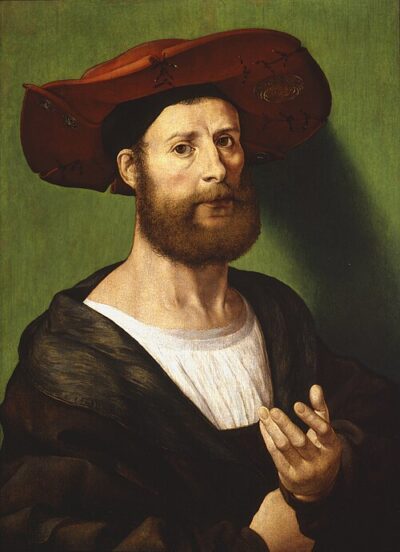
Jan Gossaert
Jan Gossaert was a Flemish painter. Born 1478, in Maubeuge. Died October 1, 1532, in Antwerp. Positions held include court painter. Known for The Adoration of the Kings, Danae and Madonna and Child Playing With the Veil.
Facts
16 facts · 2 confirmed by two sources · 2 cited · 11 from one source · 1 where the sources disagree
What’s different
- Died: we show October 1, 1532 (Confirmed). Wikidata also lists September 12, 1532
- Died in: we show Antwerp (Sources disagree). Wikidata also lists Breda
Where this comes from
Papalocal keeps its own record. It started from these sources; what each one said is kept here as it was copied, so a change on their side never changes this page by itself. Tap one to read its version.
What Wikidata says · copied November 16, 2026 · revision 2567837170
- Described as
- Flemish painter (1478–1532)
- Other names
- Jan Mabuse, Jan Gossaert van Mabuse, Jan of Maubeuge, Jennyn de Waele, Jan de Maubege, Jan Gossaert Mabuse, Nicasius Gossaert van Mauberge, Jan Maubeuge, Nicasius Gossart van Mauberge, Nicasius Gossaert Mauberge, Jan van Henegouwe, John de Mabuse
- Born
- 1478 · 2 references
- Died
- October 1, 1532 · 1 reference; September 12, 1532 · 1 reference
- Born in
- Maubeuge · 1 reference
- Died in
- Antwerp · 1 reference; Breda · 1 reference
- Citizen of
- Holy Roman Empire
- Occupation
- painter · 2 references
- Positions held
- court painter
- Worked for
- Philip of Burgundy
- Member of
- Antwerp Guild of Saint Luke
- Genre
- Northern Renaissance
- Known for
- The Adoration of the Kings; Danae; Madonna and Child Playing With the Veil; Descent from the Cross; The Metamorphosis of Hermaphrodite and Salmacis; Malvagna triptych · 1 reference
- Wikipedias with a page
- 34
Wikidata item Q346952 (wikidata.org/wiki/Q346952), public domain (CC0). Copied November 16, 2026.
What Wikipedia says · copied November 16, 2026 · revision 1378715260
Jan Gossaert (c. 1478 – 1 October 1532) was a French-speaking painter from the Low Countries also known as Jan Mabuse (the name he adopted from his birthplace, Maubeuge) or Jennyn van Hennegouwe (Hainaut), as he called himself when he matriculated in the Guild of Saint Luke, at Antwerp, in 1503. He was one of the first painters of Dutch and Flemish Renaissance painting to visit Italy and Rome, which he did in 1508–09, and a leader of the style known as Romanism, which brought elements of Italian Renaissance painting to the north, sometimes with a rather awkward effect. He achieved fame across at least northern Europe, and painted religious subjects, including large altarpieces, portraits and mythological subjects.
From at least 1508 he was apparently continuously employed, or at least retained, by quasi-royal patrons, mostly members of the extended Habsburg family, heirs to the Valois Duchy of Burgundy. These were Philip of Burgundy, Adolf of Burgundy, Christian II of Denmark when in exile, and Mencía de Mendoza, Countess of Nassau, third wife of Henry III of Nassau-Breda.
A contemporary of Albrecht Dürer and the younger Lucas van Leyden, whom he knew, he was less highly regarded in modern times than they were. As he was not a printmaker like these two artists, his works and fame did not spread as widely as theirs. His surviving drawings are excellent and are preferred by some to his paintings.
- Born, in its opening lines
- c. 1478
- Died, in its opening lines
- October 1, 1532
From the Wikipedia article “Jan Gossaert” (en.wikipedia.org/wiki/Jan_Gossaert), by its contributors, under CC BY-SA 4.0 (creativecommons.org/licenses/by-sa/4.0/). Copied November 16, 2026; not changed.
Confirmed Two sources agree. Cited One source, and it names where it got it. One source One source, without a reference of its own. Sources disagree The sources disagree. We show the best-supported value and keep theirs below.
