
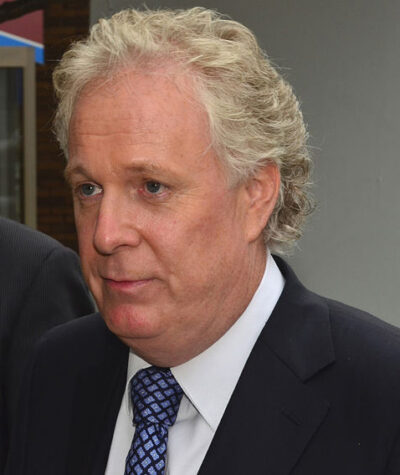
Jean Charest
Jean Charest is the 29th Premier of Quebec. Born June 24, 1958, in Sherbrooke. Positions held include Premier of Quebec (2003–2012), Member of the National Assembly of Quebec (1998–2012) and leader of the Official Opposition of Quebec (1998–2003). Educated at University of Sherbrooke. Awards include Bavarian Order of Merit, Commander of the Legion of Honour and honorary doctorate from University of Grenoble-II.
Facts
24 facts · 1 confirmed by two sources · 5 cited · 18 from one source
Where this comes from
Papalocal keeps its own record. It started from these sources; what each one said is kept here as it was copied, so a change on their side never changes this page by itself. Tap one to read its version.
What Wikidata says · copied November 15, 2026 · revision 2568988585
- Described as
- 29th Premier of Quebec (2003–2012)
- Born
- June 24, 1958 · 4 references
- Born in
- Sherbrooke
- Citizen of
- Canada
- Occupation
- politician; lawyer · 1 reference
- Positions held
- Premier of Quebec (2003–2012); Member of the National Assembly of Quebec (1998–2012); leader of the Official Opposition of Quebec (1998–2003); Deputy Prime Minister of Canada (1993); Minister of the Environment (1991–1993); member of the House of Commons of Canada (1984–1998) · 1 reference
- Political party
- Quebec Liberal Party; Progressive Conservative Party of Canada
- Worked for
- McCarthy Tétrault (2013–) · 2 references; TC Energy · 1 reference
- Education
- University of Sherbrooke
- Awards
- Bavarian Order of Merit; Commander of the Legion of Honour; honorary doctorate from University of Grenoble-II (2009) · 1 reference
- Spouse
- Michèle Dionne
- Children
- Antoine Dionne Charest
- Siblings
- Micheline Charest
- Religion
- Catholic Church
- Lived in
- Montreal
- Wikipedias with a page
- 25
Wikidata item Q48966 (wikidata.org/wiki/Q48966), public domain (CC0). Copied November 15, 2026.
What Wikipedia says · copied November 15, 2026 · revision 1379080934
John James "Jean" Charest (French pronunciation: [ʒɑ̃ ʃɑʁɛ]; born June 24, 1958) is a Canadian lawyer and former politician who served as the 29th premier of Quebec from 2003 to 2012. Prior to that, he was a member of Parliament (MP) between 1984 and 1998. After holding several Cabinet posts from 1986 to 1990 and from 1991 to 1993, he was the leader of the Progressive Conservative Party of Canada from 1993 to 1998.
Born in Sherbrooke, Quebec, Charest worked as a lawyer before becoming an MP following the 1984 federal election. In 1986 he joined Brian Mulroney's government as a minister of state, but resigned from cabinet in 1990 after improperly speaking to a judge about an active court case. He returned to cabinet in 1991 as the minister of the environment. Charest ran to succeed Mulroney as party leader and prime minister in the PCs' 1993 leadership election, but placed second to Kim Campbell. Charest served as Campbell's industry minister and deputy prime minister. After the PCs' defeat in the 1993 election, Charest succeeded Campbell as party leader. He led the PCs to a minor recovery in the 1997 election.
Charest left federal politics in 1998 and was elected to lead the Quebec Liberal Party, the province's main federalist political party. He became premier of Quebec after the Liberals won the 2003 provincial election. He won two more elections until he lost the 2012 election to the sovereigntist Parti Quebecois (PQ) and resigned as premier. After politics, Charest worked as a consultant, including for Huawei on the Meng Wanzhou case and for its 5G network plans in Canada, and joined McCarthy Tétrault LLP as a partner. Charest was a candidate in the 2022 Conservative Party of Canada leadership election, finishing a distant second to Pierre Poilievre.
- Born, in its opening lines
- June 24, 1958
From the Wikipedia article “Jean Charest” (en.wikipedia.org/wiki/Jean_Charest), by its contributors, under CC BY-SA 4.0 (creativecommons.org/licenses/by-sa/4.0/). Copied November 15, 2026; not changed.
Confirmed Two sources agree. Cited One source, and it names where it got it. One source One source, without a reference of its own. Sources disagree The sources disagree. We show the best-supported value and keep theirs below.
