
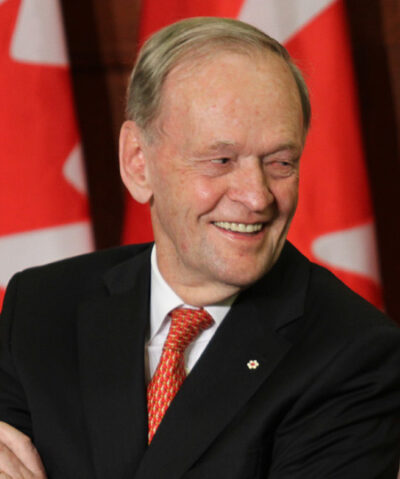
Jean Chrétien
Jean Chrétien is a prime minister of Canada from 1993 to 2003. Born January 11, 1934, in Shawinigan. Positions held include Prime Minister of Canada (1993–2003), Leader of the Official Opposition (1990–1993) and Deputy Prime Minister of Canada (1984). Educated at Faculté de droit de l'Université Laval and Séminaire Saint-Joseph de Trois-Rivières. Awards include Companion of the Order of Canada, Order of Friendship and Order of Merit.
Facts
42 facts · 1 confirmed by two sources · 8 cited · 33 from one source
Where this comes from
Papalocal keeps its own record. It started from these sources; what each one said is kept here as it was copied, so a change on their side never changes this page by itself. Tap one to read its version.
What Wikidata says · copied November 13, 2026 · revision 2568888616
- Described as
- prime minister of Canada from 1993 to 2003
- Other names
- Jean Chretien, Joseph Jacques Jean Chretien, Joseph Jacques Jean Chrétien
- Born
- January 11, 1934 · 8 references
- Born in
- Shawinigan
- Name at birth
- Joseph Jacques Jean Chrétien
- Citizen of
- Canada
- Occupation
- politician · 1 reference; lawyer · 1 reference; diplomat; autobiographer
- Positions held
- Prime Minister of Canada (1993–2003); Leader of the Official Opposition (1990–1993); Deputy Prime Minister of Canada (1984); Minister of Energy, Mines and Resources (1982–1984); Minister of Justice and Attorney General of Canada (1980–1982); Minister of Finance (1977–1979) · 1 reference; President of the Treasury Board (1974–1976); Minister of Crown-Indigenous Relations (1968–1974); Minister of National Revenue (1968); board member; Leader of the Liberal Party of Canada (1990–2003); member of the House of Commons of Canada (2 times) (1963–2003) · 1 reference
- Political party
- Liberal Party of Canada
- Education
- Faculté de droit de l'Université Laval; Séminaire Saint-Joseph de Trois-Rivières
- Awards
- Companion of the Order of Canada; Order of Friendship; Order of Merit; Queen Elizabeth II Silver Jubilee Medal; Queen Elizabeth II Golden Jubilee Medal; Queen Elizabeth II Diamond Jubilee Medal; Honorary doctor of the University of Ottawa; Canadian Newsmaker of the Year (1998); honorary doctorate at the Laval University · 1 reference; Grand Cordon of the Order of the Rising Sun (2023) · 1 reference
- Spouse
- Aline Chrétien
- Children
- Michel Chrétien; France Chrétien Desmarais; Hubert Chrétien
- Father
- Willie Chrétien · 1 reference
- Mother
- Marie Boisvert · 1 reference
- Siblings
- Michel Chrétien
- Religion
- Catholicism
- Height
- 1.88 m (6 ft 2 in) · 1 reference
- Wikipedias with a page
- 64
Wikidata item Q128543 (wikidata.org/wiki/Q128543), public domain (CC0). Copied November 13, 2026.
What Wikipedia says · copied November 13, 2026 · revision 1383958904
Joseph Jacques Jean Chrétien (born January 11, 1934) is a Canadian lawyer and former politician who served as the 20th prime minister of Canada from 1993 to 2003. He served as leader of the Liberal Party from 1990 to 2003 and as leader of the Official Opposition from 1990 to 1993.
Born and raised in Shawinigan Falls, Quebec, Chrétien studied law at Université Laval. A Liberal, he was first elected to the House of Commons in the 1963 federal election. Chrétien served in various cabinet posts in the governments of Lester B. Pearson and Pierre Trudeau, most notably as the minister of Indian affairs and northern development, president of the Treasury Board, minister of finance, and minister of justice. In the last role, Chrétien played a key role in the patriation of the Constitution of Canada and the establishment of the Canadian Charter of Rights and Freedoms. Chrétien ran for the leadership of the Liberal Party in 1984, placing second to John Turner. He then served as deputy prime minister in Turner's short-lived government, which was defeated in the 1984 federal election. Chrétien briefly left politics in 1986 amid tensions with Turner and began working in the private sector. After the Liberals were defeated again in 1988, he returned to politics and won the leadership of the party in 1990 and became leader of the Official Opposition. Chrétien led the Liberal Party to a majority government in the 1993 federal election. He led the Liberals to two additional majorities in 1997 and 2000.
Chrétien became prime minister as Canada was on the brink of a debt crisis due to the country's unsustainable budget deficit. Adhering to a centrist Third Way approach, his government produced a series of austerity budgets which sharply reduced spending and reformed various programs, resulting in a budget surplus in 1997—Canada's first in nearly three decades. The latter half of Chrétien's tenure recorded consecutive budget surpluses which were primarily used to fund tax cuts and pay down government debt. In national unity issues, Chrétien strongly opposed the Quebec sovereignty movement and led the federalist campaign to a narrow victory in the 1995 Quebec referendum. He then launched a federal sponsorship program to promote Canada in Quebec and pioneered the Clarity Act, which established the conditions for future referendums on secession. Chrétien also enacted environmental legislation, including an updated Environmental Protection Act and the Species at Risk Act. He created the long-gun registry, privatized the Canadian National Railway, and introduced the harmonized sales tax (HST). After his election victory in 2000, he oversaw Operation Yellow Ribbon in response to the 9/11 terrorist attacks, enacted the Youth Criminal Justice Act, and laid the groundwork for the legalization of same-sex marriage. In foreign policy, Chrétien's government signed the Kyoto Protocol on climate change and spearheaded the Ottawa Treaty, which aimed to ban anti-personnel landmines worldwide. He authorized military intervention during the NATO bombing of Yugoslavia and the War in Afghanistan, and opposed participation in the Iraq War.
Although his popularity and that of the Liberal Party were seemingly unchallenged for three consecutive federal elections, Chrétien became subject to several controversies. He was accused of corruption in the Shawinigate and sponsorship scandals, although he has consistently denied any wrongdoing. He also became embroiled in a prolonged leadership struggle within the Liberal Party against his finance minister and long-time political rival, Paul Martin. In December 2003, amid pressure from the pro-Martin faction of the party and the threat of losing a leadership review, Chrétien resigned as prime minister and retired from politics. He is Canada's fifth longest-serving prime minister, and ranks highly in rankings of Canadian prime ministers. At age 92, Chrétien is the oldest living former Canadian prime minister.
- Born, in its opening lines
- January 11, 1934
From the Wikipedia article “Jean Chrétien” (en.wikipedia.org/wiki/Jean_Chrétien), by its contributors, under CC BY-SA 4.0 (creativecommons.org/licenses/by-sa/4.0/). Copied November 13, 2026; not changed.
Confirmed Two sources agree. Cited One source, and it names where it got it. One source One source, without a reference of its own. Sources disagree The sources disagree. We show the best-supported value and keep theirs below.
