
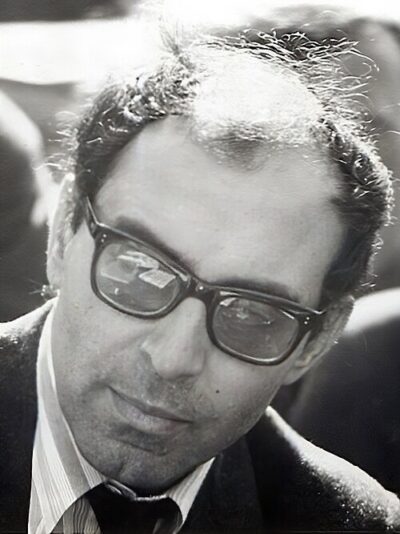
Jean-Luc Godard
Jean-Luc Godard was a French and Swiss film director. Born December 3, 1930, in 7th arrondissement of Paris. Died September 13, 2022, in Rolle. Known for Contempt, Pierrot le Fou and Every Man for Himself. Educated at University of Paris. Awards include Theodor W. Adorno Award, Praemium Imperiale and Sutherland Trophy.
Facts
50 facts · 2 confirmed by two sources · 29 cited · 19 from one source
Where this comes from
Papalocal keeps its own record. It started from these sources; what each one said is kept here as it was copied, so a change on their side never changes this page by itself. Tap one to read its version.
What Wikidata says · copied November 16, 2026 · revision 2567118787
- Described as
- French and Swiss film director (1930–2022)
- Other names
- Jean Luc Godard, JLG
- Born
- December 3, 1930 · 14 references
- Died
- September 13, 2022 · 7 references
- Born in
- 7th arrondissement of Paris · 1 reference
- Died in
- Rolle · 4 references
- Citizen of
- France · 3 references; Switzerland (1953–) · 3 references
- Occupation
- film director · 5 references; actor · 2 references; screenwriter · 6 references; cinematographer · 2 references; film producer · 3 references; film editor · 1 reference; writer; film critic
- Worked for
- Cahiers du cinéma
- Education
- University of Paris
- Member of
- Dziga Vertov Group
- Genre
- French New Wave · 1 reference
- Known for
- Contempt (1963) · 1 reference; Pierrot le Fou (1965) · 1 reference; Every Man for Himself (1980); Breathless
- Awards
- Theodor W. Adorno Award (1995); Praemium Imperiale (2002) · 1 reference; Sutherland Trophy (1965); Golden Lion (1983); Honorary César (2 times) (1987, 1998) · 1 reference; Louis Delluc Prize (1987); Academy Honorary Award (2011) · 1 reference; Jury Prize (2014) · 1 reference; Golden Bear (1965) · 1 reference; Leopard of Honour (1995); European Film Academy Lifetime Achievement Award (2007) · 1 reference; Silver Bear for Best Director (1960) · 1 reference; Silver Lion (1962); Golden Lion for Lifetime Achievement (1982); Palme d'Or (2018) · 1 reference
- Field
- film · 1 reference; cinematography · 1 reference; French New Wave · 1 reference; film direction · 1 reference; film theory · 1 reference; film criticism · 1 reference
- Spouse
- Anne Wiazemsky (1967–1970) · 1 reference; Anne-Marie Miéville (1971–2022); Anna Karina (1961–1967) · 1 reference
- Father
- Paul Godard · 1 reference
- Mother
- Odile Monod · 1 reference
- Religion
- reformed · 1 reference
- Height
- 1.70 m (5 ft 7 in) · 1 reference
- Wikipedias with a page
- 99
Wikidata item Q53001 (wikidata.org/wiki/Q53001), public domain (CC0). Copied November 16, 2026.
What Wikipedia says · copied November 16, 2026 · revision 1383048202
Jean-Luc Godard (UK: GOD-ar, US: goh-DAR; French: [ʒɑ̃ lyk ɡɔdaʁ] ; 3 December 1930 – 13 September 2022) was a French and Swiss film director, screenwriter, and film critic. He rose to prominence as a pioneer of the French New Wave film movement of the 1960s, alongside such filmmakers as François Truffaut, Agnès Varda, Éric Rohmer and Jacques Demy. He was arguably the most influential French filmmaker of the post-war era. According to AllMovie, his work "revolutionized the motion picture form" through its experimentation with narrative, continuity, sound, and camerawork.
During his early career as a film critic for Cahiers du Cinéma, Godard criticized mainstream French cinema's "Tradition of Quality" and championed Hollywood directors like Alfred Hitchcock and Howard Hawks. In response, he and like-minded critics began to make their own films, challenging the conventions of traditional Hollywood in addition to French cinema. Godard first received global acclaim for Breathless (1960), a milestone in the New Wave movement. His work makes use of frequent homages and references to film history, and often expressed his political views; he was an avid reader of existentialism and Marxist philosophy, and in 1969 formed the Dziga Vertov Group with other radical filmmakers to promote political works. After the New Wave, his politics were less radical, and his later films came to be about human conflict and artistic representation "from a humanist rather than Marxist perspective." He explained that "As a critic, I thought of myself as a film-maker. Today I still think of myself as a critic, and in a sense I am, more than ever before. Instead of writing criticism, I make a film, but the critical dimension is subsumed."
Godard was married three times, to actresses Anna Karina and Anne Wiazemsky, both of whom starred in several of his films, and later to his longtime partner Anne-Marie Miéville. His collaborations with Karina in Vivre sa vie (1962), Bande à part (1964) and Pierrot le Fou (1965) were called "arguably the most influential body of work in the history of cinema" by Filmmaker magazine. In a 2002 Sight & Sound poll, Godard ranked third in the critics' top ten directors of all time.
He is said to have "generated one of the largest bodies of critical analysis of any filmmaker since the mid-twentieth century." His work has been central to narrative theory and has "challenged both commercial narrative cinema norms and film criticism's vocabulary." In 1987 and 1998, he was honoured with two Honorary César and received the Praemium Imperiale in 2002. In 2010, Godard was awarded an Academy Honorary Award. He was known for his aphorisms, such as "All you need to make a movie is a girl and a gun" and "A film consists of a beginning, a middle and an end, though not necessarily in that order." Some critics have claimed that Godard's films contain prevailing themes of misogyny and sexism towards women. Feminist film theorist Laura Mulvey, has agreed that "While trying to decode a deep-seated, but interesting, misogyny, I came to think that Godard's cinema knows its own entrapment...for feminist curiosity, it is still a goldmine."
- Born, in its opening lines
- December 3, 1930
- Died, in its opening lines
- September 13, 2022
From the Wikipedia article “Jean-Luc Godard” (en.wikipedia.org/wiki/Jean-Luc_Godard), by its contributors, under CC BY-SA 4.0 (creativecommons.org/licenses/by-sa/4.0/). Copied November 16, 2026; not changed.
Confirmed Two sources agree. Cited One source, and it names where it got it. One source One source, without a reference of its own. Sources disagree The sources disagree. We show the best-supported value and keep theirs below.
