
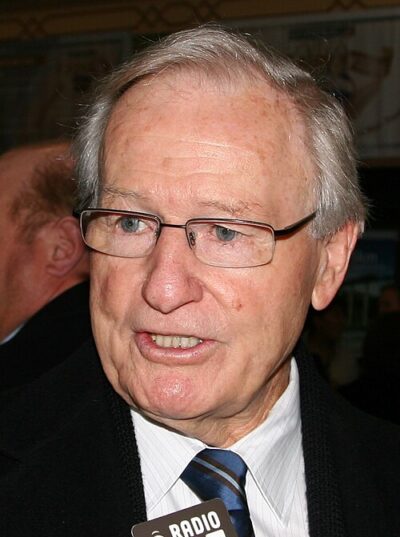
Jim Bolger
Jim Bolger was a Prime Minister of New Zealand from 1990 to 1997. Born May 31, 1935, in Ōpunake. Died October 15, 2025, in Wellington. Positions held include Prime Minister of New Zealand (1990–1997), Leader of the Opposition (1986–1990) and Member of the New Zealand Parliament (1972–1998). Educated at Opunake High School. Awards include Order of New Zealand, New Zealand Suffrage Centennial Medal 1993 and New Zealand 1990 Commemoration Medal.
Facts
27 facts · 2 confirmed by two sources · 12 cited · 13 from one source
Where this comes from
Papalocal keeps its own record. It started from these sources; what each one said is kept here as it was copied, so a change on their side never changes this page by itself. Tap one to read its version.
What Wikidata says · copied November 16, 2026 · revision 2557948585
- Described as
- Prime Minister of New Zealand from 1990 to 1997
- Other names
- James Brendan Bolger, James Bolger, The Right Honourable James Brendan Bolger
- Born
- May 31, 1935 · 3 references
- Died
- October 15, 2025 · 2 references
- Born in
- Ōpunake · 2 references
- Died in
- Wellington · 1 reference
- Cause of death
- kidney failure
- Citizen of
- New Zealand
- Occupation
- politician · 1 reference; diplomat; farmer
- Positions held
- Prime Minister of New Zealand (1990–1997); Leader of the Opposition (1986–1990); Member of the New Zealand Parliament (1972–1998); ambassador of New Zealand to the United States (1998–2002) · 1 reference; Minister of Fisheries (1977–1978); Minister of Immigration (1978–1981)
- Political party
- New Zealand National Party
- Education
- Opunake High School
- Awards
- Order of New Zealand (1997) · 1 reference; New Zealand Suffrage Centennial Medal 1993 (1993) · 1 reference; New Zealand 1990 Commemoration Medal · 1 reference; Queen Elizabeth II Silver Jubilee Medal · 1 reference; Distinguished Fellow of the Institute of Directors (2010) · 1 reference; honorary doctor of Massey University (2002) · 1 reference; honorary doctor of the University of Waikato (2019) · 1 reference
- Spouse
- Joan Bolger (1963–2025) · 1 reference
- Religion
- Catholicism
- Lived in
- Wellington (1993) · 1 reference
- Wikipedias with a page
- 30
Wikidata item Q139785 (wikidata.org/wiki/Q139785), public domain (CC0). Copied November 16, 2026.
What Wikipedia says · copied November 16, 2026 · revision 1385990362
James Brendan Bolger ( BOL-jər; 31 May 1935 – 15 October 2025) was a New Zealand politician, diplomat, and farmer who served as the 35th prime minister of New Zealand from 1990 to 1997. A member of the New Zealand National Party, he served as the party's leader from 1986 to 1997, and was Leader of the Opposition from 1986 to 1990. He later served as the 14th New Zealand ambassador to the United States from 1998 to 2002, and as the 11th chancellor of the University of Waikato from 2007 to 2019.
Bolger was born in Ōpunake, Taranaki, to Irish immigrants. Before entering politics, he farmed in Waikato, and was involved in Federated Farmers—a nationwide agricultural association. Bolger won election to Parliament in 1972, and subsequently served in several portfolios in the Third National Government. Following one unsuccessful bid for the party leadership in 1984, Bolger was elected as National Party leader in 1986, and thus became Leader of the Opposition.
Bolger led the National Party to a landslide victory—the largest in its history—in the 1990 election, leading him to become prime minister in November. The Fourth National Government was elected on the promise of delivering a "Decent Society" following the previous Labour government's economic reforms, known as "Rogernomics", which Bolger criticised. However, shortly after taking office, his government was forced to bail out the Bank of New Zealand and as a result reneged on many promises made during the election campaign. Bolger's government essentially advanced the free-market reforms of the previous government, while implementing drastic cuts in public spending. National retained power in the 1993 election, albeit with a much-reduced majority.
Bolger's second term in office saw the introduction of the MMP electoral system. In the subsequent 1996 election, National emerged as the largest party, but it was forced to enter into a coalition with New Zealand First. Bolger continued as prime minister; however, his critics argued that he gave the inexperienced NZ First too much influence in his Cabinet. In December 1997, Bolger was effectively ousted as leader by his party caucus, and was replaced as prime minister by Jenny Shipley.
After resigning from Parliament and thus retiring from politics 1998, Bolger was appointed New Zealand Ambassador to the United States by Prime Minister Shipley, a role he served until 2002. In February 2007, Bolger was elected Chancellor of the University of Waikato and served in the role until his retirement in 2019.
- Born, in its opening lines
- May 31, 1935
- Died, in its opening lines
- October 15, 2025
From the Wikipedia article “Jim Bolger” (en.wikipedia.org/wiki/Jim_Bolger), by its contributors, under CC BY-SA 4.0 (creativecommons.org/licenses/by-sa/4.0/). Copied November 16, 2026; not changed.
Confirmed Two sources agree. Cited One source, and it names where it got it. One source One source, without a reference of its own. Sources disagree The sources disagree. We show the best-supported value and keep theirs below.
