
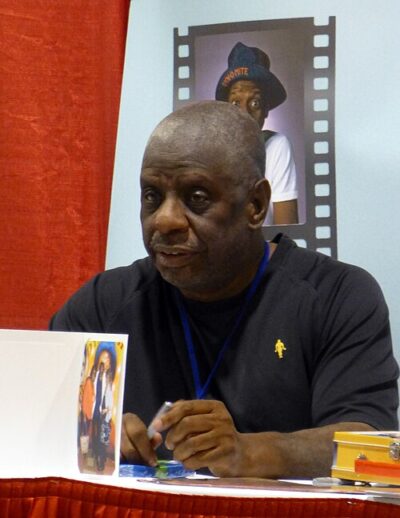
Jimmie Walker is an American actor. Born June 25, 1947, in The Bronx. Educated at Theodore Roosevelt High School.
Facts
9 facts · 1 confirmed by two sources · 4 cited · 4 from one source
Where this comes from
Papalocal keeps its own record. It started from these sources; what each one said is kept here as it was copied, so a change on their side never changes this page by itself. Tap one to read its version.
What Wikidata says · copied November 18, 2026 · revision 2567835181
- Described as
- American actor
- Born
- June 25, 1947 · 1 reference
- Born in
- The Bronx · 1 reference
- Citizen of
- United States
- Occupation
- actor · 1 reference; television actor; comedian · 1 reference
- Political party
- Republican Party · 1 reference
- Education
- Theodore Roosevelt High School · 1 reference
- Website
- http://www.dynomitejj.com/front.html
- Wikipedias with a page
- 18
Wikidata item Q1290449 (wikidata.org/wiki/Q1290449), public domain (CC0). Copied November 18, 2026.
What Wikipedia says · copied November 18, 2026 · revision 1377669554
James Carter Walker Jr. (born June 25, 1947) is an American actor and comedian. He portrayed James ("J.J.") Evans Jr., the older son of James Evans Sr. and Florida Evans, on the CBS television comedy series Good Times. The show ran from 1974 to 1979, and Walker was nominated for a Golden Globe Award in 1975 and 1976 for his role as J.J. On Good Times, Walker's character was known for his catchphrase "Dyn-o-mite!", and the actor later used it in his mid-1970s TV commercials for Panasonic cassette and 8-track tape players and in a 2021–2023 public announcement for Medicare.
Walker also starred in Let's Do It Again (1975) with John Amos, and The Greatest Thing That Almost Happened (1977) with James Earl Jones. Walker continues to tour the country with his stand-up comedy routine.
- Born, in its opening lines
- June 25, 1947
From the Wikipedia article “Jimmie Walker” (en.wikipedia.org/wiki/Jimmie_Walker), by its contributors, under CC BY-SA 4.0 (creativecommons.org/licenses/by-sa/4.0/). Copied November 18, 2026; not changed.
Confirmed Two sources agree. Cited One source, and it names where it got it. One source One source, without a reference of its own. Sources disagree The sources disagree. We show the best-supported value and keep theirs below.
