
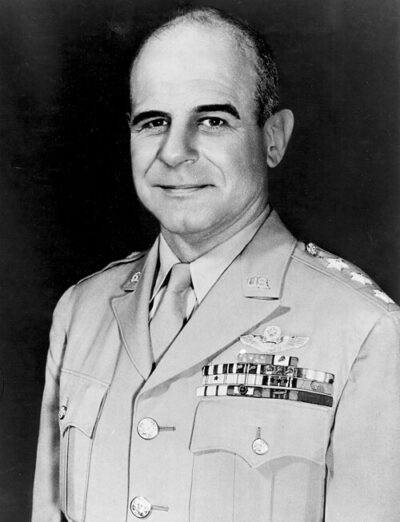
Jimmy Doolittle
Jimmy Doolittle was an American military officer and aviation pioneer. Born December 14, 1896, in Alameda. Died September 27, 1993, in Pebble Beach. Educated at University of California, Berkeley and Massachusetts Institute of Technology. Awards include Distinguished Flying Cross, Bronze Star Medal and Knight Commander of the Order of the Bath.
Facts
34 facts · 2 confirmed by two sources · 9 cited · 23 from one source
Where this comes from
Papalocal keeps its own record. It started from these sources; what each one said is kept here as it was copied, so a change on their side never changes this page by itself. Tap one to read its version.
What Wikidata says · copied November 15, 2026 · revision 2557964806
- Described as
- American military officer and aviation pioneer (1896–1993)
- Other names
- James Harold "Jimmy" Doolittle, James H. Doolittle, James Harold Doolittle
- Born
- December 14, 1896 · 8 references
- Died
- September 27, 1993 · 7 references
- Born in
- Alameda · 2 references
- Died in
- Pebble Beach · 2 references
- Buried in
- Arlington National Cemetery
- Citizen of
- United States
- Occupation
- aircraft pilot · 1 reference; military officer; engineer · 1 reference
- Education
- University of California, Berkeley (1922) · 1 reference; Massachusetts Institute of Technology · 1 reference; Manual Arts High School · 1 reference; Air Force Institute of Technology; Los Angeles City College; Massachusetts Institute of Technology School of Engineering (2 times) (1924, 1925) · 1 reference
- Awards
- Distinguished Flying Cross; Bronze Star Medal; Knight Commander of the Order of the Bath; Medal of Honor; Presidential Medal of Freedom (1989) · 1 reference; Air Medal; Silver Star; Daniel Guggenheim Medal (1942) · 1 reference; Harmon Trophy; National Aviation Hall of Fame (1967) · 1 reference; NAS Public Welfare Medal (1959) · 1 reference; Asiatic-Pacific Campaign Medal · 1 reference; European-African-Middle Eastern Campaign Medal · 1 reference; Legion of Honour · 1 reference; Order of the Condor of the Andes · 1 reference
- Military branch
- United States Air Force
- Military rank
- general · 1 reference; general · 1 reference
- Nickname
- Jimmy
- Wikipedias with a page
- 31
Wikidata item Q366547 (wikidata.org/wiki/Q366547), public domain (CC0). Copied November 15, 2026.
What Wikipedia says · copied November 15, 2026 · revision 1381728579
James Harold "Jimmy" Doolittle (December 14, 1896 – September 27, 1993) was an American military general and aviation pioneer who received the Medal of Honor for his raid on Japan during World War II, known as the Doolittle Raid in his honor. He made early coast-to-coast flights and record-breaking speed flights, won many flying races, and helped develop and flight-test instrument flying. According to the FAA, he was the first pilot ever to perform a successful instrument flight.
Doolittle grew up in Nome, Alaska. He attended the University of California, Berkeley, where he graduated with a Bachelor of Arts in 1922. That year, he made the first cross-country flight in an Airco DH.4, and in 1925, was awarded a doctorate in aeronautics from the Massachusetts Institute of Technology, the first such doctorate degree issued in the United States. In 1927, he performed the first outside loop, thought at the time to be a fatal aerobatic maneuver, and two years later, in 1929, pioneered the use of "blind flying", where a pilot relies on flight instruments alone, which later won him the Harmon Trophy and made all-weather airline operations practical.
Doolittle was a flying instructor during World War I and a reserve officer in the United States Army Air Corps, but was recalled to active duty during World War II. He was awarded the Medal of Honor for personal valor and leadership as commander of the Doolittle Raid, a bold long-range retaliatory air raid on some of the Japanese main islands on April 18, 1942, four months after the attack on Pearl Harbor. The raid used 16 North American B-25B Mitchell medium bombers with reduced armament to decrease weight and increase range, each with a crew of five and no escort fighter aircraft. It was a major morale booster for the United States and Doolittle was celebrated as a hero, making him one of the most important national figures of the war.
Doolittle was promoted to lieutenant general and commanded the Twelfth Air Force over North Africa, the Fifteenth Air Force over the Mediterranean, and the Eighth Air Force over Europe. He retired from the Air Force in 1959 but remained active in many technical fields. Doolittle was inducted into the National Aviation Hall of Fame in 1967, eight years after retirement and only five years after the Hall was founded. He was eventually promoted to general in 1985, presented to him by President Ronald Reagan 43 years after the Doolittle Raid. In 2003, he topped Air & Space/Smithsonian magazine's list of the greatest pilots of all time, and ten years later, Flying magazine ranked Doolittle sixth on its list of the 51 Heroes of Aviation. He died in 1993 at the age of 96, and was buried at Arlington National Cemetery.
- Born, in its opening lines
- December 14, 1896
- Died, in its opening lines
- September 27, 1993
From the Wikipedia article “Jimmy Doolittle” (en.wikipedia.org/wiki/Jimmy_Doolittle), by its contributors, under CC BY-SA 4.0 (creativecommons.org/licenses/by-sa/4.0/). Copied November 15, 2026; not changed.
Confirmed Two sources agree. Cited One source, and it names where it got it. One source One source, without a reference of its own. Sources disagree The sources disagree. We show the best-supported value and keep theirs below.
