
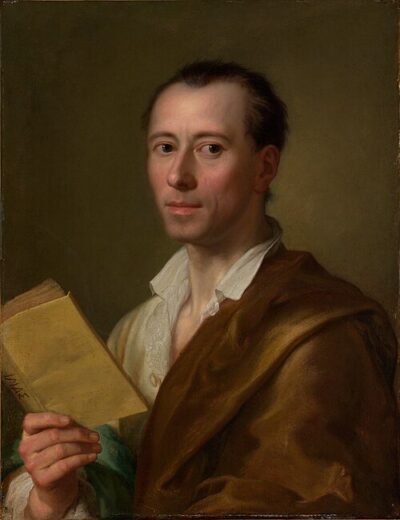
Johann Joachim Winckelmann
Johann Joachim Winckelmann was a German art historian and archaeologist, and conservator of the Vatican Library. Born December 9, 1717, in Stendal. Died June 8, 1768, in Trieste. Known for Thoughts on the Imitation of Greek Works in Painting and the Art of Sculpture and Geschichte der Kunst des Alterthums. Educated at Martin Luther University Halle-Wittenberg and Köllnisches Gymnasium.
Facts
25 facts · 2 confirmed by two sources · 11 cited · 12 from one source
Where this comes from
Papalocal keeps its own record. It started from these sources; what each one said is kept here as it was copied, so a change on their side never changes this page by itself. Tap one to read its version.
What Wikidata says · copied November 16, 2026 · revision 2569159188
- Described as
- German art historian and archaeologist, and conservator of the Vatican Library (1717–1768)
- Other names
- Giovanni Winkelmann, Johann Winkelmann, Ioann Vinkelman, Winckelmann
- Born
- December 9, 1717 · 13 references
- Died
- June 8, 1768 · 12 references
- Born in
- Stendal · 4 references
- Died in
- Trieste · 1 reference
- Buried in
- Trieste Cathedral
- Cause of death
- stab wound · 1 reference
- Citizen of
- Kingdom of Prussia
- Occupation
- art historian · 1 reference; librarian · 2 references; archaeologist · 5 references; historian; writer · 1 reference; in-home tutor; antiquarian bookseller · 1 reference
- Education
- Martin Luther University Halle-Wittenberg (1738–1740); Köllnisches Gymnasium (1736–); University of Jena (1741–1742)
- Member of
- Göttingen Academy of Sciences and Humanities in Lower Saxony
- Known for
- Thoughts on the Imitation of Greek Works in Painting and the Art of Sculpture; Geschichte der Kunst des Alterthums
- Field
- history of art; aesthetics · 1 reference; art history · 1 reference; archaeology · 1 reference
- Religion
- Catholic Church
- Wikipedias with a page
- 62
Wikidata item Q57280 (wikidata.org/wiki/Q57280), public domain (CC0). Copied November 16, 2026.
What Wikipedia says · copied November 16, 2026 · revision 1382037831
Johann Joachim Winckelmann (US: VINK-əl-mahn; German: [ˈjoːhan ˈjoːaxɪm ˈvɪŋkl̩man]; 9 December 1717 – 8 June 1768) was a German art historian and archaeologist. He was a pioneering Hellenist who first articulated the differences between Greek, Greco-Roman and Roman art. "The prophet and founding hero of modern archaeology", Winckelmann was one of the founders of scientific archaeology and first applied the categories of style on a large, systematic basis to the history of art. Many consider him the father of the discipline of art history. He was one of the first to separate Greek art into periods and time classifications.
He had a decisive influence on the rise of the Neoclassical movement during the late 18th century. His writings influenced not only a new science of archaeology and art history but Western painting, sculpture, literature and even philosophy. Winckelmann's History of Ancient Art (1764) was one of the first books written in German to become a classic of European literature. His subsequent influence on Gotthold Ephraim Lessing, Johann Gottfried Herder, Johann Wolfgang von Goethe, Friedrich Hölderlin, Heinrich Heine, Friedrich Nietzsche, Stefan George and Oswald Spengler has been provocatively called "the Tyranny of Greece over Germany".
Winckelmann maintained frequent correspondence with close male friends. He was frequently reflecting on male friendship through the lens of classical Greek ideals. In a 1752 letter, he expressed a great admiration for Frederick the Great as a "divine monarch" and praised Potsdam as a modern revival of "Athens and Sparta". Subsequent biographers and art historians—including Berthold Vallentin in his 1931 biography—have analyzed the presence of homoerotic themes and classical male friendship or männliche Liebe in his private letters. Winckelman's letters and aesthetic writings were celebrated by Johann Wolfgang von Goethe who understood them through a Platonic lens in his 1805 memorial essay Winckelmann und sein Jahrhundert.
In his major work, Geschichte der Kunst des Alterthums or The History of Ancient Art (1764), Winckelmann acknowledged classical literary evidence (such as Plato) indicating that ancient Greek sculptures were originally painted. Despite this awareness, he regarded color as secondary to line, outline, and design (Zeichnung). Winckelmann argued that white marble was optically superior for revealing form, writing that "color contributes to beauty, but it is not beauty itself" and that white surfaces reflect the greatest number of light rays.
- Born, in its opening lines
- December 9, 1717
- Died, in its opening lines
- June 8, 1768
From the Wikipedia article “Johann Joachim Winckelmann” (en.wikipedia.org/wiki/Johann_Joachim_Winckelmann), by its contributors, under CC BY-SA 4.0 (creativecommons.org/licenses/by-sa/4.0/). Copied November 16, 2026; not changed.
Confirmed Two sources agree. Cited One source, and it names where it got it. One source One source, without a reference of its own. Sources disagree The sources disagree. We show the best-supported value and keep theirs below.
