
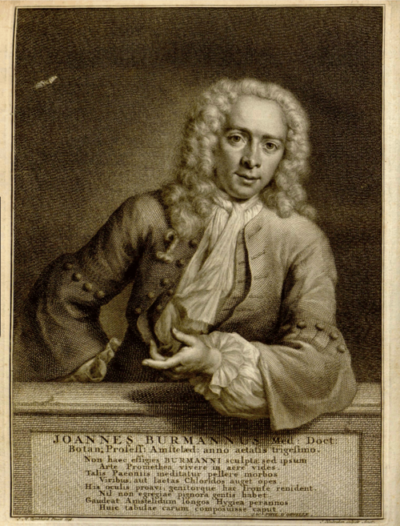
Johannes Burman
Johannes Burman was a Dutch botanist. Born April 26, 1707, in Amsterdam. Died January 20, 1779, in Amsterdam.
Facts
16 facts · 1 confirmed by two sources · 7 cited · 7 from one source · 1 where the sources disagree
What’s different
- Died: we show January 20, 1779 (Sources disagree). Wikipedia says February 20, 1780
Where this comes from
Papalocal keeps its own record. It started from these sources; what each one said is kept here as it was copied, so a change on their side never changes this page by itself. Tap one to read its version.
What Wikidata says · copied November 18, 2026 · revision 2565839881
- Described as
- Dutch botanist
- Other names
- Burm., J. Burman, Joannes Burmannus
- Born
- April 26, 1707 · 3 references
- Died
- January 20, 1779 · 3 references
- Born in
- Amsterdam · 1 reference
- Died in
- Amsterdam · 1 reference
- Citizen of
- Dutch Republic · 1 reference
- Occupation
- botanist · 1 reference; physician · 1 reference; university teacher · 1 reference; biologist · 1 reference
- Worked for
- Athenaeum Illustre of Amsterdam (1755–1777); Collegium Chirurgicum Amstelaedamense (1731–1777)
- Member of
- German Academy of Sciences Leopoldina; Russian Academy of Sciences
- Field
- biology
- Children
- Nicolaas Laurens Burman · 1 reference
- Father
- Frans Burman · 1 reference
- Wikipedias with a page
- 20
Wikidata item Q957115 (wikidata.org/wiki/Q957115), public domain (CC0). Copied November 18, 2026.
What Wikipedia says · copied November 18, 2026 · revision 1379503128
Johannes Burman (26 April 1707 in Amsterdam – 20 February 1780), was a Dutch botanist and physician. Burman specialized in plants from Ceylon, Amboina and Cape Colony. The name Pelargonium was introduced by Johannes Burman.
Johannes Burman was the eldest son of the theologian Frans Burman (1671–1719) and his wife Elizabeth Thierens. His brother was the theologian Frans Burman (1708–1793). He started his studies in Leiden in 1722 under Herman Boerhaave, and qualified in 1728 as a doctor of medicine, after which he practised in Amsterdam. After the death of Frederik Ruysch he was appointed Professor of Botany in Amsterdam. Johannes Burman was married to Adriana van Buuren. Their son Nicolaas Laurens Burman was also a botanist and studied under Linné in Uppsala.
Carl Linnaeus, in 1735 on a trip through Holland, was invited by Burman, carrying a letter of recommendation from Herman Boerhaave. Burman was impressed by his near-contemporary and offered him accommodation in his home on Keizersgracht. Linnaeus was employed by Burman for almost six weeks to complete a flora of the plants of Ceylon.
Burman introduced Linnaeus to George Clifford III and Clifford showed them a fantastic book. It was not in Burman's collections and Clifford said he could have it in exchange for Linnaeus who was employed to survey the gardens and the menagerie at Hartekamp. Burman was later commemorated by Linné in the genus Burmannia and family Burmanniaceae.
Burmann published his book with plants from the Cape Colony based on a collection by Nicolaes Witsen, the work of Caspar Commelin and Simon van der Stel. In his book on Amboinese plants, he used the work of Rumphius. For research and as illustrations on plants from the West Indies he used the work of the French botanist Charles Plumier.
The standard author abbreviation Burm. is used to indicate this individual as the author when citing a botanical name.
- Born, in its opening lines
- April 26, 1707
- Died, in its opening lines
- February 20, 1780
From the Wikipedia article “Johannes Burman” (en.wikipedia.org/wiki/Johannes_Burman), by its contributors, under CC BY-SA 4.0 (creativecommons.org/licenses/by-sa/4.0/). Copied November 18, 2026; not changed.
Confirmed Two sources agree. Cited One source, and it names where it got it. One source One source, without a reference of its own. Sources disagree The sources disagree. We show the best-supported value and keep theirs below.
