
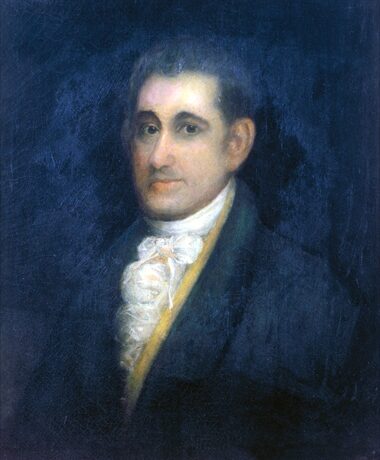
John Adair
John Adair was an American politician. Born January 9, 1757, in Chester County. Died May 19, 1840, in Harrodsburg. Positions held include United States representative (1831–1833), Governor of Kentucky (1820–1824) and United States senator (1805–1806).
Facts
23 facts · 2 confirmed by two sources · 5 cited · 16 from one source
What’s different
- Died: we show May 19, 1840 (Confirmed). Wikidata also lists May 18, 1840
Where this comes from
Papalocal keeps its own record. It started from these sources; what each one said is kept here as it was copied, so a change on their side never changes this page by itself. Tap one to read its version.
What Wikidata says · copied November 16, 2026 · revision 2569099278
- Described as
- American politician (1757–1840)
- Born
- January 9, 1757 · 4 references
- Died
- May 19, 1840 · 1 reference; May 18, 1840 · 1 reference
- Born in
- Chester County
- Died in
- Harrodsburg · 1 reference
- Buried in
- Frankfort Cemetery
- Citizen of
- United States
- Occupation
- politician · 1 reference; military personnel; registrar (1805–) · 1 reference
- Positions held
- United States representative (1831–1833); Governor of Kentucky (1820–1824); United States senator (1805–1806) · 1 reference; member of the Kentucky House of Representatives
- Political party
- Democratic-Republican Party; Democratic Party
- Children
- Ellen Adair White Beatty; Eliza Palmer Monroe; Margaret Lapsley Anderson
- Father
- William Adair
- Siblings
- William ADAIR
- Military branch
- United States Armed Forces; Continental Army (1775–1783) · 1 reference
- Military rank
- major general
- Wikipedias with a page
- 23
Wikidata item Q11595 (wikidata.org/wiki/Q11595), public domain (CC0). Copied November 16, 2026.
What Wikipedia says · copied November 16, 2026 · revision 1382327163
John Adair (January 9, 1757 – May 19, 1840) was an American pioneer, slave trader, soldier, and politician. He was the eighth governor of Kentucky and represented the state in both the U.S. House and Senate. A native of South Carolina, Adair enlisted in the state militia and served in the Revolutionary War, during which he was twice captured and held as a prisoner of war by the British. Following the War, he was elected as a delegate to South Carolina's convention to ratify the United States Constitution.
After moving to Kentucky in 1786, Adair participated in the Northwest Indian War, including a skirmish with the Miami Chief Little Turtle near Fort St. Clair in 1792. Popular for his service in two wars, he entered politics in 1792 as a delegate to Kentucky's constitutional convention. Adair was elected to a total of eight terms in the state House of Representatives between 1793 and 1803. He served as Speaker of the Kentucky House in 1802 and 1803, and was a delegate to the state's Second Constitutional Convention in 1799. He ascended to the United States Senate to fill the seat vacated when John Breckinridge resigned to become Attorney General of the United States in the Cabinet of Thomas Jefferson, but failed to win a full term in the subsequent election due to his implication in a treason conspiracy involving Vice President Aaron Burr. After a long legal battle, he was acquitted of any wrongdoing; and his accuser, General James Wilkinson, was ordered to issue an apology. The negative publicity kept him out of politics for more than a decade.
Adair's participation in the War of 1812, and a subsequent protracted defense of Kentucky's soldiers against General Andrew Jackson's charges that they showed cowardice at the Battle of New Orleans, restored his reputation. He returned to the State House in 1817, and Isaac Shelby, his commanding officer in the War who was serving a second term as governor, appointed him adjutant general of the state militia. In 1820, Adair was elected eighth governor on a platform of financial relief for Kentuckians hit hard by the Panic of 1819, and the ensuing economic recession. His primary effort toward this end was the creation of the Bank of the Commonwealth, but many of his other financial reforms were deemed unconstitutional by the Kentucky Court of Appeals, touching off the Old Court–New Court controversy. Following his term as governor, Adair served one undistinguished term in the United States House of Representatives and did not run for re-election.
- Born, in its opening lines
- January 9, 1757
- Died, in its opening lines
- May 19, 1840
From the Wikipedia article “John Adair” (en.wikipedia.org/wiki/John_Adair), by its contributors, under CC BY-SA 4.0 (creativecommons.org/licenses/by-sa/4.0/). Copied November 16, 2026; not changed.
Confirmed Two sources agree. Cited One source, and it names where it got it. One source One source, without a reference of its own. Sources disagree The sources disagree. We show the best-supported value and keep theirs below.
