
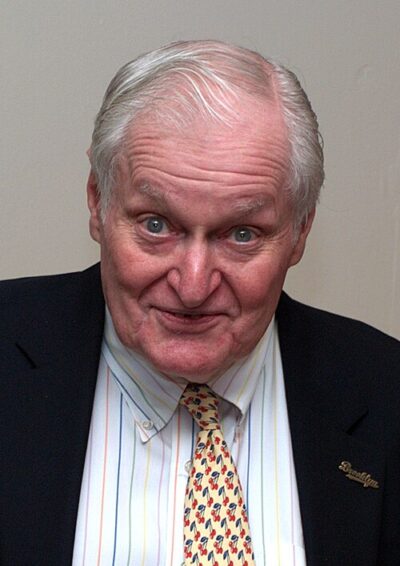
John Ashbery
John Ashbery was a poet from the United States of America. Born July 28, 1927, in Rochester. Died September 3, 2017, in Hudson. Known for Self-portrait in a Convex Mirror, The Tennis Court Oath and Flow Chart. Educated at Harvard University and Columbia University. Awards include National Humanities Medal, New York Writers Hall of Fame and honorary doctor of Yale University.
Facts
52 facts · 2 confirmed by two sources · 27 cited · 23 from one source
Where this comes from
Papalocal keeps its own record. It started from these sources; what each one said is kept here as it was copied, so a change on their side never changes this page by itself. Tap one to read its version.
What Wikidata says · copied November 14, 2026 · revision 2568874112
- Described as
- poet from the United States of America (1927–2017)
- Other names
- John Lawrence Ashbery, Jon Asshuberī, Jonas Barry, G'on Ashberi, John Ashberry
- Born
- July 28, 1927 · 10 references
- Died
- September 3, 2017 · 8 references
- Born in
- Rochester · 3 references
- Died in
- Hudson · 2 references
- Citizen of
- United States · 1 reference
- Occupation
- poet · 1 reference; writer · 1 reference; university teacher · 1 reference; journalist; art critic; translator
- Worked for
- Bard College · 1 reference; Brooklyn College · 1 reference; New York Herald Tribune; New York; Partisan Review; Harvard University
- Education
- Harvard University · 1 reference; Columbia University · 1 reference; New York University; Deerfield Academy · 1 reference; Harvard College
- Member of
- American Academy of Arts and Letters; American Academy of Arts and Sciences; Accademia Nazionale dei Lincei (2006–) · 1 reference
- Genre
- poetry
- Known for
- Self-portrait in a Convex Mirror; The Tennis Court Oath; Flow Chart; Hotel Lautréamont; Girls on the Run; Chinese Whispers; Where Shall I Wander; A Wave
- Awards
- National Humanities Medal (2011) · 2 references; New York Writers Hall of Fame (2011) · 1 reference; honorary doctor of Yale University (2008) · 1 reference; America Award in Literature (2008) · 1 reference; Robert Frost Medal (1995) · 1 reference; Chevalier des Arts et des Lettres (1993) · 1 reference; Feltrinelli Prize (1992) · 1 reference; MacArthur Fellows Program (1985) · 2 references; Bollingen Prize (1985) · 1 reference; Fellow of the American Academy of Arts and Sciences (1983) · 1 reference; Fellowship of the Academy of American Poets (1982) · 1 reference; Pulitzer Prize for Poetry (1976) · 1 reference; National Book Critics Circle Award for Poetry (2 times) (1975, 1976) · 1 reference; Guggenheim Fellowship (2 times) (1967, 1973) · 1 reference; Shelley Memorial Award (1973) · 1 reference
- Field
- poetry · 1 reference; translation from French · 1 reference
- Spouse
- David Kermani · 1 reference
- Wikipedias with a page
- 40
Wikidata item Q29418 (wikidata.org/wiki/Q29418), public domain (CC0). Copied November 14, 2026.
What Wikipedia says · copied November 14, 2026 · revision 1384470647
John Lawrence Ashbery (July 28, 1927 – September 3, 2017) was an American poet and art critic.
Ashbery is considered the most influential American poet of his time. Oxford University literary critic John Bayley wrote that Ashbery "sounded, in poetry, the standard tones of the age." Langdon Hammer, chair of the English Department at Yale University, wrote in 2008, "No figure looms so large in American poetry over the past 50 years as John Ashbery" and "No American poet has had a larger, more diverse vocabulary, not Whitman, not Pound." Stephanie Burt, a poet and Harvard professor of English, has compared Ashbery to T. S. Eliot, calling Ashbery "the last figure whom half the English-language poets alive thought a great model, and the other half thought incomprehensible".
Ashbery published more than 20 volumes of poetry. Among other awards, he received the Pulitzer Prize for Poetry, National Book Award, and National Book Critics Circle Award for his collection Self-Portrait in a Convex Mirror (1975). In 2007, he became the first living poet to be anthologized by the Library of America. Renowned for its postmodern complexity and opacity, his work still proves controversial. Ashbery said he wished his work to be accessible to as many people as possible, not a private dialogue with himself. He also joked that some critics still view him as "a harebrained, homegrown surrealist whose poetry defies even the rules and logic of Surrealism." He reflected: "I’m not very good at explaining my work... I'm unable to do so because I feel that my poetry is the explanation. The explanation of what? Of my thought, whatever that is. As I see it, my thought is both poetry and the attempt to explain that poetry; the two cannot be disentangled."
- Born, in its opening lines
- July 28, 1927
- Died, in its opening lines
- September 3, 2017
From the Wikipedia article “John Ashbery” (en.wikipedia.org/wiki/John_Ashbery), by its contributors, under CC BY-SA 4.0 (creativecommons.org/licenses/by-sa/4.0/). Copied November 14, 2026; not changed.
Confirmed Two sources agree. Cited One source, and it names where it got it. One source One source, without a reference of its own. Sources disagree The sources disagree. We show the best-supported value and keep theirs below.
