
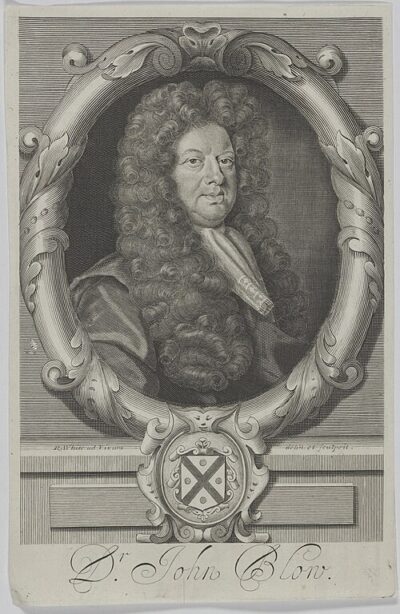
John Blow was an English composer. Born 1649, in Newark-on-Trent. Died October 1, 1708, in City of Westminster. Positions held include chapelmaster.
Facts
16 facts · 2 confirmed by two sources · 2 cited · 12 from one source
Where this comes from
Papalocal keeps its own record. It started from these sources; what each one said is kept here as it was copied, so a change on their side never changes this page by itself. Tap one to read its version.
What Wikidata says · copied November 16, 2026 · revision 2563053933
- Described as
- English composer
- Born
- 1649 · 14 references
- Died
- October 1, 1708 · 7 references
- Born in
- Newark-on-Trent · 1 reference
- Died in
- City of Westminster
- Buried in
- Westminster Abbey
- Citizen of
- England; Kingdom of Great Britain
- Occupation
- composer · 1 reference; organist · 1 reference; music educator; singer
- Positions held
- chapelmaster
- Genre
- opera
- Instrument
- organ; pipe organ; voice
- Wikipedias with a page
- 28
Wikidata item Q311110 (wikidata.org/wiki/Q311110), public domain (CC0). Copied November 16, 2026.
What Wikipedia says · copied November 16, 2026 · revision 1379344977
John Blow (baptised 23 February 1649 – 1 October 1708) was an English composer and organist of the Baroque period. Appointed organist of Westminster Abbey in late 1668, his pupils included William Croft, Jeremiah Clarke and Henry Purcell. In 1685 he was named a private musician to James II. His only stage composition, Venus and Adonis (ca. 1680–1687), is thought to have influenced Henry Purcell's later opera Dido and Aeneas. In 1687, he became choirmaster at St Paul's Cathedral, where many of his pieces were performed. In 1699 he was appointed to the newly created post of Composer to the Chapel Royal.
- Born, in its opening lines
- February 23, 1649
- Died, in its opening lines
- October 1, 1708
From the Wikipedia article “John Blow” (en.wikipedia.org/wiki/John_Blow), by its contributors, under CC BY-SA 4.0 (creativecommons.org/licenses/by-sa/4.0/). Copied November 16, 2026; not changed.
Confirmed Two sources agree. Cited One source, and it names where it got it. One source One source, without a reference of its own. Sources disagree The sources disagree. We show the best-supported value and keep theirs below.
