
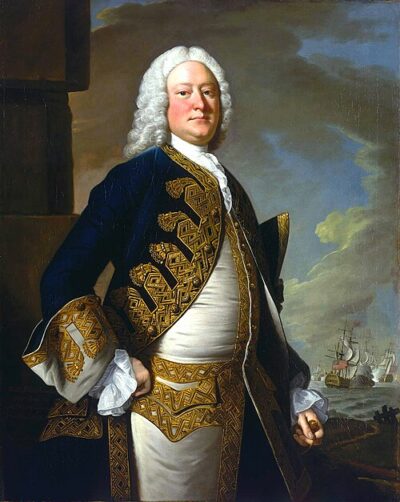
John Byng
John Byng was a Royal Navy officer, shot for failure in combat. Born October 28, 1704, in Southill. Died March 14, 1757, in Portsmouth. Positions held include member of the 11th Parliament of Great Britain and member of the 10th Parliament of Great Britain.
Facts
22 facts · 1 confirmed by two sources · 10 cited · 9 from one source · 2 where the sources disagree
What’s different
- Born: we show October 28, 1704 (Sources disagree). Wikipedia says October 29, 1704
- Died in: we show Portsmouth (Sources disagree). Wikidata also lists Portsmouth Harbour and HMS Monarch
Where this comes from
Papalocal keeps its own record. It started from these sources; what each one said is kept here as it was copied, so a change on their side never changes this page by itself. Tap one to read its version.
What Wikidata says · copied November 18, 2026 · revision 2568870476
- Described as
- Royal Navy officer, shot for failure in combat (1704-1757)
- Other names
- Admiral John Byng, Adm. Hon. John Byng
- Born
- October 28, 1704 · 1 reference
- Died
- March 14, 1757 · 9 references
- Born in
- Southill · 1 reference
- Died in
- Portsmouth · 1 reference; Portsmouth Harbour; HMS Monarch
- Buried in
- Church of All Saints, Southill
- Cause of death
- gunshot wound · 1 reference
- Citizen of
- Kingdom of Great Britain
- Occupation
- politician · 1 reference; naval officer; admiral · 1 reference
- Positions held
- member of the 11th Parliament of Great Britain; member of the 10th Parliament of Great Britain
- Father
- George Byng, 1st Viscount Torrington · 3 references
- Mother
- Margaret Master · 2 references
- Siblings
- Pattee Byng, 2nd Viscount Torrington · 2 references; Robert Byng · 2 references; George Byng, 3rd Viscount Torrington · 1 reference; Sarah Osborn · 1 reference
- Military branch
- Royal Navy (1718–1757)
- Military rank
- admiral (1756–); vice admiral (1747–); rear admiral (1745–)
- Wikipedias with a page
- 21
Wikidata item Q130261 (wikidata.org/wiki/Q130261), public domain (CC0). Copied November 18, 2026.
What Wikipedia says · copied November 18, 2026 · revision 1371225625
Admiral of the Blue John Byng (baptised 29 October 1704 – 14 March 1757) was a Royal Navy officer and politician who was court-martialled and executed by firing squad. After joining the navy at the age of thirteen, he participated at the Battle of Cape Passaro in 1718. Over the next thirty years he built up a reputation as a solid naval officer and received promotion to vice-admiral in 1747. He also served as Commodore-Governor of Newfoundland Colony in 1742, Commander-in-Chief, Leith, 1745 to 1746 and was a member of Parliament from 1751 until his death.
Byng failed to relieve a besieged British garrison during the Battle of Minorca at the beginning of the Seven Years' War. He had sailed for Minorca at the head of a hastily assembled fleet of vessels, some of which were in poor condition. In the ensuing battle with a French Royal Navy squadron of ships off the Minorcan coast, he was defeated and the fleet under his command considerably damaged. He then elected to withdraw to Gibraltar to repair his ships. Upon return to Britain, Byng was court-martialled and found guilty of breaching the 12th Article of War in failing to "do his utmost" to prevent Minorca from falling to the French. He was sentenced to death and, after pleas for clemency were denied, was shot dead by a firing squad on 14 March 1757.
- Born, in its opening lines
- October 29, 1704
- Died, in its opening lines
- March 14, 1757
From the Wikipedia article “John Byng” (en.wikipedia.org/wiki/John_Byng), by its contributors, under CC BY-SA 4.0 (creativecommons.org/licenses/by-sa/4.0/). Copied November 18, 2026; not changed.
Confirmed Two sources agree. Cited One source, and it names where it got it. One source One source, without a reference of its own. Sources disagree The sources disagree. We show the best-supported value and keep theirs below.
