
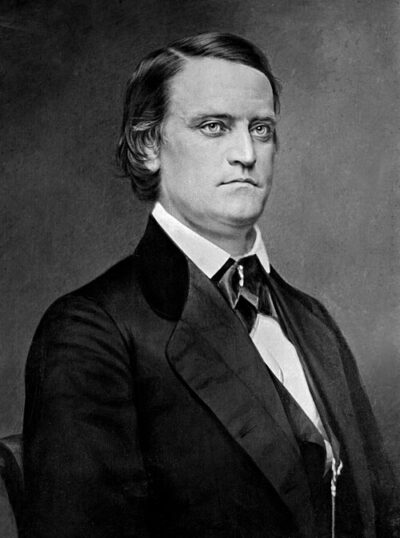
John C. Breckinridge
John C. Breckinridge was a vice president of the United States from 1857 to 1861. Born January 16, 1821, in Lexington. Died May 17, 1875, in Lexington. Positions held include United States representative, Vice President of the United States (1857–1861) and Confederate States Secretary of War (1865). Educated at Centre College and Transylvania University.
Facts
34 facts · 2 confirmed by two sources · 10 cited · 22 from one source
Where this comes from
Papalocal keeps its own record. It started from these sources; what each one said is kept here as it was copied, so a change on their side never changes this page by itself. Tap one to read its version.
What Wikidata says · copied November 13, 2026 · revision 2562736549
- Described as
- vice president of the United States from 1857 to 1861 (1821–1875)
- Other names
- John Breckinridge, J. C. Breckinridge, John Cabell Breckinridge
- Born
- January 16, 1821 · 4 references
- Died
- May 17, 1875 · 6 references
- Born in
- Lexington · 1 reference
- Died in
- Lexington · 1 reference
- Buried in
- Lexington Cemetery
- Cause of death
- liver cirrhosis
- Citizen of
- United States; Confederate States of America
- Occupation
- politician · 1 reference; lawyer; university teacher; military personnel; military officer · 1 reference
- Positions held
- United States representative; Vice President of the United States (1857–1861); Confederate States Secretary of War (1865); United States senator (1861) · 1 reference; member of the Kentucky House of Representatives; United States Ambassador to Spain; board member (1857–1861); senator · 1 reference; defence minister · 1 reference
- Political party
- Democratic Party
- Education
- Centre College; Transylvania University; Princeton University
- Spouse
- Mary Cyrene Breckinridge (1843–) · 2 references
- Children
- Clifton Rodes Breckinridge; John Witherspoon Breckinridge · 1 reference; Joseph Cabell Breckinridge, II · 1 reference
- Father
- Cabell Breckinridge
- Mother
- Mary Stanhope Clay Smith · 1 reference
- Military branch
- Confederate States Army
- Military rank
- general
- Wikipedias with a page
- 55
Wikidata item Q273212 (wikidata.org/wiki/Q273212), public domain (CC0). Copied November 13, 2026.
What Wikipedia says · copied November 13, 2026 · revision 1384142925
John Cabell Breckinridge (January 16, 1821 – May 17, 1875) was an American politician who served as the 14th vice president of the United States, with President James Buchanan, from 1857 to 1861, and as a general in the Confederate Army during the American Civil War. Having assumed office at the age of 36, Breckinridge is the youngest vice president in U.S. history. He was also the Southern Democratic candidate in the 1860 presidential election, losing to Republican candidate Abraham Lincoln.
Breckinridge was born near Lexington, Kentucky, to a prominent local family. After serving as a noncombatant during the Mexican–American War, he was elected as a Democrat to the Kentucky House of Representatives in 1849, where he took a pro-slavery stance. Elected to the U.S. House of Representatives in 1851, he allied with Stephen A. Douglas in support of the Kansas–Nebraska Act. After reapportionment in 1854 made his re-election unlikely, he declined to run for another term. He was nominated for vice president at the 1856 Democratic National Convention to balance a ticket headed by James Buchanan. The Democrats won the election, but Breckinridge had little influence with Buchanan, and as presiding officer of the Senate, could not express his opinions in debates. He joined Buchanan in supporting the pro-slavery Lecompton Constitution for Kansas, which led to a split in the Democratic Party. In 1859, he was elected to succeed Senator John J. Crittenden at the end of Crittenden's term in 1861.
After Southern Democrats walked out of the 1860 Democratic National Convention, the party's northern and southern factions held rival conventions in Baltimore that nominated Douglas and Breckinridge, respectively, for president. A third party, the Constitutional Union Party, nominated John Bell. These three men split the Southern vote, while Lincoln won all but three electoral votes in the North, winning the election. Breckinridge carried most of the Southern states. Taking his seat in the Senate, Breckinridge urged compromise to preserve the Union. Unionists were in control of the state legislature, and gained more support when Confederate forces moved into Kentucky. After fleeing behind Confederate lines, Breckinridge was commissioned a brigadier general in the Confederate Army and then expelled from the Senate.
Following the Battle of Shiloh in 1862, Breckinridge was promoted to major general, and in October, he was assigned to the Army of Mississippi under Braxton Bragg. After Bragg charged that Breckinridge's drunkenness had contributed to defeats at Stones River and Missionary Ridge, and after Breckinridge joined many other high-ranking officers in criticizing Bragg, he was transferred to the Trans-Allegheny Department, where he won his most significant victory in the 1864 Battle of New Market. After participating in Jubal Early's campaigns in the Shenandoah Valley, Breckinridge was charged with defending supplies in Tennessee and Virginia. In February 1865, Confederate President Jefferson Davis appointed him Secretary of War in the Confederate Cabinet. Concluding that the war was hopeless, he urged Davis to arrange a national surrender. After the fall of Richmond, Breckinridge ensured the preservation of Confederate records. He then escaped the country and lived abroad for over three years. When President Andrew Johnson extended amnesty to all former Confederates in 1868, Breckinridge returned to Kentucky, but resisted all encouragement to resume his political career. War injuries sapped his health, and he died in 1875. Breckinridge is regarded as an effective military commander.
- Born, in its opening lines
- January 16, 1821
- Died, in its opening lines
- May 17, 1875
From the Wikipedia article “John C. Breckinridge” (en.wikipedia.org/wiki/John_C._Breckinridge), by its contributors, under CC BY-SA 4.0 (creativecommons.org/licenses/by-sa/4.0/). Copied November 13, 2026; not changed.
Confirmed Two sources agree. Cited One source, and it names where it got it. One source One source, without a reference of its own. Sources disagree The sources disagree. We show the best-supported value and keep theirs below.
